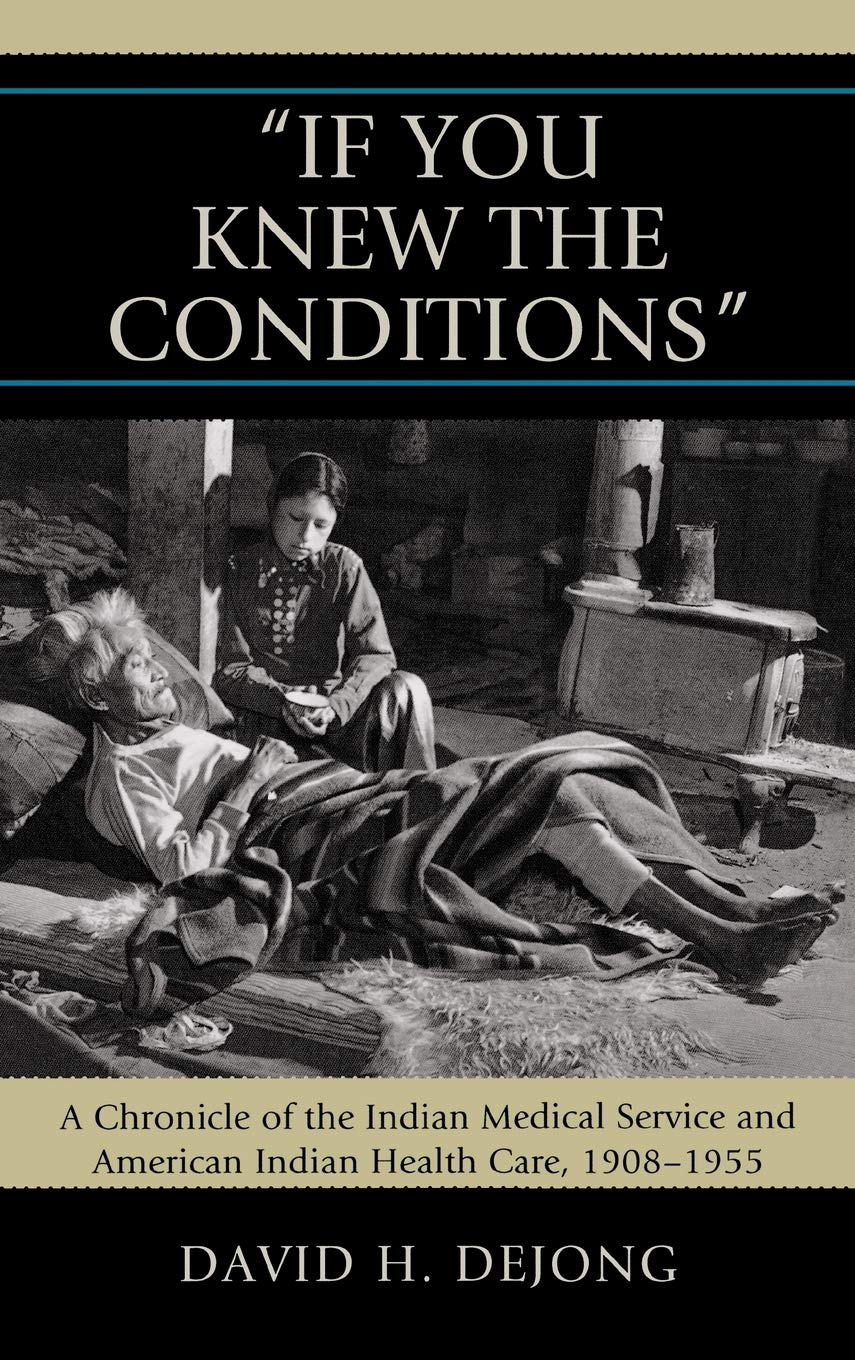
'If You Knew the Conditions': A Chronicle of the Indian Medical Service and American Indian Health Care, 1908-1955
$103.10
by David H. DeJong



After their sequestering on reservations across the West, American Indians suffered from appalling rates of disease and morbidity. While the United States Indian Service (Bureau of Indian Affairs) provided some services prior to 1908, it was not until then that the Indian Medical Service was established for the purpose of providing services to American Indians. Born in an era of assimilation and myths of vanishing Indians, the Indian Medical Service provided emergency and curative care with little forethought of preventive medicine. DeJong argues that the U.S. Congress provided little more than basic, curative treatment, and that this Congressional parsimony is reflected in the services (or lack thereof) provided by the Indian Medical Service. DeJong considers the mediocre results of the Indian Medical Service from a cultural perspective. He argues that, rather than considering a social conservation model of medicine, the Indian Service focused on curative medicine from a strictly Western perspective. This failure to appreciate the unique American Indian cultural norms and values associated with health and well-being led to a resistance from American Indians which seemingly justified parsimonious Congressional appropriations and initiated a cycle of benign neglect. "If You Knew the Conditions" examines the impact of the long-standing Congressional mandate of cultural assimilation, combined with the Congressional desire to abolish the Indian Service, on the degree and extent of disease in Indian Country. “We are forever indebted to David H. DeJong for not only producing a valuable book on the history of Indian health but for his gift of scholarship [which] also serves as a critical reminder on why innumerable health disparities continue to haunt the health of contemporary American Indians and Alaska Natives.” ―Jennie Joe, University of Arizona David H. Dejong holds a PhD from the University of Arizona and has worked in Indian country for 18 years and is author of Plagues, Politics, and Policy: A Chronicle of the Indian Health Service, 1955-2008. "If You Knew the Conditions" A Chronicle of the Indian Medical Service and American Indian Health Care, 1908–1955 By David H. DeJong ROWMAN & LITTLEFIELD PUBLISHERS, INC. Copyright © 2008 Lexington Books All rights reserved. ISBN: 978-0-7391-2445-1 Contents Tables, Acknowledgment, 1 "If You Knew the Conditions", 2 Organizing the Indian Medical Service, 3 Reform and Reorganization, 4 The Collier Years, 5 Trachoma and Tuberculosis, 6 A Justified Wave of Criticism?, 7 Into the Public Health Service, 8 "If You Knew the Conditions", Bibliography, Index, CHAPTER 1 "If You Knew the Conditions" On November 15, 1907, Dr. Susan La Flesche-Picotte, a member of the Omaha tribe and the first American Indian female doctor in the United States, penned a letter to Commissioner of Indian Affairs Francis Leupp. "I am an Omaha Indian and have been working as [a] medical missionary among the Omahas," La Flesche-Picotte began, "but [I] have broken down from overwork.... I know what a small figure our affairs cut with all the Department has on its hand, but I also know that if you knew the conditions and circumstances to be remedied you would do all you could to remedy them." She then described the needs of the Omaha people. La Flesche-Piatte could have been describing the needs of any tribe in the country as, by 1907, most were approaching the nadir of their existence. "The spread of tuberculosis among my people is something terrible—it shows itself in the lungs, kidneys, abdominal track, blood, brain and glands." Recognizing the severity of the situation and the dire need for medical care, she begged Leupp "that something must be done" for the people. "The physical degeneration in 20 years among my people is terrible," La Flesche-Picotte concluded, "but I want to know if the Govt can't do for us, what it did for the Sioux in preventing the spread of the White Plague." Scores of Indians and non-Indians echoed La Flesche-Picotte's plea across Indian Country. Mary Wynkoop, a field matron from the Gila River (Arizona) Indian Reservation lamented the spread of disease among the Pima and Maricopa. "When we came to the reservation seven years ago (1896) we only knew of one case of tuberculosis among 1,500 people," she informed Commissioner William Jones. "Since that time we have buried by the scores promising young people from the schools." If Jones doubted the extent of disease, the matron encouraged him to order an examination that "would, I think, bring to light surprising results." Leupp's reply to La Flesche-Picotte is illustrative of the inability of the Indian Service to combat disease. What medical services were provided were scattered and disjointed, with many provided by missionary agencies such as the one employing La Flesche-Picotte. "Owing to lack of funds it is quite impossible," Leupp told the physician, to do more than what is bei