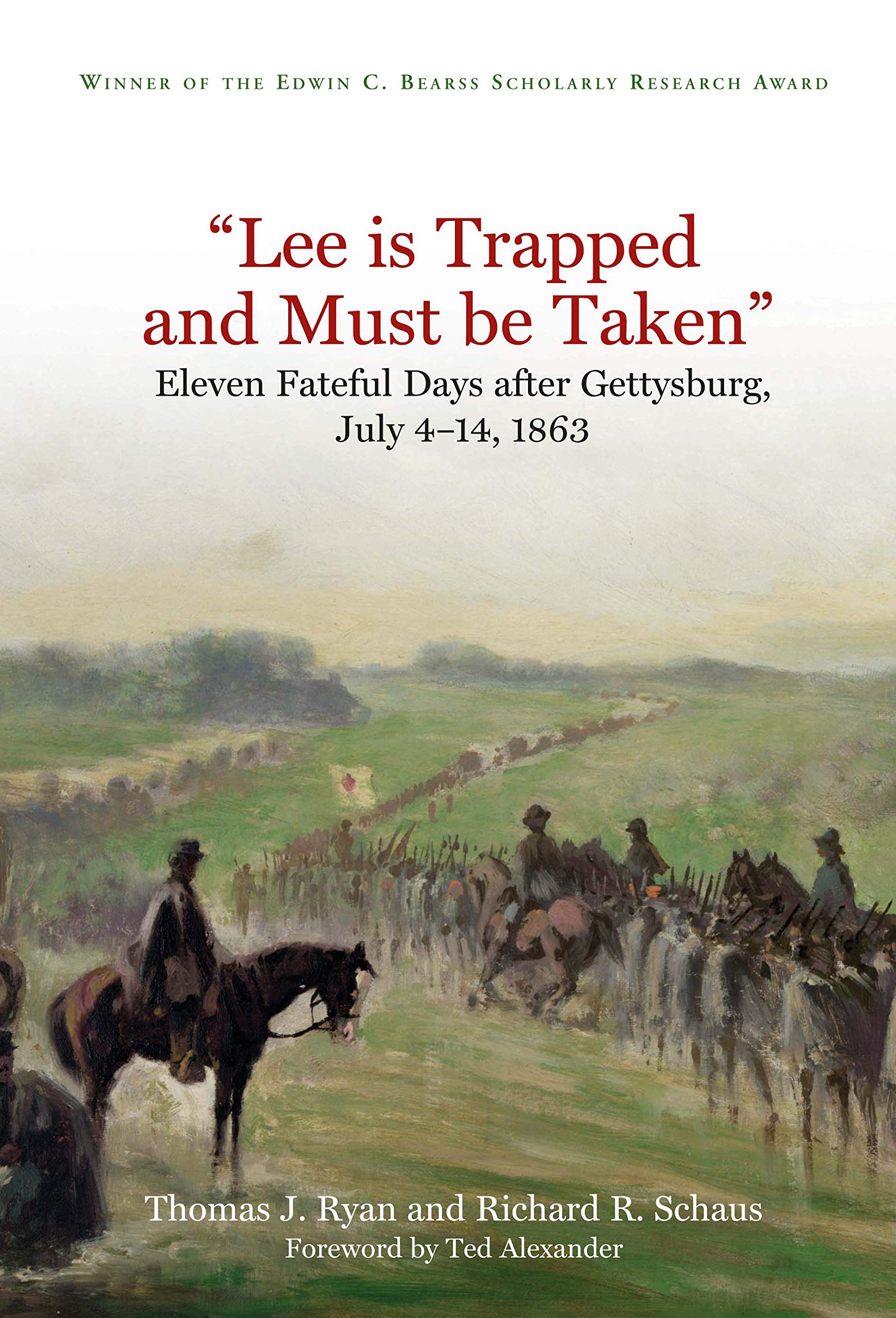
"Lee is Trapped, and Must be Taken": Eleven Fateful Days after Gettysburg: July 4 - 14, 1863
$30.22
by Thomas J. Ryan



Winner, Edwin C. Bearss Scholarly Research Award Winner, 2019, Hugh G. Earnhart Civil War Scholarship Award, Mahoning Valley Civil War Round Table Countless books have examined the battle of Gettysburg, but the retreat of the armies to the Potomac River and beyond has not been as thoroughly covered. “Lee is Trapped, and Must be Taken”: Eleven Fateful Days after Gettysburg: July 4 to July 14, 1863 , by Thomas J. Ryan and Richard R. Schaus goes a long way toward rectifying this oversight. This comprehensive study focuses on the immediate aftermath of the battle and addresses how Maj. Gen. George G. Meade organized and motivated his Army of the Potomac in response to President Abraham Lincoln’s mandate to bring about the “literal or substantial destruction” of Gen. Robert E. Lee’s retreating Army of Northern Virginia. As far as the president was concerned, if Meade aggressively pursued and confronted Lee before he could escape across the flooded Potomac River, “the rebellion would be over.” The long and bloody three-day battle exhausted both armies. Their respective commanders faced difficult tasks, including the rallying of their troops for more marching and fighting. Lee had to keep his army organized and motivated enough to conduct an orderly withdrawal away from the field. Meade faced the same organizational and motivational challenges, while assessing the condition of his victorious but heavily damaged army, to determine if it had sufficient strength to pursue and crush a still-dangerous enemy. Central to the respective commanders’ decisions was the information they received from their intelligence-gathering resources about the movements, intentions, and capability of the enemy. The eleven-day period after Gettysburg was a battle of wits to determine which commander better understood the information he received, and directed the movements of his army accordingly. Prepare for some surprising revelations. Woven into this account is the fate of thousands of Union prisoners who envisioned rescue to avoid incarceration in wretched Confederate prisons, and a characterization of how the Union and Confederate media portrayed the ongoing conflict for consumption on the home front. The authors utilized a host of primary sources to craft their study, including letters, memoirs, diaries, official reports, newspapers, and telegrams, and have threaded these intelligence gems in an exciting and fast-paced narrative that includes a significant amount of new information. “Lee is Trapped, and Must be Taken” is a sequel to Thomas Ryan’s Spies, Scouts, and Secrets in the Gettysburg Campaign , the recipient of the Bachelder-Coddington Literary Award and Gettysburg Civil War Round Table Distinguished Book Award. examine the decision-making process of the upper echelon of command and note opportunities offered and opportunities missed. Drawing from rich first-hand testimony and personal reflections of the campaign, the highly partisan press, the OR , published memoirs and regimental histories of the battle and its aftermath, the authors present a meticulously detailed account of Lee's withdrawal from Gettysburg beginning on July 4, 1863 through the South Mountain passes to the Potomac River and the (relative) safety of Virginia. The authors couple narrative with careful analysis of the events. I enjoy books like this simply for the fact that they inspire further thought on the campaign, and I never grow tired of discussing it and reading different takes on the action. Readers should find plenty to debate after reading "Lee is Trapped..." Keith Harris - The Rogue Historian Many historians have wondered why the Union Army, headed by Gen. George Meade, didn't draw Lee into a decisive war-ending battle before he could get across the Potomac. Among the reasons suggested for the failure were logistics, manpower, as well as command and communications difficulties. One of the lingering mysteries not examined was the role intelligence played during the 11 days of opportunity after the battle. Lee is Trapped and Must be Taken fills that gap. In succeeding days, the objective of cutting off Lee's retreat was obvious to all, even Meade. Yet, although he employed his cavalry on reconnaissance missions and engaged in minor skirmishes, he found excuse after excuse not to undertake a decisive battle. By the 11th day, Meade was again ready to strike, but it was too late. Lee was safe in Virginia--an outcome that intelligence had foretold but only the commanding general had refused to accept. Why General Meade behaved as he did is difficult to understand. But Ryan and Schaus make clear it was not because he lacked solid intelligence. Hayden P eake, Central Intelligence Agency Longtime Gettysburg historian Thomas J. Ryan authored one ofmy favorite Gettysburg books of recent memory - the multi-award winning Spies,Scouts, and Secrets in the Gettysburg Campaign: How the Critical Role of IntelligenceImpacted the Outcome of Lee'