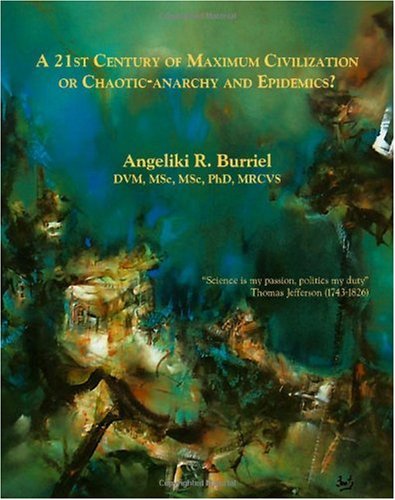
A 21st Century of Maximum Civilization or Chaotic-anarchy and Epidemics
$17.50
by Angeliki Burriel



An analysis of what is an epidemic, how it is influenced by state authority or influences the state's behavior, and what are the factors predisposing to epidemics. Dr. Burriel was born is a small Greek town. She took her first steps where Aesculapius treated his patients in the 5th century BC. Her bedtime stories were of his professional life in the area where his daughter Hygeia (Health) was also born. Dr. Burriel studied Veterinary Medicine in Greece and traveled the world, physically and emotionally, before and during her studies at the University of London for the degrees of Master of Science in Animal Health, and Doctor of Philosophy in Bacteriology. There she had the pleasure to meet colleagues from various nations, cultures and economic backgrounds. Her experience and professional expertise were married in a Master of Science in International Relations. This degree was her source of stimulation for the present book and other writing projects waiting to come to light. Cover: Oil painting, Light in Chaos painted by the French painter and sculptor Frederic Bootz. Foreword The midnight stroke of the clock and the sounds of celebration around the world greeting the New Millennium on the 1st of January 2000 signified the hope of ending cultural plurality. The world was supposedly beginning to accepting universality and the internationalization of Western culture and ideals. One could argue that westernization was evident in that when members of cultures with different calendars celebrated the millennium as measured by the West. Many of various religious identities recognized, through the acceptance of millennial celebrations, the birth of Jesus as the beginning of modernity and true civilization. This is how a westerner perceived the events on TV screens. This view means, in essence, that the world's politico-economic betterment depends on a political and economic elite that controls world resources, information and technology. This same elite group controls the length and quality of life between the two ends of the economic ladder: the rich and the poor. The size and nature of the gap between these two economic extremes will influence social chaos, anarchy and epidemics of the future. Chaos - collapse of shorter or longer duration - anarchy - an unwritten ethical code for social contact - and epidemics - an unusually high proportion of physical or psychological ill health among people - are conditions that may have different meanings, depending on one's knowledge, social status and political conscience. They are, first of all, three words, which have a semantic meaning defined in every dictionary, the source used by people of various ages and educational status. Secondly, these three conditions can affect anyone within a social group regardless of economic class. Their impact in society determines also state behavior and the means it is expressed. However, the means state authority uses to respond to chaos, anarchy and epidemics depend on the form of state rule - democratic, anarchic, authoritarian etc.- and the economic class and political power of those suffering the consequences. Poverty is apparently the one economic class concentrating all those factors predisposing to chaotic-anarchy - partial or total lack of political and self order - and epidemic disease. For a better understanding of the relationship between these important conditions - chaotic anarchy and epidemics - and their influence on the health of the general public in the 21st century, one must deeply understand their relationship to state authority and legitimate order. This book argues that, in the new millennium, increased chaos, misery, and epidemics of various sorts will likely result from a confluence of contradictory tendencies toward order, unity, inequity and disorder if the economic and political trends that comprise the New World Order do not materialize for all people on earth. To maximize the impact of the information used in the discussion of future Chaotic-anarchy and Epidemics, the book is divided into two major parts. Part A briefly analyzes the causes of chaos, anarchy, epidemics, and the social meaning and importance of these conditions. It analyzes the need for new terms to describe the current politico-economic world situation, and how capitalism and technology shape the current politico-economic order and influence Chaotic-anarchy and Epidemics. Part B defines the factors influencing the subjects described in Part A and analyzes the role of each in the future, including the organizations that will determine their outcome. In both parts of the analysis two terms have being used through out and needing more explanation. They are the terms elite(s) and masses. The term elite(s) has been used to describe a group of individuals with a decision making power or those who influence such decisions invisibly. They are individuals having common social, economic and educational characteristics grouping them on the top