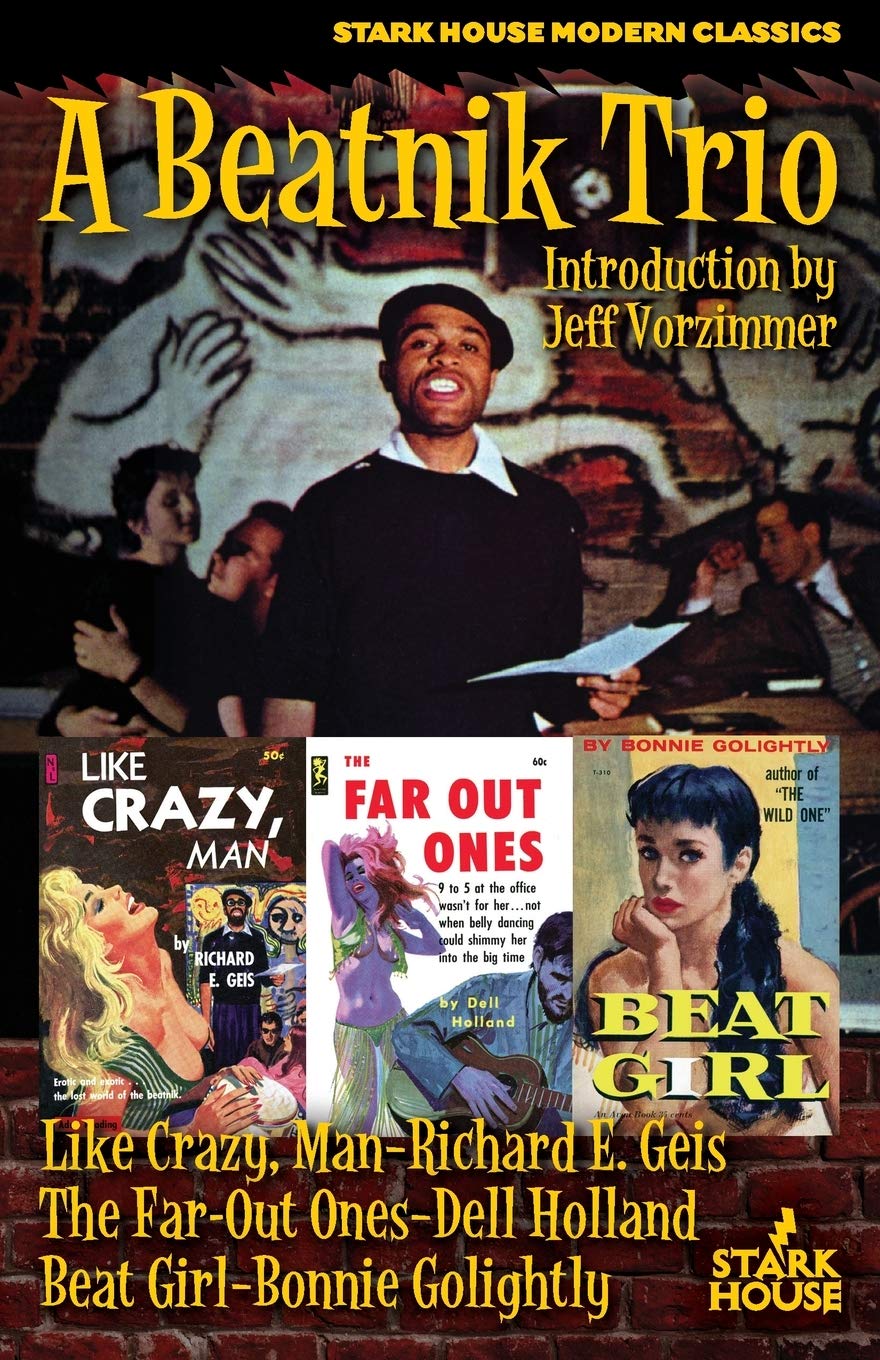



BEATSPOLITATIONToday we would call the sensationalizing of the cultural phenomenon known as the beat generation to sell books and movies, Beatsploitation. What you won’t be reading in this volume are lost or overlooked classics of Beat Lit. Don’t expect to find books the caliber of On the Road, Go, Junky or Last Exit to Brooklyn. The books herein were written to cash in on the beat movement… Although the writers of these books never achieved any literary grandeur, it shouldn’t be inferred that they didn’t have beatnik cred. Indeed, all three of the authors lived in that milieu—Coons and Golightly in Greenwich Village and Geis in Venice, California. These books don’t have any literary pretension of defining what the beat movement was, but rather they reflect the places and period in which beatniks were prevalent. This fact doesn’t make these books any less worth the attention of the student of the beat generation. Indeed more can be learned about the reaction of the public to the beatniks than by reading the entire oeuvre of authors such as Kerouac or Ginsberg…—from “How JFK Killed the Beatniks” by Jeff Vorzimmer I cannot make myself write 'straight' science fiction. I cannot write gothics. I cannot force a murder mystery out of my fingers. All I want to do is write 'my' type of fiction highly sexual, sometimes with a high degree of violence, with often anti-social, non-conformist themes, characters There's something perverse operating in me. Something in me decided: sex is your fiction beat, so beat it. --Richard E. Geis BEATSPOLITATION Today we would call the sensationalizing of the cultural phenomenon known as the beat generation to sell books and movies, Beatsploitation. What you won t be reading in this volume are lost or overlooked classics of Beat Lit. Don t expect to find books the caliber of On the Road, Go, Junky or Last Exit to Brooklyn. The books herein were written to cash in on the beat movement Although the writers of these books never achieved any literary grandeur, it shouldn t be inferred that they didn t have beatnik cred. Indeed, all three of the authors lived in that milieu Coons and Golightly in Greenwich Village and Geis in Venice, California. These books don t have any literary pretension of defining what the beat movement was, but rather they reflect the places and period in which beatniks were prevalent. This fact doesn t make these books any less worth the attention of the student of the beat generation. Indeed more can be learned about the reaction of the public to the beatniks than by reading the entire oeuvre of authors such as Kerouac or Ginsberg from How JFK Killed the Beatniks by Jeff Vorzimmer Richard Erwin Geis was born on July 19, 1927, in Portland, Oregon, where he continued to live most of his life as a legendary recluse. He is best known for his involvement in science fiction fandom, winning the Hugo Award for Best Fan Writer in 1982 and 1983. Geis produced the fanzine Science Fiction Review, which won the Hugo in 1969, 1970, 1977 and 1979; as well as The Alien Critic, which also won for Best Fanzine in 1974 and 1975. Geis won 13 Hugos in all. He also published 114 books, most of them soft-core porn written during the 1960s while living in Venice, California. Geis eventually returned to Portland, where he died on February 4, 2013. William R. Coons was born February 8, 1934. He only wrote one novel under his own name based on his experiences serving time in Attica for selling LSD in 1969 and is better known by his pseudonym Dell Holland. As Holland, he wrote six novels for sleaze publishers Bedside Books and Neva Paperbacks. He also took over writing some of the Andrew Shaw sex books for Lawrence Block during the early 1960s. Coons unfortunately drank too much and had a drug problem, and was in and out of trouble with both the law and his wife, who eventually divorced him. He died December 24, 2001. Bonnie Golightly was born June 23, 1919, in Illinois, and raised in Tennessee. After moving to Manhattan s East Side in New York City, she worked as a folk singer, a bookstore owner, and was an active member of the Beat subculture. She is perhaps best known as the possible inspiration for Truman Capote s character Holly Golightly in Breakfast at Tiffany s. She sued Capote and his publishers in 1959, but lost the suit. Golightly went on to write many books set in the Beat world as well as some movie novelizations most of them published in what is now known as the sleaze market. She died on October 11, 1998.