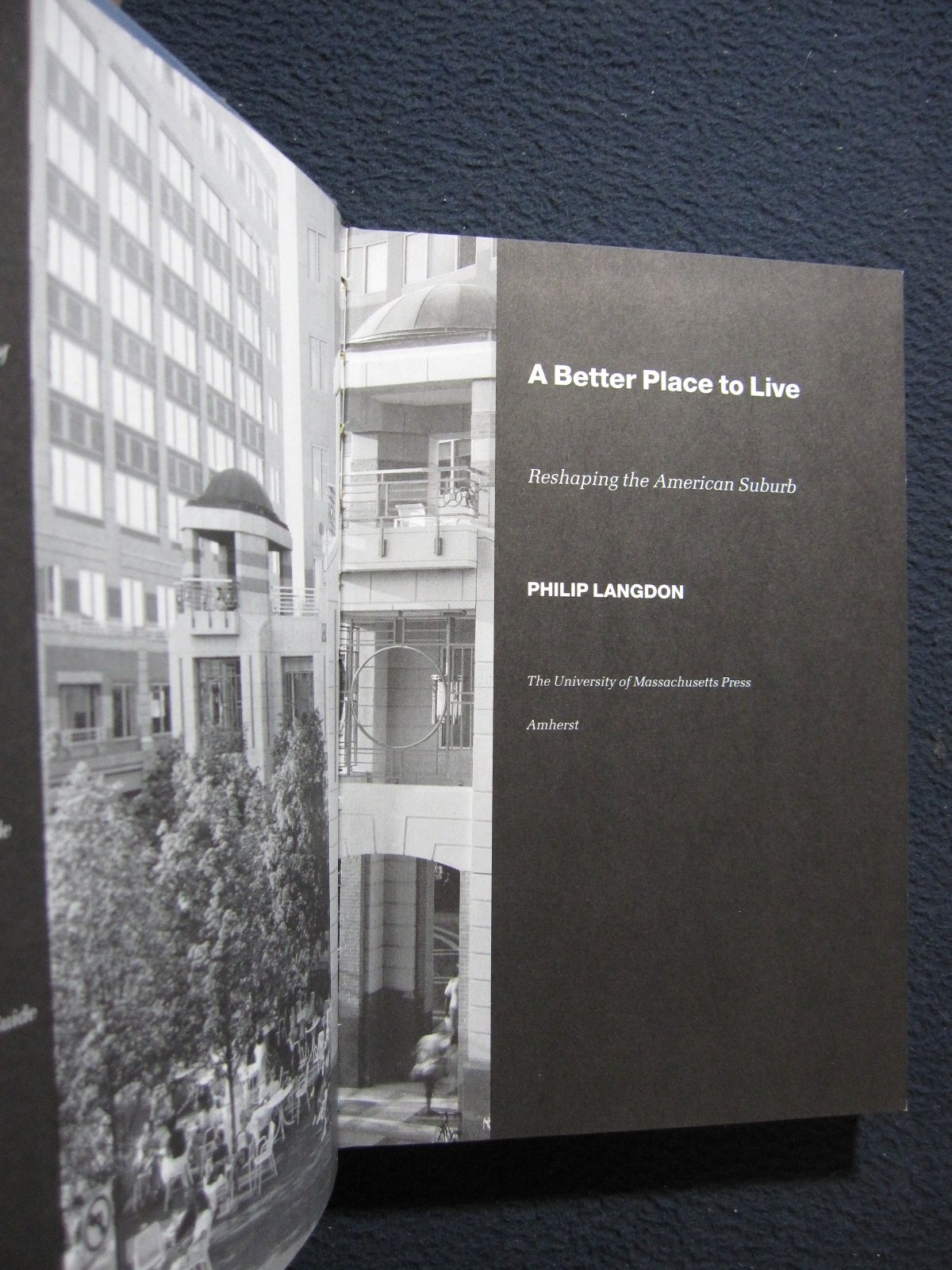



Citing interviews with developers, planners, and residents, the author explains the connection between typical modern suburban designs and the feelings of community satisfaction, while pointing out the virtues of older designs A student of American middle-class life, Langdon has written some impressive books, including Orange Roofs, Golden Arches: The Architecture of American Chain Restaurants (LJ 6/1/86). Here, he trains his eye on that landmark of American middle-class culture, the suburb and small town. Walkable streets, neighborhood stores, affordable gathering places, compact downtowns, dense housing, and more amenable parks and public places-these are the palliatives he prescribes for suburban residents crucified on a grid of commodity fetishism. He is also a postmodernist; he wants to return to the circumstances of his upbringing in small towns in western Pennsylvania and New York. This book summarizes a great deal of recent writing on the dystopia of suburbia, and it prescribes sensible and workable cures for many of our environmental ills such as improved pedestrian circulation, greater contextualism in design, and better use of older buildings. Recommended for subject collections. Peter Kaufman, Boston Architectural Ctr. Copyright 1994 Reed Business Information, Inc. Langdon offers a fascinating near-deconstruction of the American suburb, arguing that at the "moment when the United States has become a predominately suburban nation, the country has suffered a bitter harvest" of numerous social ills. Is the suburb to blame, the very place so many go to escape the problems of the day? Langdon recognizes that suburbs are certainly not the only culprit, but does see them as creating and reinforcing a sense of "apartness" between people. He convincingly details the many problems and stresses inherent in today's subdivision: long commutes, the exaggerated costs of suburban living, a lack of central gathering places, and dictatorial homeowner's associations, to name a few. Life in the suburbs, however, is not irredeemable, and Langdon provides examples and suggestions for living arrangements that lend themselves to true neighborhood and community. A fine study of fragmentation, the American way. Brian McCombie A would-be Jane Jacobs of the suburbs offers some savvy analysis and worthy advice. ``The suburbs we build are fostering an unhealthy way of life,'' declares Langdon (Urban Excellence, not reviewed), as he expands on his Atlantic Monthly articles on the topic, citing examples from around the country as well as his home community in New Haven, Conn. Thus he critiques the distortions our culture wreaks on houses and neighborhoods and observes that such fragmented communities can't teach kids street smarts. He suggests good streets make connections between people and local institutions. Noting that outdoor life has shifted from social front porches to private backyards, he suggests that zoning changes and limits on mortgage deductibility could hamper the spread of overlarge houses; and he recommends that building-trade publications acquire a more critical ethos. He closely describes the Florida Gulf Coast suburb of Seaside, showing how ``neotraditionalist'' architects Andres Duany and Elizabeth Plater- Zyberk have created a more connected community. A success story in the Minneapolis-St. Paul area shows how city and suburb have reduced competition by tax sharing, and Kirkland, Wash., is an example of suburban renewal, having rebuilt its downtown with offices, housing, and discreet parking. Observing that robust neighborhood life in the past was the product of scarce resources, Langdon tempers his prescriptions with the caution that current surplus wealth fosters waste, but he suggests that a heightened environmental consciousness could presage reform in community design. Langdon's narrative voice sometimes could be smoother as he cobbles together previous writings with new material, but this is a vital contribution to a too-often neglected issue. (104 illustrations, not seen) -- Copyright ©1994, Kirkus Associates, LP. All rights reserved. Used Book in Good Condition