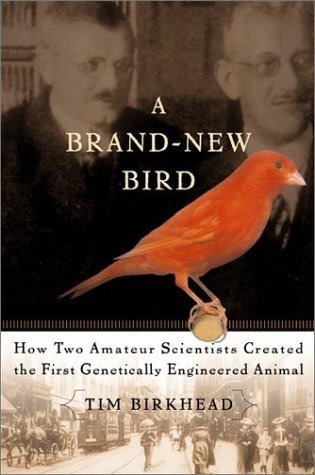
A Brand New Bird: How Two Amateur Scientists Created The First Genetically Engineered Animal
$25.04
by Tim Birkhead



Long before Dolly the Sheep or bioengineered corn, there was the Red Canary-the first organism to be manipulated by genetic technology, back in the 1920s. The effort to produce a red canary invoked all of the deep issues that troubled genetic engineering decades later: the nature of genes and how they work, the specter of eugenics, and the relative roles of nature and nurture in determining what an organism is. Behavioral ecologist Tim Birkhead describes how a sweet-voiced green bird discovered by Spanish explorers in the 1300s became a craze in Renaissance Europe, how breeders gradually turned its green plumage to yellow, and how a pair of German scientists used the first bit of gene technology in the 1920s to produce an almost-red canary. But the true red canary would not come until the 1960s, when British scientists successfully bred one, and genes alone would not be sufficient to create one. A Brand New Bird is a compelling tale of a fascinating episode in the history of genetics. The brand-new bird is the red canary. It was the object of a quest that two Germans--Hans Duncker, a high school teacher interested in genetics, and Karl Reich, a bird keeper--carried on in Bremen for many years, beginning in 1921. Duncker's idea was to pluck the genes from a red siskin (a relative of the canary) and insert them into the yellow canary. His method was cross-breeding. The effort fell short of the goal, producing canaries of a reddish coppery hue. But it led to success years later by others who recognized the subtle connection between genes and the environment, in this case a diet containing carotenoids. Birkhead, professor of evolutionary biology at the University of Sheffield in England, makes a grand story by weaving in lore about genetics, bird keeping and the people involved in the quest. Editors of Scientific American The phrase "genetic engineering" conjures up images of test tubes, in vitro fertilization, and scientific laboratories. However, attempts at genetic engineering have been made since animals and plants were domesticated, only then it was simply called "breeding." Farmers and fanciers bred the best with the best, and occasionally crossed different species, in order to get offspring that might improve on their parents. When Spanish explorers discovered a little green bird with a lovely song, it set the stage for the formation of a new domestic animal, the canary. By the 1920s the familiar yellow canaries were common, but a pair of German bird enthusiasts wanted a red canary. The exciting story of how a scientist and an amateur bird breeder created an almost red one makes for fascinating reading. Birkhead, a behavioral ecologist and author, places this achievement in the context of scientific knowledge of the day. Birkhead's treatise on the canary as an example of the interaction between genes and environment is a terrific example of popular-science writing. Nancy Bent Copyright © American Library Association. All rights reserved " A Brand-New Bird is popular science at its very best--a perfect blend of exactness and superb entertainment." -- Mark Cocker, author of Birders: Tale of A Tribe " A Brand-New Bird reads like a fine novel." -- Matt Ridley, author of Nature via Nurture and Genome "A gem of scientific exposition for the lay reader...A fascinating book and a real pleasure to read." -- Ian Newton FRS, Monks Wood Research Station, United Kingdom "An intriguing and unusual story about genetics...that gives these attractive little birds their moment in history." -- Janet Browne, author of Charles Darwin: Voyaging and Charles Darwin: The Power of Place "Biological scholarship, social history and biography merge deftly in this marvelously illuminating study." -- Nigel Collar, Leventis Fellow in Conservation Biology, Birdlife International "Reads like a biological allegory for our times--genes and environment woven together to produce a successful outcome." -- Robert Trivers, author of Natural Selection and Social Theory "The detective story is gripping, the science authoritative. A treat, whatever your interests." -- Helena Cronin, author of The Ant and the Peacock "Tim Birkhead has journeyed far into the forgotten backwaters of biology and returned with a riveting story." -- Michael McCarthy, Environment Editor, The Independent "[A] wonderful book...of breeders, of science, and above all of human beings and the living world around them." -- Michael Ruse, author of The Philosophy of Biology and Darwin and Design Tim Birkhead trained in behavioral ecology at Oxford University under Richard Dawkins and is now Professor of Evolutionary Biology at the University of Sheffield. He contributes regularly to the Independent, New Scientist, Natural History , and BBC Wildlife . His previous books include Promiscuity and Great Auk Islands , and he is co-editor of The Cambridge Encyclopedia of Ornithology .