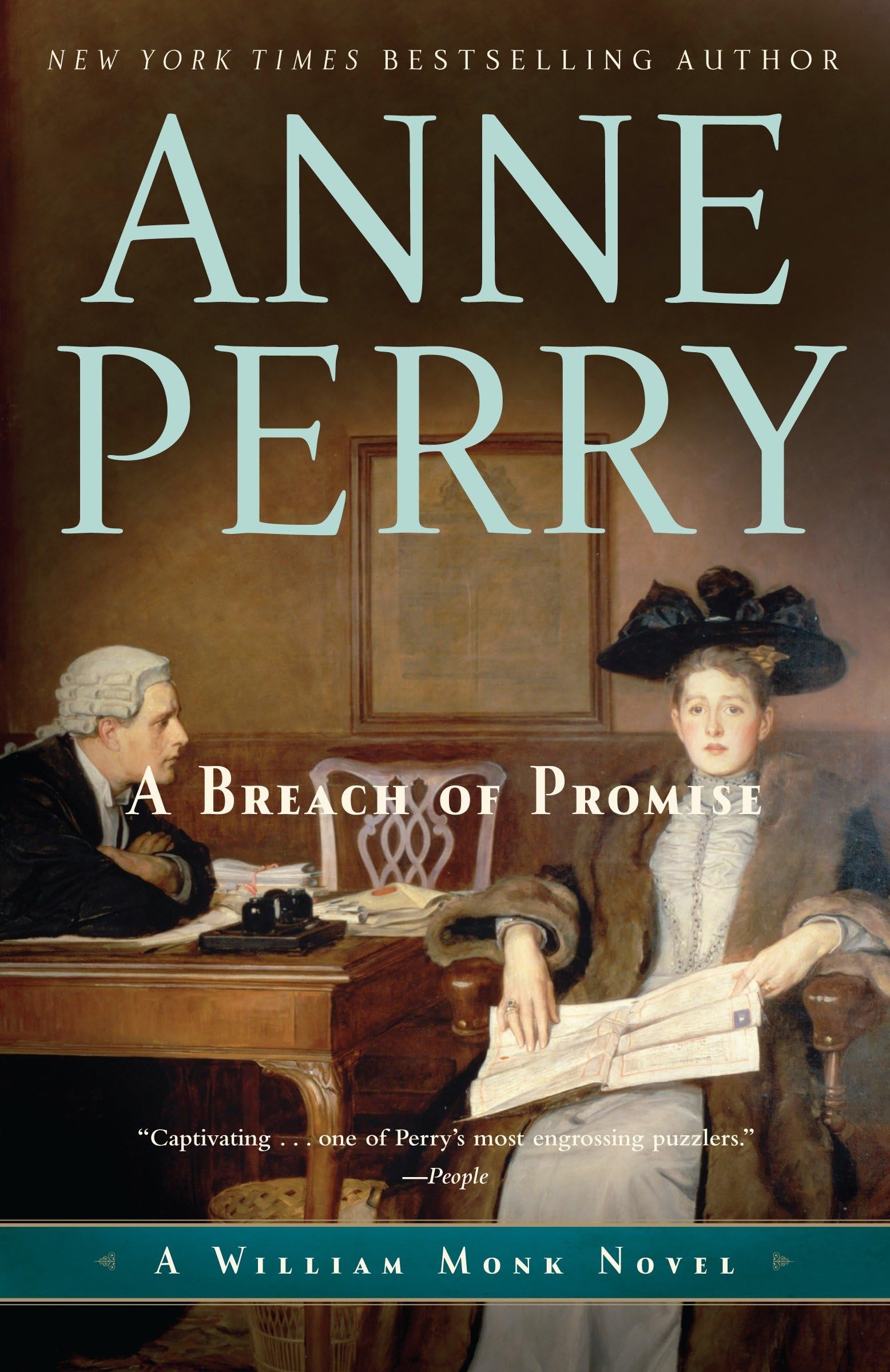



In a sensational breach-of-promise suit, two wealthy social climbers are suing on behalf of their beautiful daughter, Zillah. The defendant is Zillah’s alleged fiancé, brilliant young architect Killian Melville, who adamantly declares that he will not, cannot, marry her. Utterly baffled by his client’s refusal, Melville’s counsel, Sir Oliver Rathbone, turns to his old comrades in crime—William Monk and nurse Hester Latterly. But even as they scout London for clues, the case suddenly and tragically ends, in an outcome that no one—except a ruthless murderer—could have foreseen. “Captivating . . . one of Perry’s most engrossing puzzlers.”— People “Anne Perry, hailed as the queen of the Victorian mystery, shows why with A Breach of Promise .”— San Diego Union-Tribune “No one weaves plot and subplots as seamlessly as Perry. . . . Fans will be delighted by the long-awaited romantic denouement, which brought tears to my eyes.”— Los Angeles Times “The story is full of feeling and weighted with intelligent thought about the status of women in mid-Victorian society.”— The New York Times Book Review “Scenes of Victorian England so rich in detail that they seem more a product of Perry’s memory than her prodigious research.”— The Denver Post Anne Perry was the bestselling author of two acclaimed series set in Victorian England: the William Monk novels and the Charlotte and Thomas Pitt novels. She was also the author of a series featuring Charlotte and Thomas Pitt's son, Daniel, as well as the Elena Standish series; a series of five World War I novels; twenty-one holiday novels; and a historical novel, The Sheen on the Silk, set in the Byzantine Empire. Anne Perry died in 2023. OLIVER RATHBONE LEANED BACK in his chair and let out a sigh of satisfaction. He had just successfully completed a long and tedious case. He had won most substantial damages for his client over a wrongful accusation. The man’s name was completely cleared and he was grateful. He had told Rathbone that he was brilliant, and Rathbone had accepted the compliment with grace and appropriate humility, brushing it aside as more a courtesy than truth. But he had worked very hard and had exercised excellent judgment. He had once again used the skills which had made him one of the finest barristers in London, if not in England. He found himself smiling in anticipation of a most pleasant evening at Lady Hardesty’s ball. Miss Annabelle Hardesty had been presented to the Queen, and had even earned an agreeable comment from Prince Albert. She was launched upon society. It was an evening in which all manner of victories might be celebrated. It would be a charming affair. There was a knock on the door, interrupting his reverie. “Yes?” He sat up straight. He was not expecting anyone. He had rather thought he would go home early, perhaps take a short walk in the park and enjoy the late-spring air, see the chestnuts coming into bloom. The door opened and Simms, his chief clerk, looked in. “What is it?” Rathbone asked with a frown. “A young gentleman to see you, Sir Oliver,” Simms replied very seriously. “He has no appointment, but seems extremely worried.” His brow puckered with concern and he looked at Rathbone intently. “He’s quite a young gentleman, sir, and although he’s doing his best to hide it, I think he is more than a little afraid.” “Then I suppose you had better ask him to come in,” Rathbone conceded, more from his regard for Simms than conviction that the young man’s difficulty was one he could solve. “Thank you, sir.” Simms bowed very slightly and withdrew. The moment after, the door swung wide again and the young man stood in the entrance. He was, as Simms had said, deeply troubled. He was not tall—perhaps an inch less than Rathbone himself—although his slender build and the squareness of his shoulders gave him an extra appearance of height. He had very fair skin and fine, regular features. Strength was given to his face by the width of his jaw and the level, unflinching gaze with which he met Rathbone’s eyes. It was difficult to place his age, as it can be with those of a very fair complexion, but he could not have been far on either side of thirty Rathbone rose to his feet. “Good afternoon, sir. Come in, and tell me in what way I may be of service to you.” “Good afternoon, Sir Oliver.” The young man closed the door behind him and advanced towards the chair in front of Rathbone’s desk. He was breathing very steadily, as if it were a deliberate effort, and when he was closer it was possible to see that his shoulders were tense, his body almost rigid. “My name is Killian Melville,” he began slowly, watching Rathbone’s face. “I am an architect.” He said it with great meaning; his light voice almost caressed the word. He hesitated, still staring at Rathbone. “I am afraid that I am about to be sued for breach of promise.” “Promise to do what?” Rathbone asked, although he was all but c