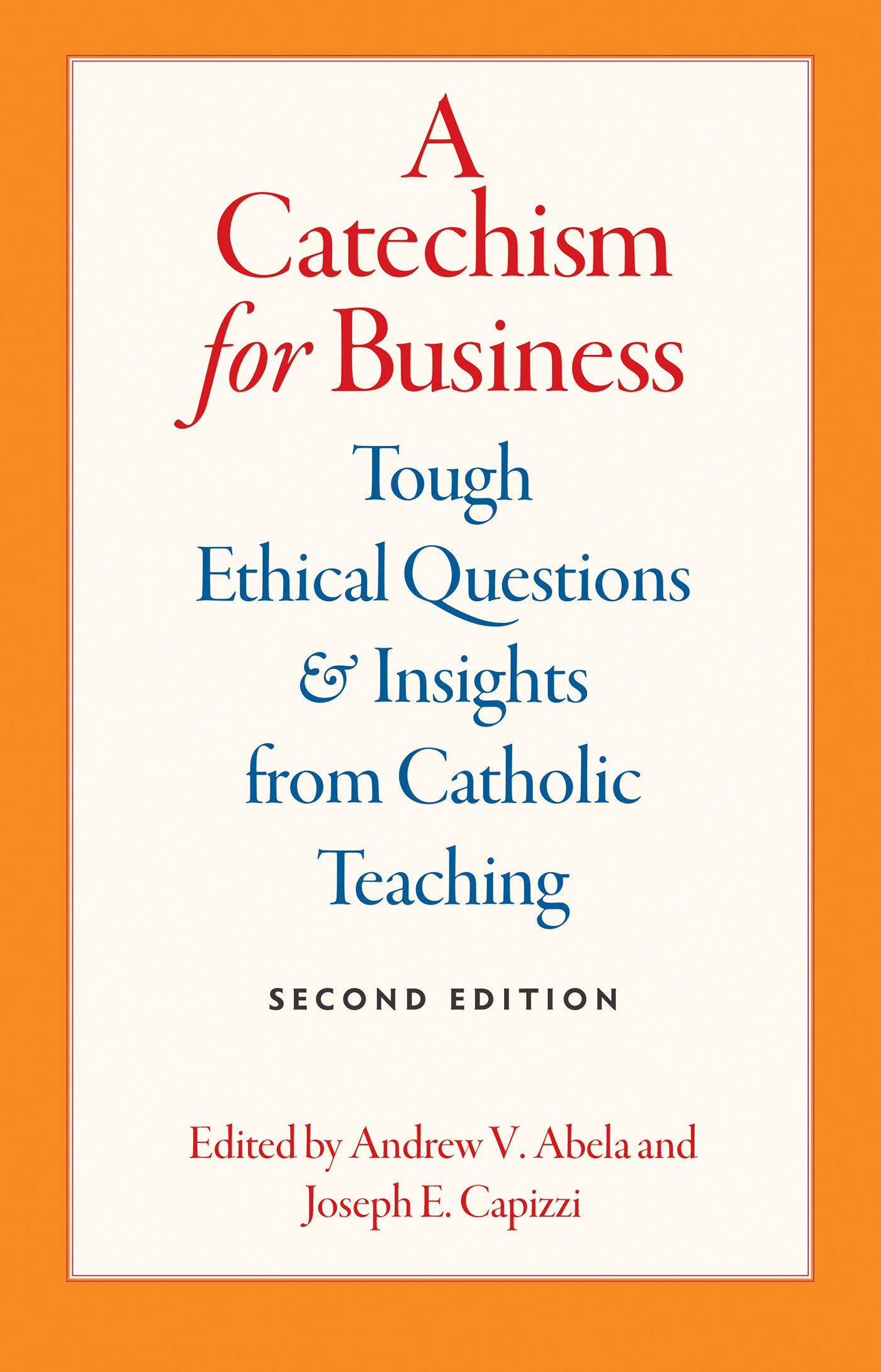
A Catechism for Business: Tough Ethical Questions and Insights from Catholic Teaching
$24.95
by Andrew V Abela



This second edition streamlines some of the editing from the first addition, and more importantly, includes material from Pope Francis's encyclical, Laudato Si' , and his apostolic exhortation, Evangelii Gaudium . A Catechism for Business presents the teachings of the Catholic Church as they relate to more than one hundred specific and challenging moral questions as they have been asked by business leaders. Andrew V. Abela and Joseph E. Capizzi have assembled the relevant quotations from recent Catholic social teaching as responses to these questions. Questions and answers are grouped together under major topics such as marketing, finance and investment. The book's easy-to-use question and answer approach invites quick reference for tough questions and serves as a basis for reflection and deeper study in the rich Catholic tradition of social doctrine. Andrew V. Abela is the Provost of the Catholic University of America. Joesph E. Capizzi is the Director of Moral Theology in the School of Theology and Religious Studies at the Catholic University of America A Catechism for Business Tough Ethical Questions & Insights from Catholic Teaching By Andrew V. Abela, Joseph E. Capizzi The Catholic University of America Press Copyright © 2016 Libreria Editrice Vaticana All rights reserved. ISBN: 978-0-8132-2884-6 Contents Introduction to the Second Edition, Introduction to the First Edition, 1. General Questions, 2. Finance and Investing, 3. Management, 4. Marketing and Sales, 5. Manufacturing, 6. International Business, 7. Particularly Morally Sensitive Industries, 8. Conclusion, Index, CHAPTER 1 General Questions Economic Context 1. Do we have a right to private property? "In the beginning God entrusted the earth and its resources to the common stewardship of mankind to take care of them, master them by labor, and enjoy their fruits. [footnote reference to Gn 1:26–29] The goods of creation are destined for the whole human race. However, the earth is divided up among men to assure the security of their lives, endangered by poverty and threatened by violence. The appropriation of property is legitimate for guaranteeing the freedom and dignity of persons and for helping each of them to meet his basic needs and the needs of those in his charge." — Catechism of the Catholic Church, 2402 (577) "The private ownership of goods is justified by the need to protect and increase them, so that they can better serve the common good." — Francis, Evangelii Gaudium, 189 "The Christian tradition has never recognized the right to private property as absolute or inviolable, and has stressed the social purpose of all forms of private property." — Francis, Laudato Si, 93 "[The right to private property,] which is fundamental for the autonomy and development of the person, has always been defended by the Church up to our own day. At the same time, the Church teaches that the possession of material goods is not an absolute right, and that its limits are inscribed in its very nature as a human right." — St. John Paul II, Centesimus annus, 30 "[The principle of private property] as it was then stated and as it is still taught by the Church, diverges radically from the program of collectivism as proclaimed by Marxism and put into practice in various countries in the decades following the time of Leo XIII's Encyclical. At the same time it differs from the program of capitalism practiced by liberalism and by the political systems inspired by it. In the latter case, the difference consists in the way the right to ownership or property is understood. Christian tradition has never upheld this right as absolute and untouchable. On the contrary, it has always understood this right within the broader context of the right common to all to use the goods of the whole of creation: the right to private property is subordinated to the right to common use, to the fact that goods are meant for everyone." — St. John Paul II, Laborem exercens, 14 "Private property or some ownership of external goods confers on everyone a sphere wholly necessary for the autonomy of the person and the family, and it should be regarded as an extension of human freedom." — Gaudium et spes, 71 "Let it be considered as certain and established that neither [Pope Leo XIII] nor those theologians who have taught under the guidance and authority of the Church have ever denied or questioned the twofold character of ownership, called usually individual or social according as it regards either separate persons or the common good. For they have always unanimously maintained that nature, rather the Creator Himself, has given man the right of private ownership not only that individuals may be able to provide for themselves and their families but also that the goods which the Creator destined for the entire family of mankind may through this institution truly serve this purpose. All this can be achieved in no wise except through t