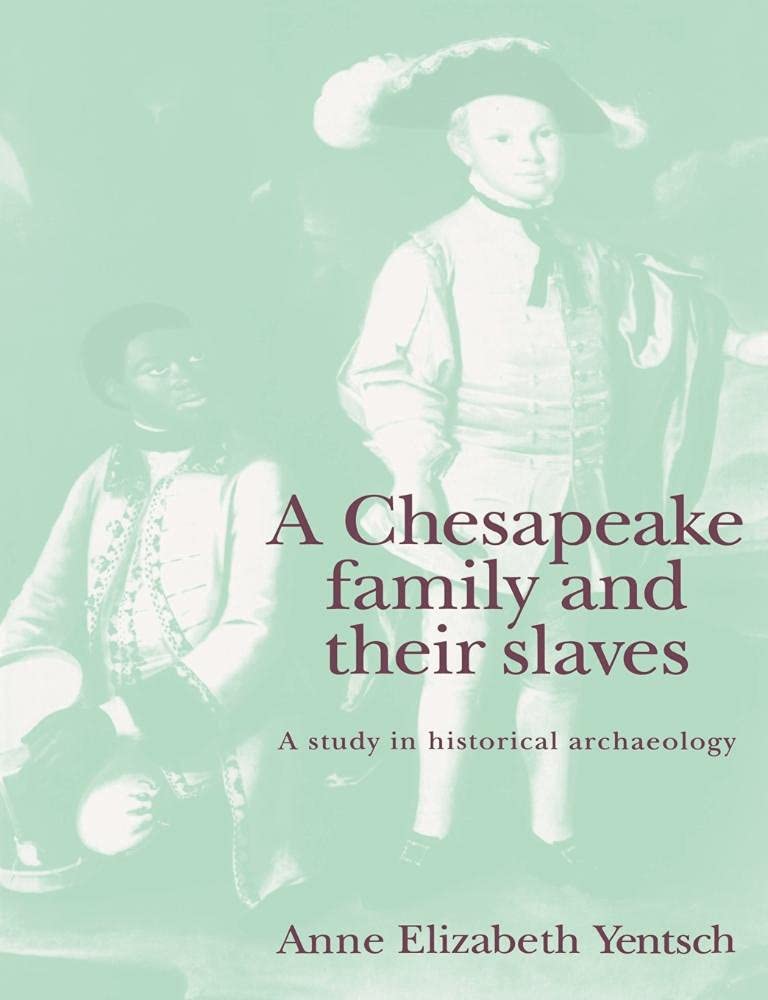
A Chesapeake Family and their Slaves: A Study in Historical Archaeology (New Studies in Archaeology)
$35.58
by Anne Elizabeth Yentsch



Analyzing the material remains left by Maryland's colonists in the eighteenth century in conjunction with historical records and works of art, archaeologists have reconstructed the daily life of the aristocratic British Calvert family, whose head was governor of Maryland. In this large household people from different cultures interacted, and English and West African lifestyles merged. Using this fascinating case study, Anne Yentsch illustrates the way in which historical archaeology draws on different disciplines to interpret the past. "For those scholars who have waited for a new kind of scholarship to emerge from the Chesapeake, it has made its first appearance in Yentsch's important book." Carter L. Hudgins "The author successfully uses thick description to elucidate the natural, personal, and cultural aspects of everyday life in Annapolis....her African-American discourse productively frames the interpretation of this small but important site with ever-widening and meaningful circles of a community and its creole context." William and Mary Quarterly "In an excellent example of the leading edge of American historical archaeology, Yentsch provides a richly detailed case study proving the value of an anthropological and archaeological approach to American Colonial history....Highly recommended." Choice "This is an extremely rich and complex volume, and, as with the other titles in Cambridge's New Studies in Archaeology Series, it seeks to bring the results of archaeological inquiry to a broad inter-disciplinary audience....It is no less than an interpretive tour de force that will stimulate discussion and debate for many years....She admirably succeeds in presenting a detailed picture of life and culture at a particular time and place in the Chesapeake region that should be of interest to a wide range of scholars." John P. McCarthy, Journal of Middle Atlantic Archaeology "What began as salvage archaeology has resulted in one of three or four most innovative and rewarding books written during the past quarter century about the colonial Chesapeake...The book subsumes its strictly archaeological findings into an ambitious historical ethnography. As its remarkably rich bibliography shows, the book draws on social and political historiography in addition to historical archaeology to provide a context for understanding a complex household of free and enslaved families in the first half of the eighteenth century...Besides the rich specific information for historians of the early Chesapeake, the book can be read for its generic lessons about anthropological perspectives on history, of which archaeology is only one strategy." Jack Crowley, The Journal of American History This book is a unique archaeological study of a British aristocratic family in eighteenth century Chesapeake. Analysing the material remains left by Maryland's colonists in the eighteenth century in conjunction with historical records and works of art, archaeologists have reconstructed the daily life of an aristocratic British family, whose head was governor of Maryland. In this large household people from different cultures interacted, and English and West African lifestyles merged. Using this fascinating case-study, Anne Yentsch illustrates the way in which historical archaeology draws on different disciplines to interpret the past. Used Book in Good Condition