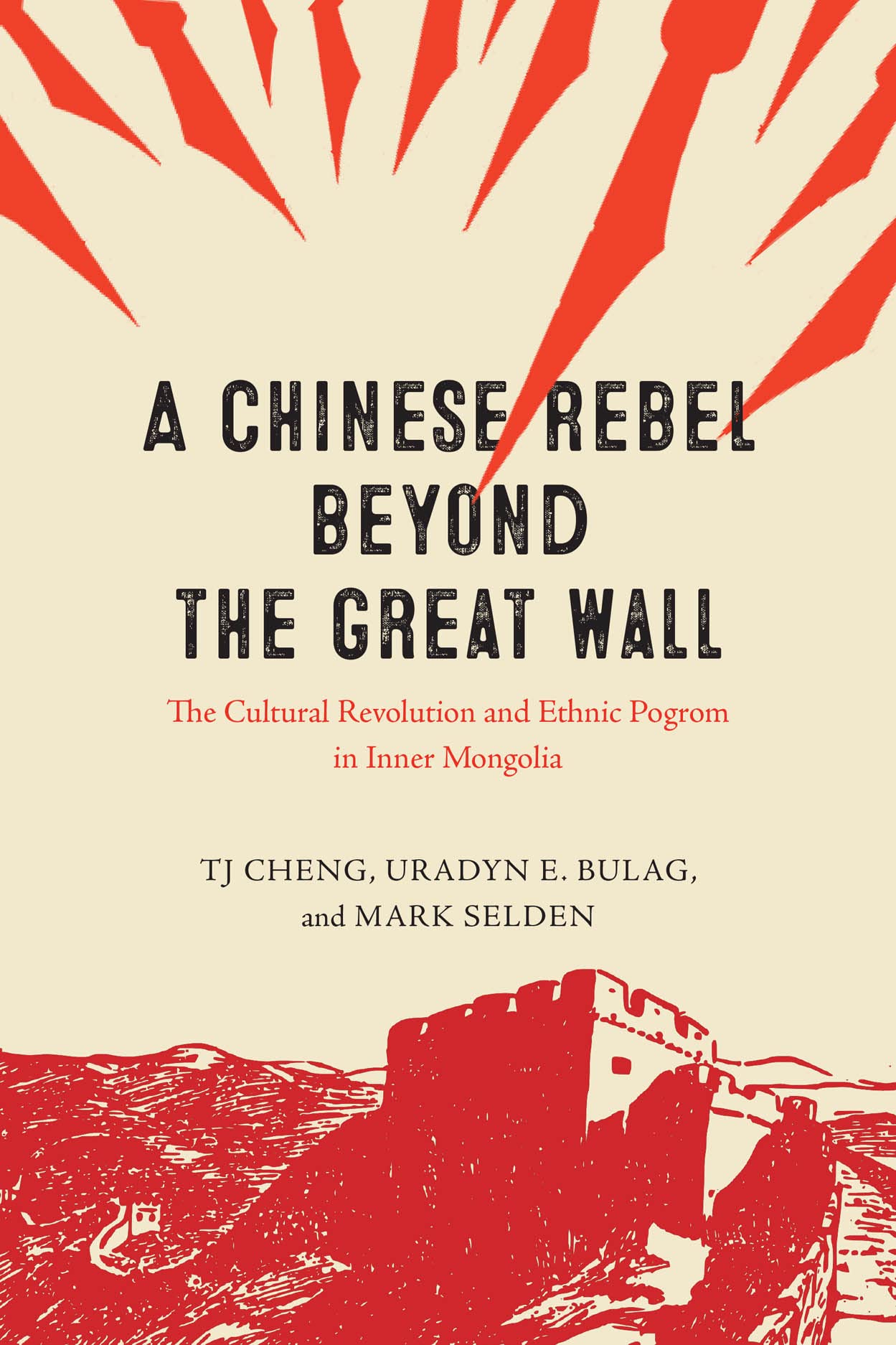



A striking first-person account of the Cultural Revolution in Inner Mongolia, embedded in a close examination of the historical evidence on China’s minority nationality policies to the present. During the Great Leap Forward, as hundreds of thousands of Chinese famine refugees headed to Inner Mongolia, Cheng Tiejun arrived in 1959 as a middle school student. In 1966, when the PRC plunged into the Cultural Revolution, he joined the Red Guards just as Inner Mongolia’s longtime leader, Ulanhu, was purged. With the military in control, and with deepening conflict with the Soviet Union and its ally Mongolia on the border, Mongols were accused of being nationalists and traitors. A pogrom followed, taking more than 16,000 Mongol lives, the heaviest toll anywhere in China. At the heart of this book are Cheng’s first-person recollections of his experiences as a rebel. These are complemented by a close examination of the documentary record of the era from the three coauthors. The final chapter offers a theoretical framework for Inner Mongolia’s repression. The repression’s goal, the authors show, was not to destroy the Mongols as a people or as a culture—it was not a genocide. It was, however, a “politicide,” an attempt to break the will of a nationality to exercise leadership of their autonomous region. This unusual narrative provides urgently needed primary source material to understand the events of the Cultural Revolution, while also offering a novel explanation of contemporary Chinese minority politics involving the Uyghurs, Tibetans, and Mongols. “Inner Mongolia witnessed the most extreme brutalities of the Cultural Revolution, but the authors go beyond just narrating these horrific events to trace the cruelty to an aim of ‘politicide’. A grim and timely reminder.” ― Christopher Pratt Atwood, University of Pennsylvania “An eye-opening, heartrending eyewitness account of the atrocities committed against the Mongols by the Communist Party-state. Unforgettable reading and all too pertinent to our times.” ― Peter C. Perdue, Yale University “Although scholars are increasingly considering and assessing issues of colonialism in China’s working out of its nationality strategies, such work has rarely been carried out at this level of detail and analysis. With its academic depth and the sophistication of its authors’ argument and research, A Chinese Rebel beyond the Great Wall will be groundbreaking in many ways.” ― Robert Barnett, SOAS, University of London "Riveting. . . . [Cheng's] first-hand account is invaluable." ― The China Quarterly “At its core, the book offers a forensic case study in the complex politics of minzu 民族 (nation, race, nationality) in modern China and illustrates how the Chinese Communist Party (CCP) came to assert Han control over its ethnocultural periphery.” ― Journal of Asian Studies TJ Cheng is emeritus professor of sociology at Macau University and a freelance writer based in California Uradyn E. Bulag is professor of social anthropology at the University of Cambridge. Mark Selden is emeritus professor of sociology and history at the State University of New York at Binghamton. It was 1959, one year into the Great Leap Forward, one of the twentieth century’s boldest, yet most disastrous, utopian experiments. The Mao Zedong–initiated Leap sought to accelerate China’s economic growth and transform its society with the creation of communes in order to swiftly surpass the prosperity of the United States and the United Kingdom in a new socialist order. Instead, the Leap resulted in one of the deadliest famines humanity has ever seen. In the summer of 1958, in rural Hebei, as in much of rural China, the agricultural fields were deserted as many able-bodied men and women, and even middle school students, were dispatched for industrial work far from their villages. The primary task for most was to smelt iron, the symbol of scientific communism, not in giant factories but in homemade stoves scattered throughout the countryside. Heaps of useless jagged metal were produced while famine devastated rural communities as crops were left standing in the fields. Between 1959 and 1961 thirty million or more Chinese villagers died of hunger. Cheng Tiejun, the protagonist and coauthor of this book, was fourteen years old, a junior middle school student living with his mother and brother in a poverty-stricken North China village in Raoyang county, one hundred miles south of Beijing. His parents had divorced, and his father worked as a truck driver in Hohhot, the capital of the Inner Mongolia Autonomous Region (IMAR). With sharp cutbacks in middle school education in the countryside during the famine, his mother decided that Tiejun would fare better by moving to live with his father. At that time, hundreds of thousands of famine refugees also set their eyes on the Mongolian steppe to the north beyond the Great Wall on the Mongolian-Soviet borderland. The Chinese state turned b