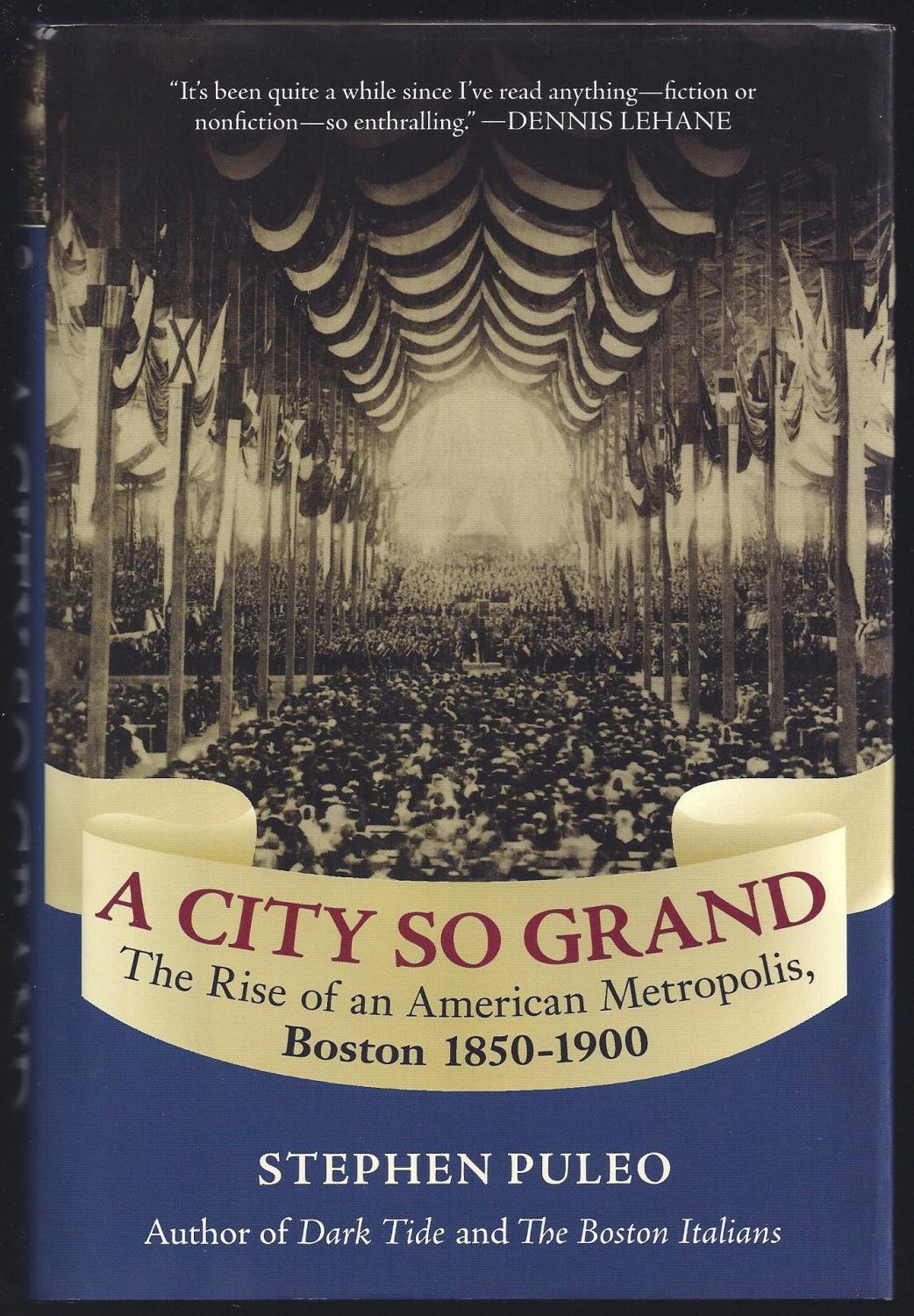
A City So Grand: The Rise of an American Metropolis: Boston 1850-1900
$37.25
by Stephen Puleo



Once upon a time, "Boston Town" was an insulated New England township. But the community was destined for greatness. Between 1850 and 1900, Boston underwent a stunning metamorphosis to emerge as one of the world's great metropolises-one that achieved national and international prominence in politics, medicine, education, science, social activism, literature, commerce, and transportation. Long before the frustrations of our modern era, in which the notion of accomplishing great things often appears overwhelming or even impossible, Boston distinguished itself in the last half of the nineteenth century by proving it could tackle and overcome the most arduous of challenges and obstacles with repeated-and often resounding-success, becoming a city of vision and daring. In A City So Grand , Stephen Puleo chronicles this remarkable period in Boston's history, in his trademark page-turning style. Our journey begins with the ferocity of the abolitionist movement of the 1850s and ends with the glorious opening of America's first subway station, in 1897. In between we witness the thirty-five-year engineering and city-planning feat of the Back Bay project, Boston's explosion in size through immigration and annexation, the devastating Great Fire of 1872 and subsequent rebuilding of downtown, and Alexander Graham Bell's first telephone utterance in 1876 from his lab at Exeter Place. These lively stories and many more paint an extraordinary portrait of a half century of progress, leadership, and influence that turned a New England town into a world-class city, giving us the Boston we know today. It's been quite a while since I've read anything—fiction or nonfiction—so enthralling.—Dennis Lehane Stephen Puleo is author of the Boston Globe best seller The Boston Italians and the critically acclaimed Dark Tide: The Great Boston Molasses Flood of 1919 . A former award-winning newspaper reporter and contributor to American History magazine, he holds a master's degree in history and wrote his thesis on Italian immigration and the settlement of Boston's North End. He donates a portion of his book proceeds to the Juvenile Diabetes Research Foundation (JDRF), the leading charitable funder and advocate of juvenile (Type 1) diabetes research. He and his wife, Kate, live in Weymouth, Massachusetts. CHAPTER ONE I think we must get rid of slavery, or we must get rid of freedom. —Ralph Waldo Emerson, 1856 Tuesday, April 8, 1851 . The conspirators would wait one more day, and then strike under cover of darkness. They knew full well the risks—arrests, fines, perhaps prison—but the justness of their cause outweighed any personal consequences, and the timing of events made delay impossible. Though hastily conceived, their plan withstood scrutiny; sound in concept, its brazenness was equaled only by its simplicity. The men stood clustered in a tight circle, their voices low, their demeanor somber, unaffected by the disbanding crowd, which still buzzed with excitement. The boisterous meeting had ended, but those who attended would long remember the thunderous speeches delivered inside the Tremont Temple this day, ten hours of addresses that represented more than rhetoric to the small band of abolitionists who now gathered in one corner of Boston’s downtown meetinghouse. To them, the day’s oratory cried out for justice and demanded action. Led by the fiery Unitarian minister Thomas Wentworth Higginson, these men saw their mission in the clearest of terms: free the imprisoned runaway slave Thomas Sims and convey him to a stop along the Underground Railroad for eventual safe passage to Canada. If they failed, Sims would be hauled back to Georgia to face punishment from his former owner and resume a pitiful existence in slavery’s shackles, a life he had fled when he stowed away on a brig that left Savannah in late February. The twenty-three-year-old Sims had already overcome daunting odds on his journey to freedom, making his current confinement all the more tragic. For two weeks during the vessel’s wintry northern voyage he had escaped detection, avoiding the crew and providing for himself. Then, on March 6, with Boston’s lights in sight, the brig’s mate discovered the stowaway. “Sims was cursed at, struck, and brought before the captain,” according to one newspaper account, and then locked in a cabin while the ship lay anchored outside Boston Harbor. But the crew had failed to take his pocketknife. That night, Sims jimmied the lock, lowered one of the ship’s lifeboats into the water, and rowed toward freedom. He landed in South Boston and “took lodging in a colored seaman’s boardinghouse, and while in the city, made no effort to conceal himself.” But then Sims made a grave mistake. Destitute and hoping to arrange for funds to bring his free wife and children to Boston, he wired to Savannah for money—and the telegram included his return address. Somehow, Sims’s