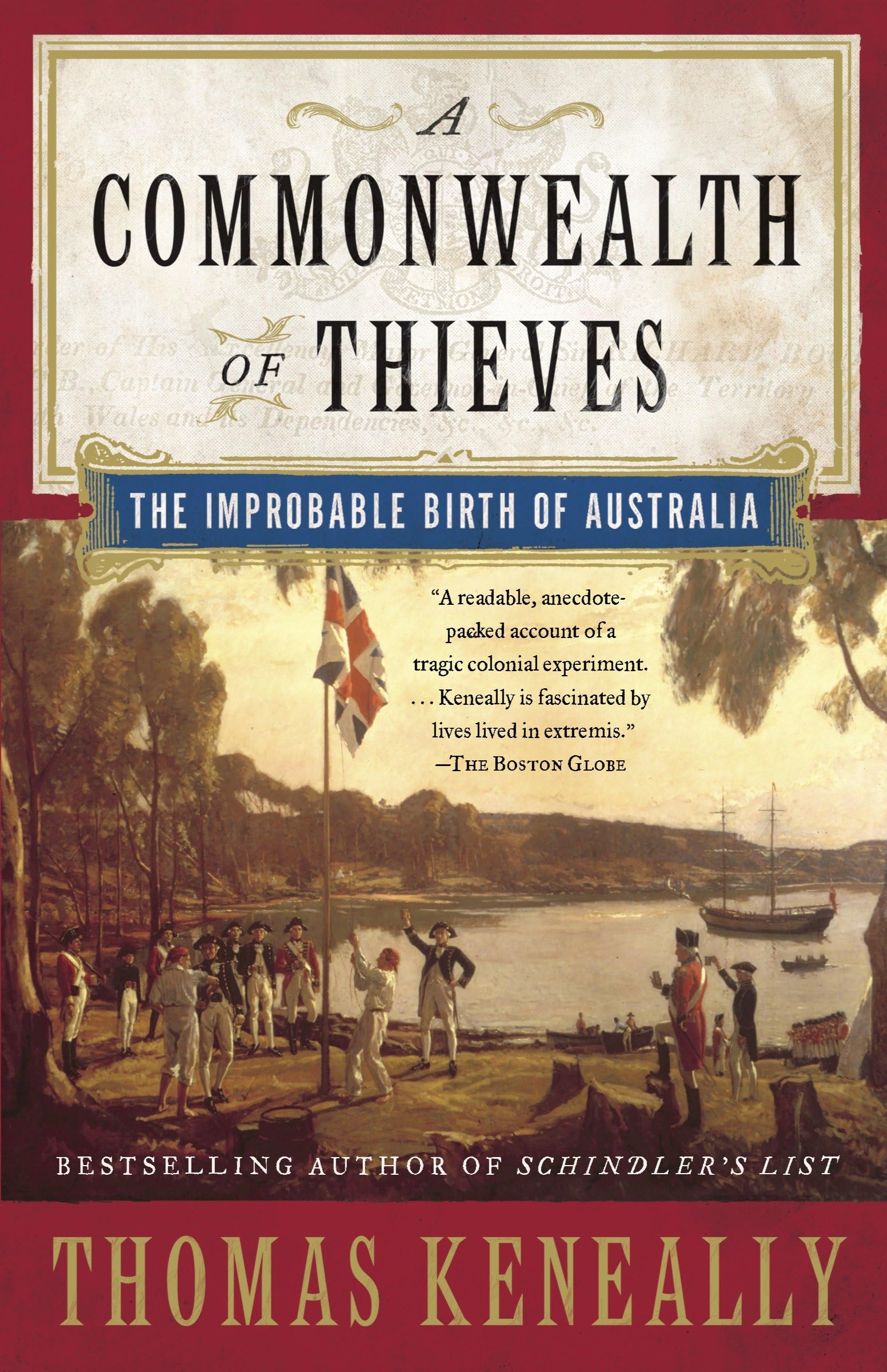



In this spirited history of the remarkable first four years of the convict settlement of Australia, Thomas Keneally offers us a human view of a fascinating piece of history. Combining the authority of a renowned historian with a brilliant narrative flair, Keneally gives us an inside view of this unprecedented experiment from the perspective of the new colony’s governor, Arthur Phillips. Using personal journals and documents, Keneally re-creates the hellish overseas voyage and the challenges Phillips faced upon arrival: unruly convicts, disgruntled officers, bewildered and hostile natives, food shortages, and disease. He also offers captivating portrayals of Aborigines and of convict settlers who were determined to begin their lives anew. A Commonwealth of Thieves immerses us in the fledgling penal colony and conjures up the thrills and hardships of those first four improbable years. "A readable, anecdote-packed account of a tragic colonial experiment." — Boston Globe "Superb. . . . Keneally uses his novelist's skill to construct a lively mosaic from contemporary accounts." — Financial Times "Evocative. . . . Weaving together many individual stories, Keneally paints an impressionistic picture of a society in the making." — The Washington Post Book World “Keneally deploys his skills as a novelist to give depth to his work as an historian.” — The Economist THOMAS KENEALLY has won international acclaim for his novels Schindler’s List (the basis for the movie and the winner of the Booker Prize), The Chant of Jimmie Blacksmith, Confederates, Gossip from the Forest, The Playmaker, Woman of the Inner Sea, A River Town, Office of Innocence, and The Tyrant’s Novel . His most recent works of nonfiction are The Great Shame and American Scoundrel . He resides in Sydney, Australia. ONE If, in the New Year of 1788, the eye of God had strayed from the main games of Europe, the Americas, Asia, and Africa, and idled over the huge vacancy of sea to the south-east of Africa, it would have been surprised in this empty zone to see not one, but all of eleven ships being driven east on the screaming band of westerlies. This was many times more than the number that had ever been seen here, in a sea so huge and vacant that in today’s conventional atlases no one map represents it. The people on the eleven ships were lost to the world. They had celebrated their New Year at 44 degrees South latitude with “hard salt beef and a few musty pancakes.” Their passage was in waters turbulent with gales, roiling from an awful collision between melted ice from the Antarctic coast and warm currents from the Indian Ocean behind them, and the Pacific ahead. High and irregular seas broke over the decks continuously, knocking the cattle in their pens off their legs. The travelers knew they were past the rocks of sub-Antarctic Kerguelen Island and were reaching for the dangerous southern capes of Van Diemen’s Land, which they intended to round on their way to their destination.What would have intrigued the divine eye was the number of vessels–though they travelled in two sections, each division separated from the other by a few hundred miles. So far in the history of Europe, only six ships had come into this area named the Southern Ocean, which lay between the uncharted south coast of New Holland (later to be known as Australia) and Antarctica’s massive ice pack. In 1642, a Dutchman, Abel Tasman, a vigorous captain of the Dutch East India Company, had crossed this stretch to discover the island he would name Van Diemen’s Land after his Viceroy in Batavia (now Jakarta), but which would in the end be named Tasmania to honour him.His ships, a high-sterned, long-bowed yacht named Heemskerck and a round-sterned vessel of the variety called a flute, the Zeehaean, were of such minuscule tonnage as to be overshadowed by HMS Resolution and HMS Adventure ’s roughly 400 ton each. These last two, still tiny vessels by modern standards, less than one-third a football field in length, came through the Southern Ocean in 1774 under the overall command of the Yorkshireman James Cook. The Resolution travelled well to the south near the Antarctic ice mass, and rendezvoused with Adventure at the islands Tasman had named New Zealand. Then in 1776, the Resolution and the HMS Discovery, again under Cook, could have been seen in these waters. And that was all.What were these eleven ships that in 1788 followed the path of Cook and Tasman to the southern capes of Van Diemen’s Land? One might expect them to be full of Georgian conquistadors, or a task force of scientists to suit the enlightened age. If not that, then they must have carried robust dissenters from the political or religious establishment of their day.The startling fact was they carried prisoners, and the guardians of prisoners. They were the degraded of Britain’s overstretched penal system, and the obscure guardians of the degraded. Any concepts of commerce and science on these ships were