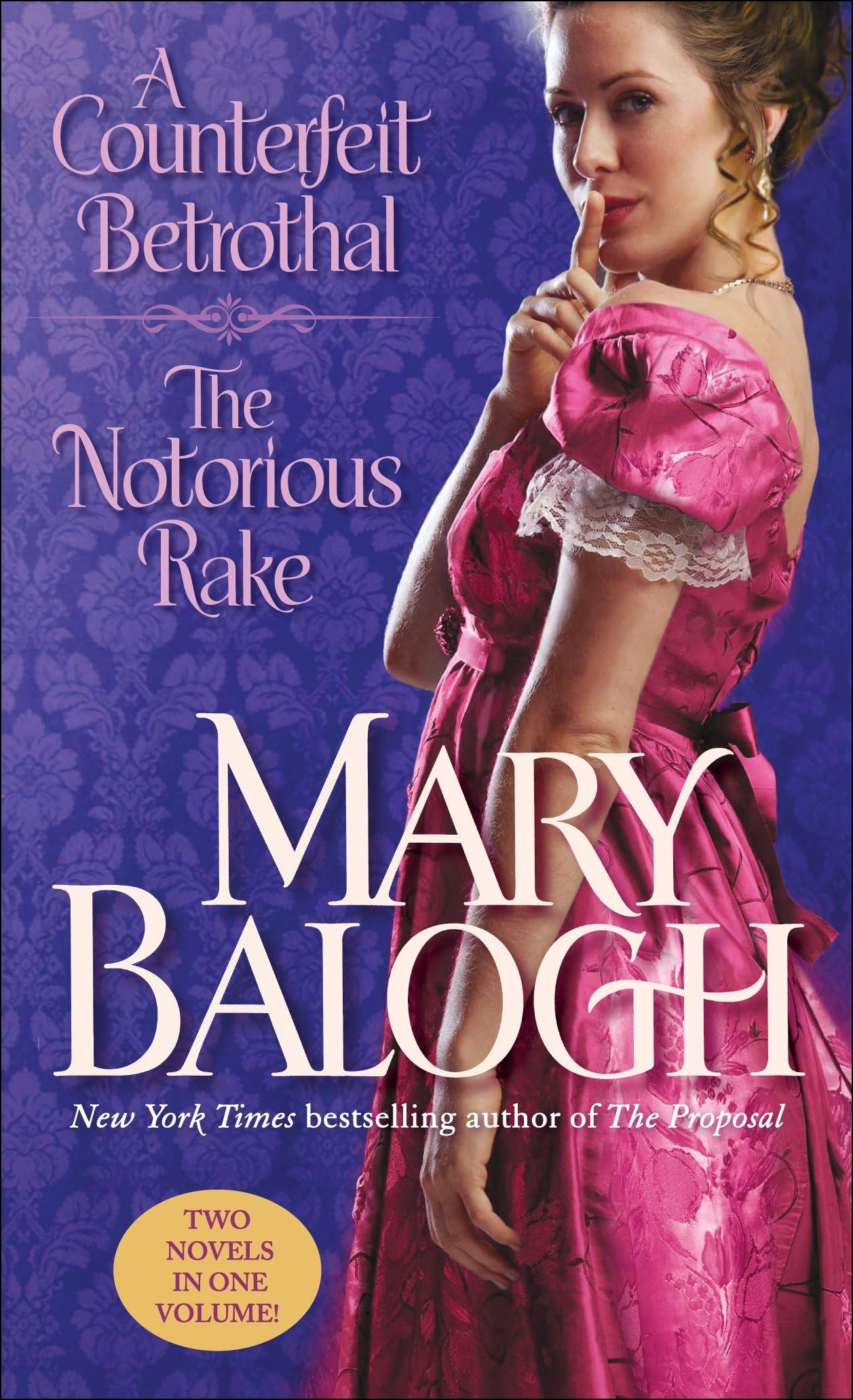



NEW YORK TIMES BESTSELLER Mary Balogh presents two of her classic Regency-era romances—seductive tales of ladies who are running away from love . . . and rogues who enjoy the chase. A COUNTERFEIT BETROTHAL Lady Sophia Bryant has no intention of marrying anytime soon. Her one desire is to reunite her parents, who have been estranged for fourteen years. Surely, if she happens to announce her betrothal—even a false one—they will be forced to see each other. Devilishly handsome Lord Francis Sutton seems perfect for such deceit, always agreeable to games of passion in which he has nothing to lose. The trap is set—if only Lady Sophia can keep her foolish heart from falling prey to her brilliant snares. THE NOTORIOUS RAKE Lord Edmund Waite is everything that Lady Mary Gregg despises: lewd, lascivious, mocking—the most incorrigible and successful rogue around. A bluestocking like her would never tempt a man whose taste runs to pretty playthings—so Mary is startled to find herself the object of Lord Edmund’s desires. Even more surprising is her reaction to his shocking advances. She may be a lady, but this man knows so well how to make her feel like a woman. Includes excerpts of The Proposal and The Arrangement by Mary Balogh Mary Balogh is the New York Times bestselling author of numerous books, including The Arrangement, The Proposal, The Secret Mistress, the acclaimed Slightly and Simply novels, and the five titles in her Huxtable series: First Comes Marriage, Then Comes Seduction, At Last Comes Love, Seducing an Angel, and A Secret Affair . A former teacher, she grew up in Wales and now lives in Canada. 1 “Anyway,” Lady Sophia Bryant said, “I have no intention of marrying anyone. Ever.” She gave her yellow parasol a twirl above her head and looked into the flowing waters of the River Thames, which sparkled in the May sunshine. It was a rash statement to make considering the fact that there were three perfectly eligible gentlemen in the group that adorned the grass on the riverbank at Lady Pinkerton’s garden party in Richmond. There were two other young ladies there, too, one Lady Sophia’s close friend and the other one of the greatest gossips of the younger generation. By nightfall the whole of London would know what she had just said, including her papa, who had brought her to London for the Season, doubtless with the intention of finding her a husband despite the fact that she had not quite reached her eighteenth birthday. But she had meant the words. “Then there will be no further point in being in town,” Mr. Peter Hathaway said. “We gentlemen might as well pack our trunks and retire to the country, Lady Sophia.” He caught the eye of Lord Francis Sutton, who was sprawled on his side, propped on one elbow, his chin on his hand. He was sucking on a blade of grass. He raised one expressive eyebrow and Mr. Hathaway grimaced. “Were it not for the presence of Miss Maxwell and Miss Brooks-Hyde, of course,” he added hastily. “But why, Lady Sophia?” Miss Dorothy Brooks-Hyde asked. “Would you prefer to be a spinster dependent upon your male relatives for the rest of your life? You do not even have any brothers.” “I shall not be dependent,” Lady Sophia said. “When I am one-and-twenty I shall come into my fortune and set up my own establishment. I shall cultivate the best of company about me, and all the married ladies will envy me.” “And you will cultivate the label of bluestocking into the bargain, Soph,” Lord Francis said, first removing the blade of grass from his mouth. “It won’t suit you.” “Nonsense,” she said. “You are going to be horribly covered with grass, Francis.” “Then you can brush me down,” he said, winking at her and returning the blade of grass to his mouth. “I do not wonder that the name of rake has sometimes been attached to you in the past few years, Francis,” Lady Sophia said severely. “Sophia!” Miss Cynthia Maxwell said reproachfully, dipping her parasol in front of her face to hide her blushes from the gentlemen. Sir Marmaduke Lane entered the conversation. “Seriously, Lady Sophia,” he said, “it is neither easy nor advisable to avoid matrimony. Our society and the whole future of the human race depends upon our making eligible connections. Indeed, one might even say it is our duty to enter the married state.” “Fiddle!” was Lady Sophia’s reaction to this rather pompous speech. “Why would one give up one’s freedom and the whole of one’s future happiness just out of a sense of duty?” “I would rather have said that happiness comes from marriage and the bearing of children,” Dorothy said. “What else is there for a woman, after all?” She glanced at Lord Francis for approval but he was occupied with the absorbing task of selecting another blade of grass to suck upon. “Marriage brings nothing but unhappiness,” Lady Sophia said hotly. “Once the first flush of romance has worn off, there is nothing left. Nothing at all. The husband can return to his old way