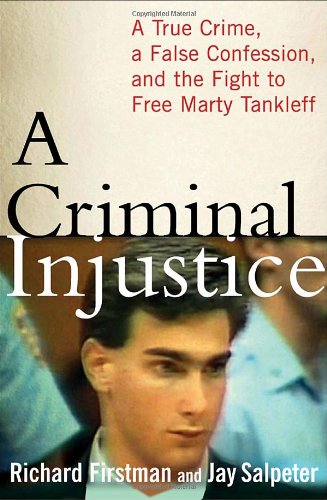
A Criminal Injustice: A True Crime, a False Confession, and the Fight to Free Marty Tankleff
$42.49
by Richard Firstman



When he went to bed on the night of September 6, 1988, seventeen-year-old Marty Tankleff was a typical kid in the upscale Long Island community of Belle Terre. He was looking forward to starting his senior year at Earl L. Vandermeulen High School the next day. But instead, Marty woke in the morning to find his parents brutally bludgeoned, their throats slashed. His mother, Arlene, was dead. His father, Seymour, was barely alive and would die a month later. With remarkable self-possession, Marty called 911 to summon help. And when homicide detective James McCready arrived on the scene an hour later, Marty told him he believed he knew who was responsible: Jerry Steuerman, his father’s business partner. Steuerman owed Seymour more than half a million dollars, had recently threatened him, and had been the last to leave a high-stakes poker game at the Tankleffs’ home the night before. However, McCready inexplicably dismissed Steuerman as a suspect. Instead, he fastened on Marty as the prime suspect–indeed, his only one. Before the day was out, the police announced that Marty had confessed to the crimes. But Marty insisted the confession was fabricated by the police. And a week later, Steuerman faked his own death and fled to California under an alias. Yet the police and prosecutors remained fixated on Marty–and two years later, he was convicted on murder charges and sentenced to fifty years in prison. But Marty’s unbelievable odyssey was just beginning. With the support of his family, he set out to prove his innocence and gain his freedom. For ten years, disappointment followed disappointment as appeals to state and federal courts were denied. Still, Marty never gave up. He persuaded Jay Salpeter, a retired NYPD detective turned private eye, to look into his case. At first it was just another job for Salpeter. As he dug into the evidence, though, he began to see signs of gross ineptitude or worse: Leads ignored. Conflicts of interest swept under the rug. A shocking betrayal of public trust by Suffolk County law enforcement that went well beyond a simple miscarriage of justice. After Salpeter’s discoveries brought national media attention to the case, Marty’s conviction was finally vacated in 2007, and New York’s governor appointed a special prosecutor to reopen the twenty-year-old case. At the same time, the State Investigation Commission announced an inquiry into Suffolk County’s handling of what has come to be widely viewed as one of America’s most disturbing wrongful conviction cases. As gripping as a Grisham novel, A Criminal Injustice is the story of an innocent man’s tenacious fight for freedom, an investigator’s dogged search for the truth. It is a searing indictment of justice in America. Richard Firstman is an award-winning author and journalist whose books include The Death of Innocents, a New York Times Notable Book of the Year and Edgar Award winner co-authored with his wife, Jamie Talan. He has written for numerous publications, and his work as a producer has appeared on 60 Minutes. He was previously a reporter at large and an editor at Newsday. Jay Salpeter , a highly decorated former New York City police detective and hostage negotiator, is one of the country’s top private investigators. His work has led to frequent appearances on Dateline, 48 Hours, MSNBC, Fox News, and Court TV (now truTV). In 2008, he co-founded the Fortress Innocence Group, the nation’s first private investigations firm devoted to overturning wrongful convictions. Chapter 1 Belle Terre, Long Island: September 6, 1988 All along the coastline, a succession of jagged peninsulas gives the northern shore of Long Island its idiosyncratic contours and most desirable real estate. Great Neck . . . Manhasset Neck . . . Lloyd Neck . . . Eatons Neck . . . eight haphazard glacial formations in all, each in its way heaven or hell to centuries of seamen. Fifty miles out from the New York City line, the last of them pushes into Long Island Sound. And then the coastline abruptly straightens, becoming as regular as a riverbank from there to Orient Point. It is a hilly cape, this last one, smaller than the others, shaped something like a crabeater seal. The peninsula’s tree-lined western edge shelters Port Jefferson Harbor, whose wharf docks the ferries that rumble by on their way to Connecticut and back. On the sound side of the neck, a line of low cliffs overlooks a stretch of rocky shoreline. There was a time, before the first land speculators came along in the early 1900s and gave it a more agreeable name, that the peninsula was known for the misfortune it brought ship captains who didn’t see it in the night. Mount Misery Neck was what they called it, before they called it Belle Terre. Now, late in the century, the cape remains serene and secluded, home to a small community of suburbanites who live in upscale homes on significant properties. Apart from a lavish estate at the end of Cliff Road, where a manor known as the Pink