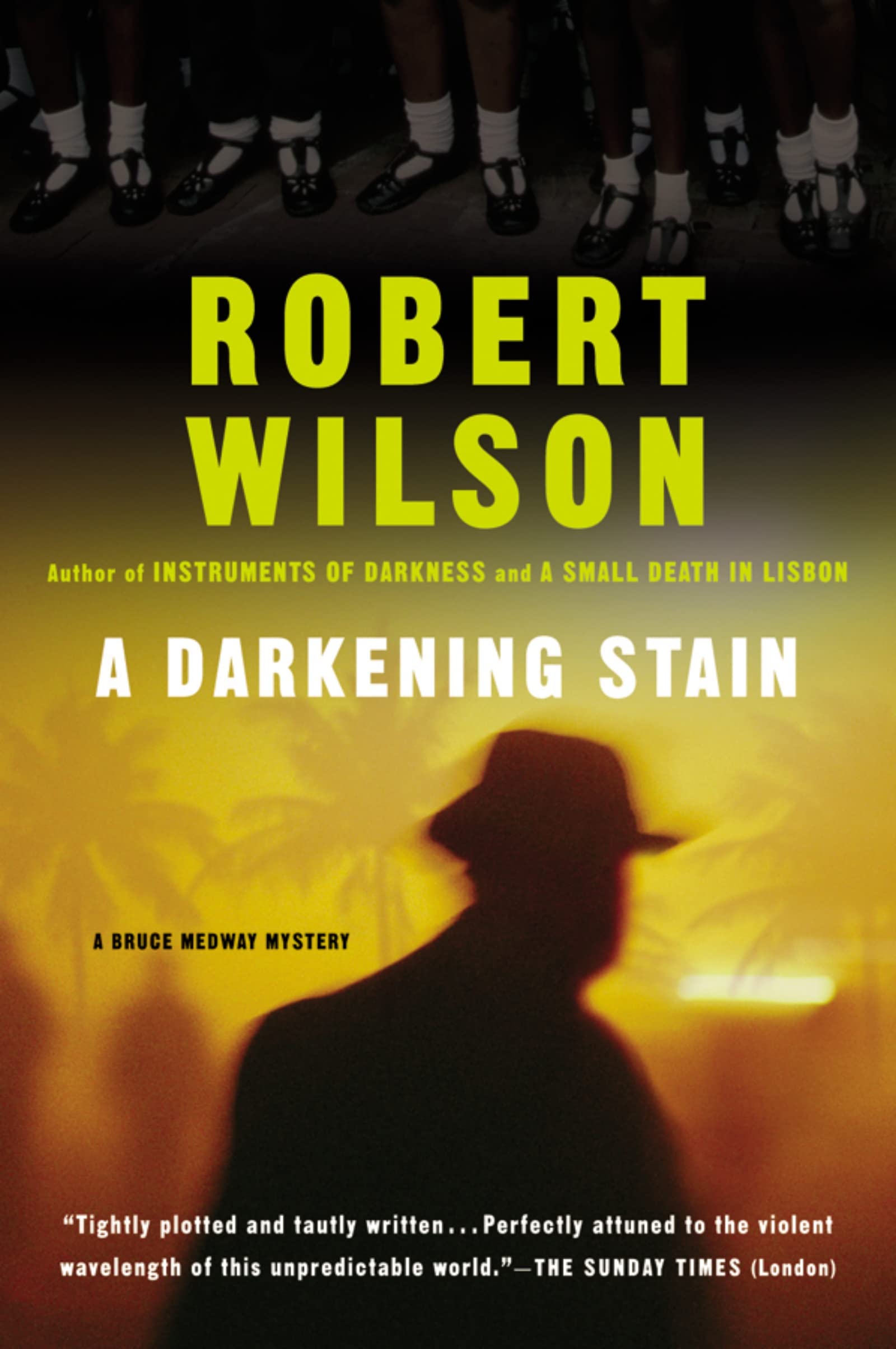



When schoolgirls begin to disappear on the West African coast, "troubleshooter" Bruce Medway tries to remain detached. Meanwhile, he reluctantly acquires a new job from former nemesis and mafia capo Franconelli. Franconelli gives Bruce forty-eight hours to find a French trader, Mariner, whom not even the mafia has been able to track. Yet as Bruce sets out on his assignment, he is unable to remain disconnected from the mysterious schoolgirl disappearances, and finds that girls, gold, and greed are all interconnected; corruption abounds everywhere. There are no safe havens for Bruce in this situation, and he must devise a scam that risks everything in order to stay alive. A brilliant follow-up to Blood is Dirt, and the fourth novel in the Bruce Medway series, A Darkening Stain takes Bruce Medway into the darkest territory of West Africa yet. A Harvest Original PRAISE FOR A DARKENING STAIN “Robert Wilson dissects the dark heart of Africa with an insight and compassion that makes it so sleazily vivid you’d pay money not to go there.”—VAL McDERMID, a u t h o r o f THE DISTANT ECHO "Tightly plotted and tautly written ... Perfectly attuned to the violent wavelength of this unpredictable world." —THE SUNDAY TIMES (LONDON) The fourth in a series of critically acclaimed novels set in West Africa by the award-winning author of A SMALL DEATH IN LISBON When schoolgirls begin to disappear on the West African coast, "troubleshooter" Bruce Medway tries to remain detached. Meanwhile, he reluctantly acquires a new job from former nemesis and mafia capo Franconelli. Yet as Bruce sets out on his assignment, he is unable to remain disconnected from the mysterious schoolgirl disappearances, and finds that girls, gold, and greed are all interconnected. Corruption abounds everywhere, and in order to save his own life, Bruce must devise a scam that risks everything. Robert Wilson, a graduate of Oxford University, is the author of seven novels. He has worked in shipping, advertising, and trading in Africa, and has lived in Greece and West Africa. He currently lives in Portugal and Oxford, England. ROBERT WILSON is the author of numerous novels, including The Company of Strangers and A Small Death in Lisbon , which won the Gold Dagger Award as Best Crime Novel of the Year from Britain’s Crime Writers’ Association. A graduate of Oxford University, he has worked in shipping, advertising, and trading in Africa, and has lived in Greece, Portugal, and West Africa. Friday 19th July, Cotonou Port. The thirty-five-ton Titan truck hissed and rocked on its suspension as it came to a halt. Shoulders hunched, it gave a dead-eyed stare over the line of scrimmage which was the chain across the opening of the port gates. On the wood panelling behind the cab were two hand-painted film posters of big men holding guns-Chuck Norris, Sly Stallone-the bandana boys. He handed down his papers to the customs officer who took them into the gatehouse and checked them off. Excitement rippled through the rollicking crowd of whippet-thin men and boys who'd gathered outside the gates in the afternoon's trampling heat, which stank of the sea and diesel and rank sweat. The Titan was loaded with bales of second-hand clothes tied down on to the flat-bed of the truck by inch-thick hemp rope. The driver, faceless behind his visor, kicked up the engine which blatted black fumes from a four-inch-wide pipe, ballooning a passing policeman's shirt. A squeal of anticipation shimmered through the crowd. Six men, armed with wooden batons the thickness of pickaxe handles, climbed on to the edges of the flat-bed, three a side. Each of them twisted a wrist around a rope and hung off, twitching their cudgels through the thick air. The crowd positioned themselves along the thirty metres of road from the gates to the junction with Boulevard de la Marina. The officer came out with the papers and handed them back up to the driver. He nodded to the man on chain duty who looked at the crowd outside and grinned. The huge truck farted up some more and lurched as the driver thumped it into gear. He taunted the crowd with his air brakes. They giggled, high-pitched, nearly mad. The chain dropped and the battered, grinning face of the Titan dipped and surged across the line. The men hanging off the back roared and slashed with their batons. The truck picked up some momentum, the cab through the gates now, and the crowd threw themselves at the wall of bales, clawing at the clothes packed tight as scrap metal. The batons connected. Men and boys fell stunned as insects, one was dragged along by the leg of a pair of jeans he'd torn from a bale until a sharp crack on the wrist dropped him. The Titan snarled into second gear. I saw the boy coming from some way off. He was dressed in a white shirt, a pair of long white shorts and flip-flops. He turned the corner off Boulevard de la Marina up to the port gates and was swallowed up by the mêlée who were now running at a sprin