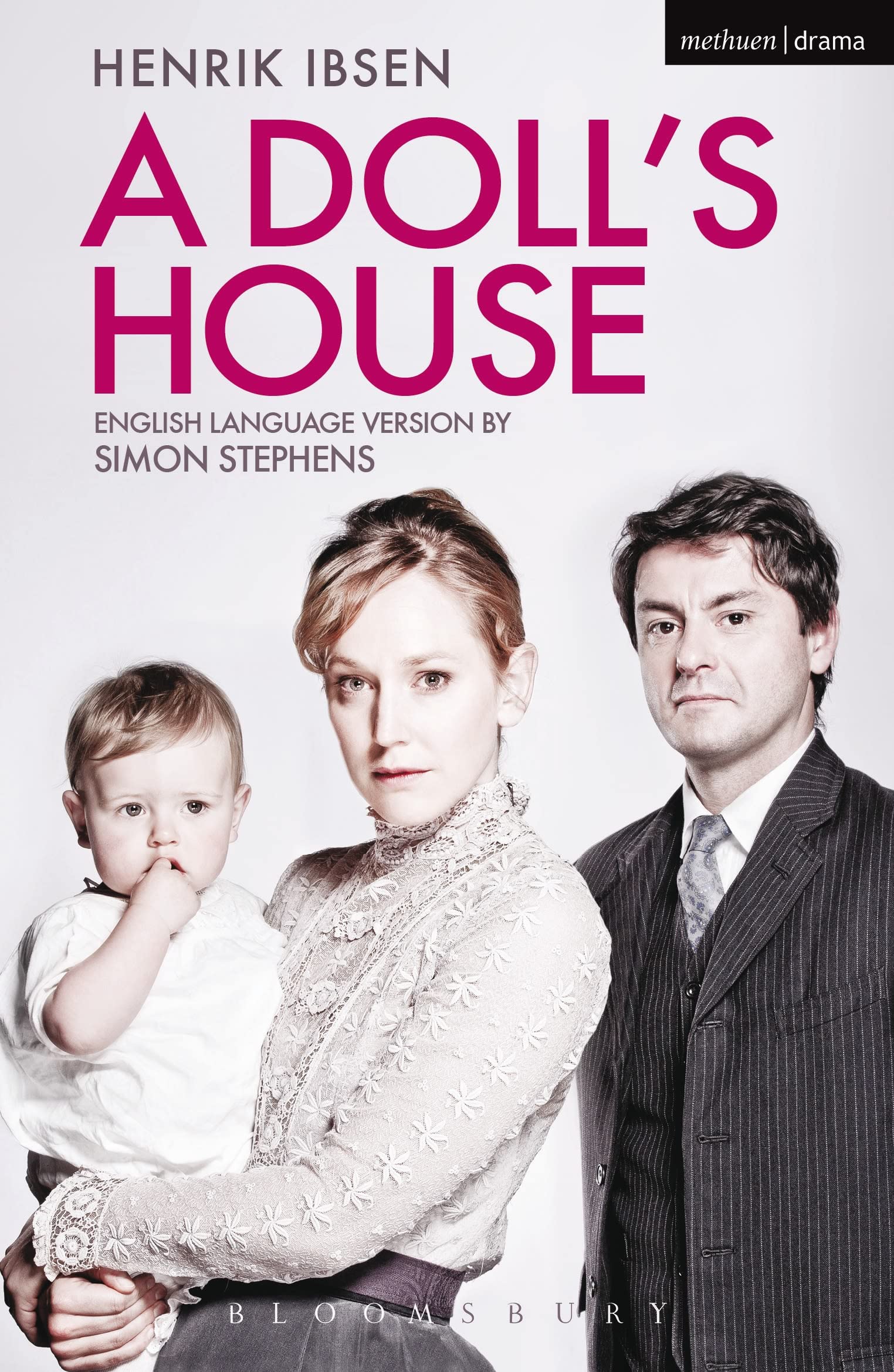



'I think I'm a human being before anything else. I don't care what other people say. I don't care what people write in books. I need to think for myself.' Henrik Ibsen's A Doll's House premiered in 1879 in Copenhagen, the second in a series of realist plays by Ibsen, and immediately provoked controversy with its apparently feminist message and exposure of the hypocrisy of Victorian middle-class marriage. In Ibsen's play, Nora Helmer has secretly (and deceptively) borrowed a large sum of money to pay for her husband, Torvald, to recover from illness on a sabbatical in Italy. Torvald's perception of Nora is of a silly, naive spendthrift, so it is only when the truth begins to emerge, and Torvald appreciates the initiative behind his wife, that unmendable cracks appear in their marriage. This compelling new version of Ibsen's masterpiece by playwright Simon Stephens premiered at the Young Vic Theatre, London, on 29 June 2012. It was updated with minor changes in 2013. “Simon Stephens's agile new version [is] . . . quick and clear and full of subtle touches” ― Susannah Clapp, Guardian “A sensible, sensitive and spirited version . . . that chimes with the debt-laden times we're trapped in and poses still-pressing questions” ― Dominic Cavendish, Telegraph “The supple new version of the text by Simon Stephens is [a] great plus point . . . in this definitive take on a classic” ―Fiona Mountford, Evening Standard “An astute, often savagely funny version by Simon Stephens . . . And as the doll at the play's heart and hearth cracks like porcelain and the woman emerges, it's with a force that's shattering.” ―Sam Marlowe, Metro “Simon Stephens's new English-language version of the text . . . makes the characters' anxieties feel contemporary despite the period dress. "Feminism" may not have been in Ibsen's vocabulary, but he was undoubtedly concerned with the roles we all play and why.” ― Financial Times Henrik Ibsen (1828-1906) has been described as 'the father of modern theatre'. Most of his early plays were traditional historical dramas. After 'Peer Gynt', a fairy-tale fantasy in verse, Ibsen wrote the rest of his plays in prose, and came to be regarded as the great Naturalist dramatist. Simon Stephens began his theatrical career in the literary department of the Royal Court Theatre, where he ran its Young Writers' Programme. His plays for theatre include Bluebird (Royal Court Theatre) Herons (Royal Court Theatre, 2001); Port (Royal Exchange Theatre, Manchester, 2002); One Minute (Crucible Theatre, Sheffield, 2003 and Bush Theatre, London, 2004); Christmas (Bush Theatre, 2004); Country Music (Royal Court Theatre Upstairs, 2004); On the Shore of the Wide World (Royal Exchange Theatre and National Theatre, London, 2005); Motortown (Royal Court Theatre Downstairs, 2006); Pornography (Tricycle Theatre, London, 2009); Harper Regan (National Theatre, 2008); Sea Wall (Bush Theatre, 2009); Heaven (Traverse Theatre, 2009); Punk Rock (Lyric Hammersmith, London, 2009); The Trial of Ubu (Essen Schauspielhaus/Toneelgroep Amsterdam, 2010); A Thousand Stars Explode in the Sky (co-written with David Eldridge and Robert Holman; Lyric Hammersmith, London, 2010); Wastwater (Royal Court Theatre Downstairs, 2011); Morning (Lyric Hammersmith, 2012); an adaptation of A Doll's House ( Young Vic, 2012); an adaptation of The Curious Incident of the Dog in the Night-Time (National Theatre, 2012); Blindsided (Royal Exchange, 2014); and Birdland (Royal Court, 2014). His radio plays include Five Letters Home to Elizabeth (BBC Radio 4, 2001) and Digging (BBC Radio 4, 2003). Awards include the Pearson Award for Best New Play, 2001, for Port ; Olivier Award for Best New Play for On the Shore of the Wide World , 2005; and for Motortown German critics in Theater Heute's annual poll voted him Best Foreign Playwright, 2007. His adaptation of Curious Incident of the Dog in the Night-Time won the 2015 Tony Award for Best Play.