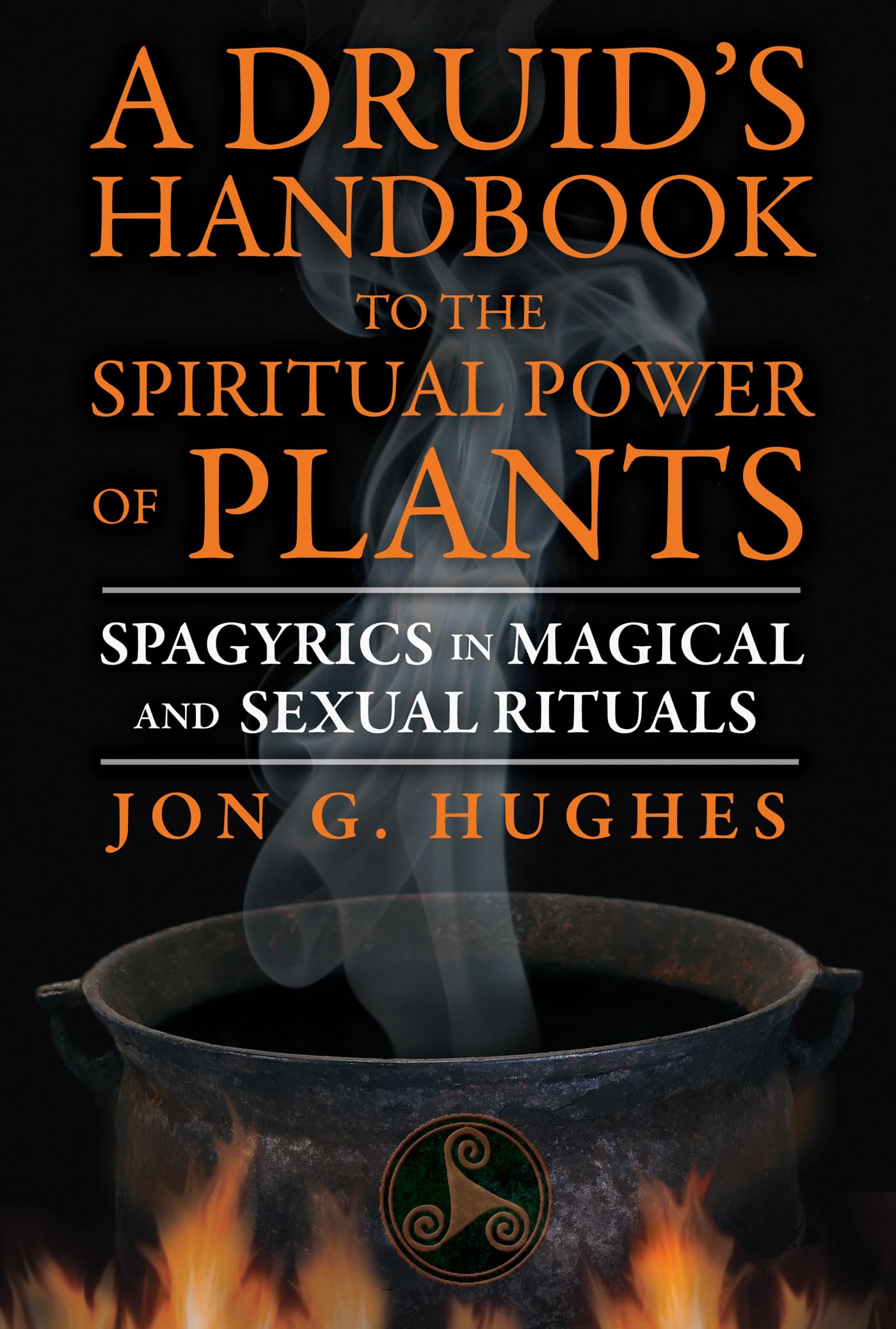
A Druid's Handbook to the Spiritual Power of Plants: Spagyrics in Magical and Sexual Rituals
$12.28
by Jon G. Hughes



A practical guide to creating plant extracts, essences, and complexes for use in Druidic sex magic rituals • Explores the identification, harvesting, and magical properties of more than 70 flowers and trees • Details the careful and meticulous spagyric preparation of plant extracts and complexes • Demonstrates how plant compounds are used in Druidic sex magic rituals by both couples and groups In this practical guide to Druidic plant magic, Jon G. Hughes reveals the gentle alchemy of converting plant essences into potent compounds for working sex magic rituals. Examining the identification, harvesting, and magical properties of more than 70 flowers and trees, he details the careful and meticulous spagyric preparation of plant extracts and complexes as well as the process of obtaining or creating suitable alcoholic spirits for the base of these preparations. He includes instructions to make all necessary tools and explores how to prepare yourself to work with plant essences and properly use the magical compounds you create. Hughes explains how to release the energies, healing attributes, and magical capacities of flowers and trees through the respectful seduction of a plant’s virtue and the 3-step spagyric process of separation, purification, and reunification. He shows how the spagyric process maximizes the power of the acquired essence in preparation for its use in magical ritual. Detailing Druidic sex rituals for both a couple and a group, Hughes demonstrates how plant compounds are used in specific magical rituals and practices as well as the role of the plant complex in sexual potency. Exploring the underlying accord between alchemy and Druidic practices, Hughes provides a valuable manual for anyone wishing to harness the magical potential of plant energy. Jon G. Hughes is part of a lineage of Druids that has been practicing for five generations in a remote area of Wales. He is now teaching the tradition at his home in western Ireland and gives workshops and seminars throughout Europe under his Welsh name of Cynon. He is the director of the Irish Centre for Druidic Practices and the author of Sexual Practices of the Druids . THE TREE The three cardinal essences derived from the tree are refined from the leaves, bark, and wood of the donor plant. It is necessary to harvest these three cardinal components in the correct proportion so that they will each yield the desired amount of cardinal essence for our use. The tree exerts its influence over a much larger area than do the smaller flowering plants. Here follows an account of the harvesting of a branch from the oak tree ( Quercus robur ). This particular oak is growing in a secluded grove deep in the heart of the oldest oak forest in Europe, a place of supreme significance to me. This huge, ancient oak has donated much to the physical and spiritual development of my work. The tree is surrounded by many other oaks, each of which reinforces and strengthens its energies. In the spring, large numbers of bluebells, foxgloves, and primroses grow under the dappled sunlight of its canopy. Because I know this tree intimately, it was not difficult for me to pick out one of its new branches as an ideal candidate for harvesting. Oak branches are best harvested in April and May, when tender new branches appear all over the tree. The oak is a tree of the sun, so I planned my harvesting to take place early in the morning. For the harvesting ritual we need the following materials: Your stave to cast the Protective Circle before harvesting. Your dagger or triple-knotted rope to seal the cast Circle. A sharp knife or pruning shears to cut the branch from the donor tree. Your ritual robe. A suitable wood sealant or natural beeswax to seal the stub of the branch left on the tree after harvesting and the end of the harvested branch. A length of string or natural twine to tie the harvested branch into a loop. A compass. It is essential that you be aware of your orientation as you begin the harvesting ritual. An earth gift. A small token to leave at the harvesting site in return for the plants harvested. I often use the remains of libations or incenses used in previous rituals. A small cloth or working stone cover on which to lay out the ritual tools. Having gathered all my essentials, I soon found my way to the familiar glade and my favorite oak. I had established earlier that the branch I intended to harvest was growing due north out of the northern side of the oak, so I positioned myself and my cache of tools to the south of the tree, facing the tree and the north. I changed into my ritual robe and, facing the tree with both my hands on the head of my stave, I adopted the power position of the inverted pyramid stance. Having raised my sensory awareness to a level where I felt prepared for the task ahead, I held the stave in both hands, lifted it high above my head, and began the ritual with the opening words o