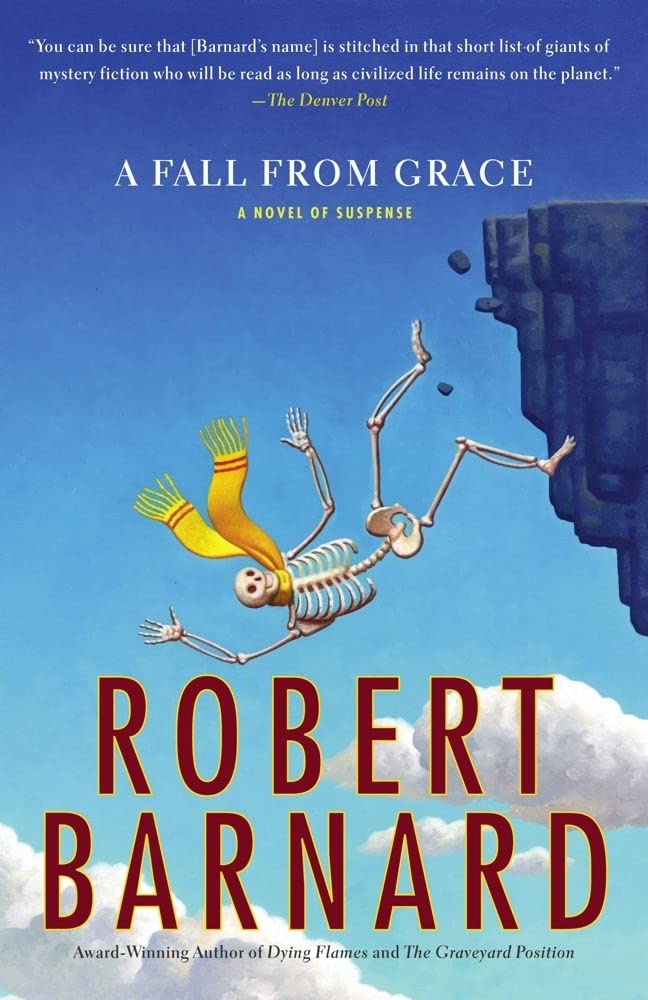



From Robert Barnard, the internationally acclaimed Diamond Dagger-winning crime writer . . . With A Fall from Grace , Robert Barnard triumphs once again with a witty tale of family discord and murder. Detective Inspector Charlie Peace and his wife, Felicity, are shocked when Felicity's difficult dad, Rupert Coggenhoe, suddenly announces that he's moving north to their Yorkshire village. Felicity has never much liked her father, and to have him as a near-neighbor fills her with foreboding. The boorish old man has always loved to impress the ladies, young and old, by exaggerating his modest success as a novelist. True to form, soon after his move to Slepton Edge he surrounds himself with adoring females, including a precocious, theatrical teenager named Anne Michaels. Rupert and Anne could make a lethal combination. Rumors fly, but Felicity convinces herself that Rupert would do nothing seriously wrong. He can be annoying and outrageous but he's not a criminal. She relies on a friend, a doctor who seems to be strangely aware of everything that's happening in the community, to warn her if he hears of anything really troubling. She doesn't have long to wait, but the news is not what she expects. It's worse. A body has been found and it looks like murder. Stunned by a difficult reality, Felicity is even more shocked to discover that she, herself, may be a suspect. This is one criminal investigation that's much too close to home for Charlie Peace. He's not officially on the case, but he uses his copper's instincts and a husband's heart to find a killer and to discover anew the meaning of family. Praised for his "perfect pitch, exquisite pacing, and meticulous plotting" (Marilyn Stasio, The New York Times ), Robert Barnard proves yet again that he is one of the great masters of mystery. *Starred Review* Barnard, who has won just about every mystery award there is, including the Malice Domestic Lifetime Achievement Award and the Cartier Diamond Dagger Award, never falls from grace. His writing (in almost 40 novels to date) is always stiletto sharp, his observations darkly witty, his plotting perniciously surprising. In his latest, Leeds cop Charlie Peace (who goes back to The Bad Samaritan, 1995) is a newly made inspector, relocating with his wife to the village of Slepton Edge, a move somewhat darkened by the parallel move of Peace's detested father-in-law to a house nearby. Barnard takes full advantage of village atmosphere, with characters revealing secrets about themselves and others in the local pub. Peace and his wife, Felicity, learn that her father had to leave his former village hurriedly, after he struck a young woman. And now the old man is hitting on a teenage girl. Before the Peaces have a chance to figure out how to protect her, the old man is found dead at the bottom of a quarry. Suspects abound, including a clutch of murderous children and Felicity herself. Peace moves into full detective mode with a murder on his doorstep and his wife a prime suspect. This very satisfying riff on the traditional village mystery finds Barnard at the top of his game. Connie Fletcher Copyright © American Library Association. All rights reserved Robert Barnard (1936–2013) was awarded the Agatha Award for Lifetime Achievement, the Nero Wolfe Award, and the Macavity Award. An eight-time Edgar nominee, he was a member of Britain’s distinguished Detection Club, and in May 2003, he received the Cartier Diamond Dagger for lifetime achievement in mystery writing. CHAPTER 1 Prospecting Charlie Peace came out of the door of Blackett and Podmore, the estate agents, holding a sheaf of property descriptions. He slipped into his car, parked on the edge of the little square in the center of the village, and began to riffle through them. Ten minutes later he got on the mobile to his wife. "Well, there seem to be several houses here that might suit, going by the descriptions." "You can't," said Felicity. "I know. There are lies, damned lies and estate agents' brochures," he said. "Trouble is, you only get to plumb the depths of their deceptions when you've actually lived in the places they've sold for a few months." "And it doesn't help that we're looking for two places rather than just one." Driving off on a circuit of inspections of exteriors mapped out for him by the maligned estate agents, Charlie echoed Felicity's words. His attaining the rank of inspector some months earlier had coincided with a proposal from his father-in-law, who, on the first hint that the new job might enable Charlie and Felicity to move out of Leeds, had decided that he needed to move in with or close to them. "Close to," Charlie had said firmly. "Not in with." "Not on your life," Felicity had agreed. "I'm not going to be his dogsbody." She knew her father through and through, of course. Rupert Coggenhoe had used people (notably his wife) throughout his life, and Felicity knew that old age would not chang