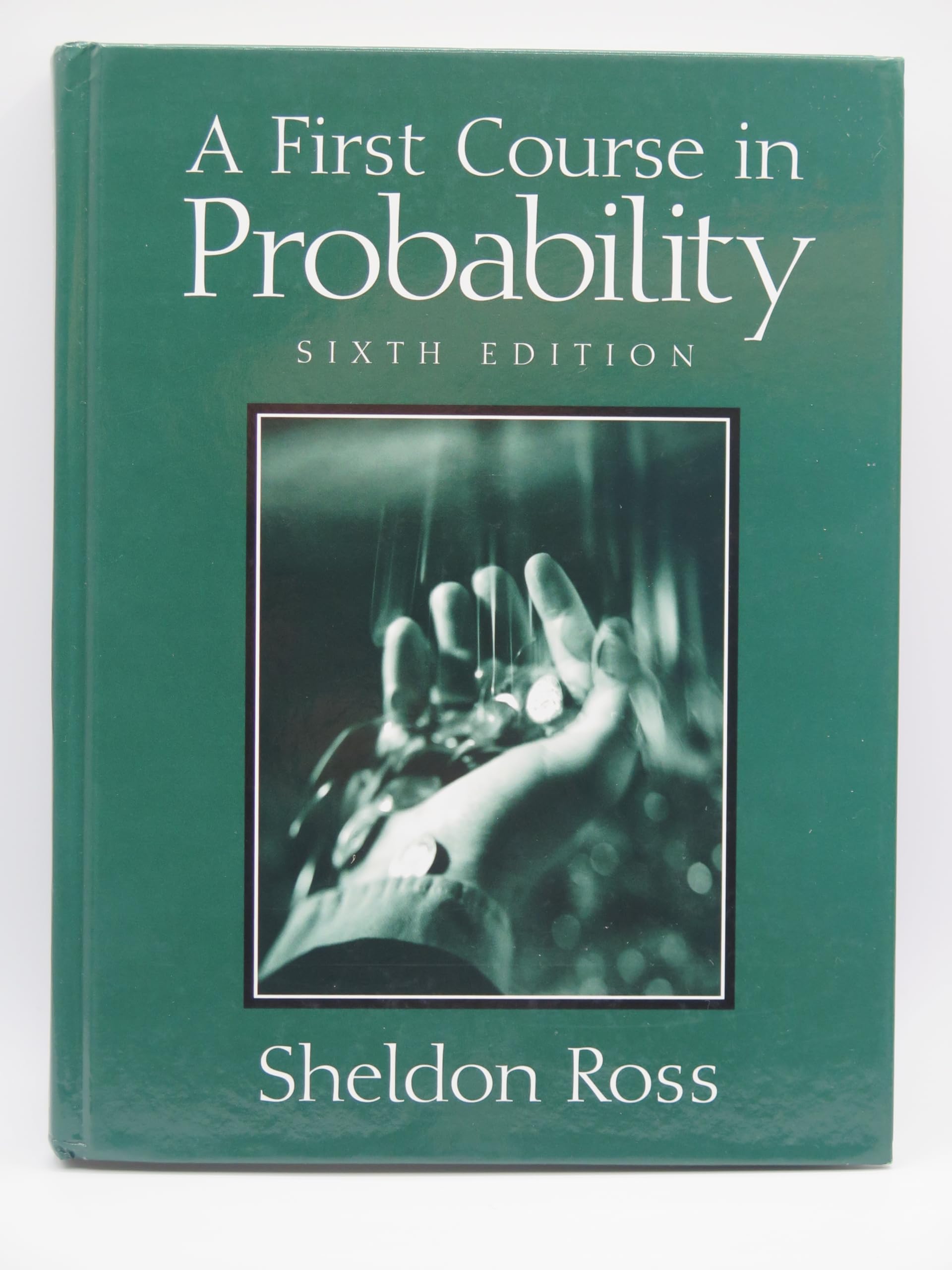



This market-leading introduction to probability features exceptionally clear explanations of the mathematics of probability theory and explores its many diverse applications through numerous interesting and motivational examples. The outstanding problem sets are a hallmark feature of this book. Provides clear, complete explanations to fully explain mathematical concepts. Features subsections on the probabilistic method and the maximum-minimums identity. Includes many new examples relating to DNA matching, utility, finance, and applications of the probabilistic method. Features an intuitive treatment of probabilityintuitive explanations follow many examples. The Probability Models Disk included with each copy of the book, contains six probability models that are referenced in the book and allow readers to quickly and easily perform calculations and simulations. This market-leading introduction to probability features exceptionally clear explanations of the mathematics of probability theory and explores its many diverse applications through numerous interesting and motivational examples. The outstanding problem sets are a hallmark feature of this book. Provides clear, complete explanations to fully explain mathematical concepts. Features subsections on the probabilistic method and the maximum-minimums identity. Includes many new examples relating to DNA matching, utility, finance, and applications of the probabilistic method. Features an intuitive treatment of probabilityintuitive explanations follow many examples. The Probability Models Disk included with each copy of the book, contains six probability models that are referenced in the book and allow readers to quickly and easily perform calculations and simulations. "We see that the theory of probability is at bottom only common sense reduced to calculation; it makes us appreciate with exactitude what reasonable minds feel by a sort of instinct, often without being able to account for it .... It is remarkable that this science, which originated in the consideration of games of chance, should have become the most important object of human knowledge .... The most important questions of life are, for the most part, really only problems of probability." So said the famous French mathematician and astronomer (the "Newton of France") Pierre Simon, Marquis de Laplace. Although many people might feel that the famous marquis, who was also one of the great contributors to the development of probability, might have exaggerated somewhat, it is nevertheless true that probability theory has become a tool of fundamental importance to nearly all scientists, engineers, medical practitioners, jurists, and industrialists. In fact, the enlightened individual had learned to ask not "Is it so?" but rather "What is the probability that it is so?" This book is intended as an elementary introduction to the theory of probability for students in mathematics, statistics, engineering, and the sciences (including computer science, the social sciences and management science) who possess the prerequisite knowledge of elementary calculus. It attempts to present not only the mathematics of probability theory, but also, through numerous examples, the many diverse possible applications of this subject. In Chapter 1 we present the basic principles of combinatorial analysis, which are most useful in computing probabilities. In Chapter 2 we consider the axioms of probability theory and show how they can be applied to compute various probabilities of interest. Chapter 3 deals with the extremely important subjects of conditional probability and independence of events. By a series of examples we illustrate how conditional probabilities come into play not only when some partial information is available, but also as a tool to enable us to compute probabilities more easily, even when no partial information is present. This extremely important technique of obtaining probabilities by "conditioning" reappears in Chapter 7, where we use it to obtain expectations. In Chapters 4, 5, and 6 we introduce the concept of random variables. Discrete random variables are dealt with in Chapter 4, continuous random variables in Chapter 5, and jointly distributed random variables in Chapter 6. The important concepts of the expected value and the variance of a random variable are introduced in Chapters 4 and 5: These quantities are then determined for many of the common types of random variables. Additional properties of the expected value are considered in Chapter 7. Many examples illustrating the usefulness of the result that the expected value of a sum of random variables is equal to the sum of their expected values are presented. Sections on conditional expectation, including its use in prediction, and moment generating functions are contained in this chapter. In addition, the final section introduces the multi-variate normal distribution and presents a simple proof concerning the joint distributio