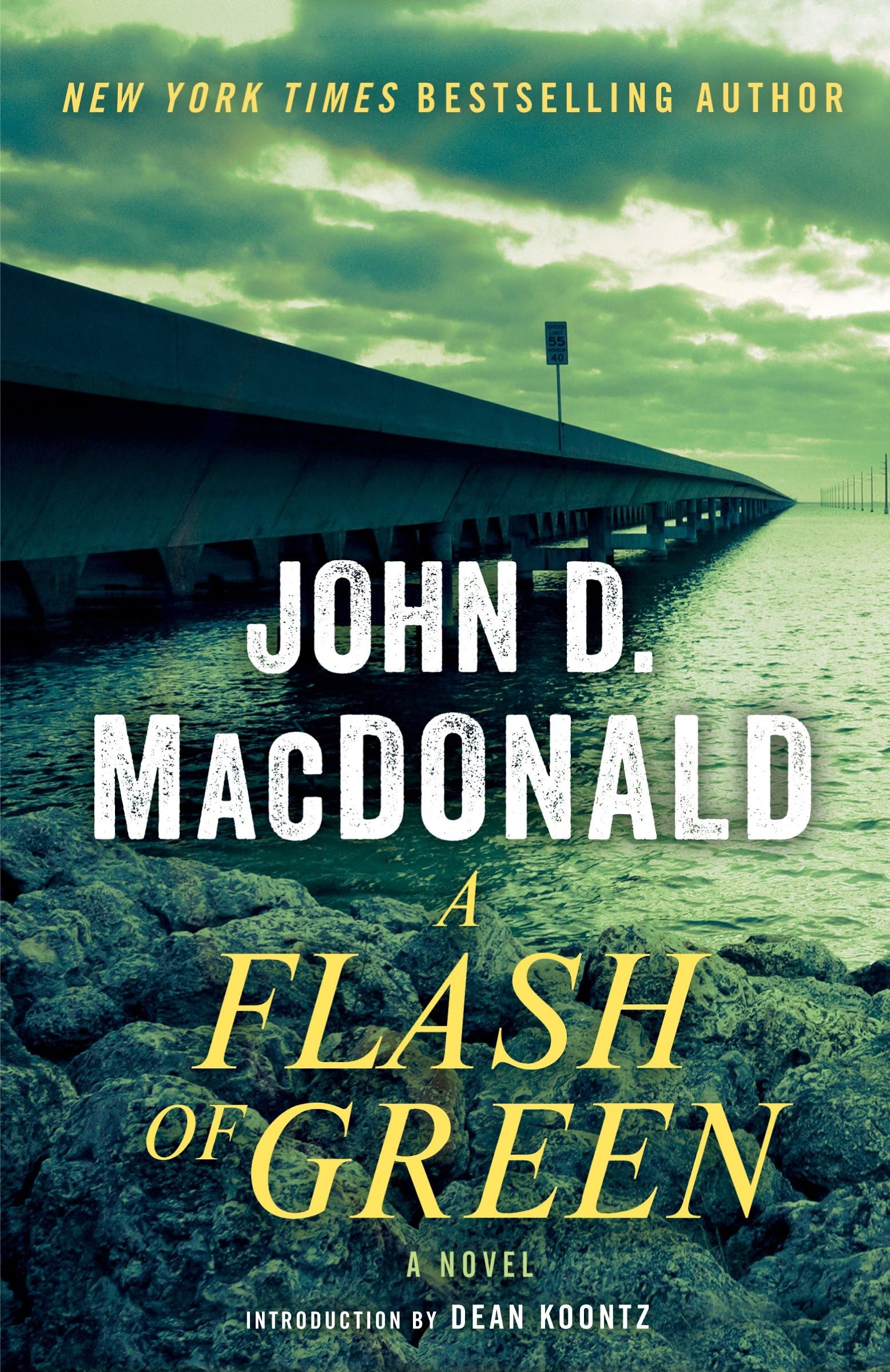



A Flash of Green tells the gripping story of small-town corruption and two people brave enough to fight back, featuring many of the themes John D. MacDonald explored better than anyone in his legendary career as a leading crime novelist. Introduction by Dean Koontz The opportunists have taken over Palm City. Silent and deadly, like the snakes that infest the nearby swamps, they lay hidden from view, waiting for the right moment to strike. Political subterfuge has already eased the residents toward selling out. All that’s left now is to silence a few stubborn holdouts. James Wing is only trying to help a friend’s widow. At least that’s what he tells himself after warning Kat Hubble that the beautiful bay she and her neighbors have struggled to save is going to be sold to developers. He knows that he shouldn’t have told her anything. He’s a reporter, trained to reveal nothing. But he’s falling in love with her. Now cutthroats have set their sights on Kat—and they’ll do anything, use anyone, to stop her from interfering in their plans. Praise for John D. MacDonald “John D. MacDonald was the great entertainer of our age, and a mesmerizing storyteller.” —Stephen King “The first modern writer to nail Florida dead-center, to capture all its languid sleaze, racy sense of promise, and breath-grabbing beauty.” —Carl Hiaasen “To diggers a thousand years from now, the works of John D. MacDonald would be a treasure on the order of the tomb of Tutankhamen.” —Kurt Vonnegut Praise for John D. MacDonald “ The great entertainer of our age, and a mesmerizing storyteller.” —Stephen King “My favorite novelist of all time . . . All I ever wanted was to touch readers as powerfully as John D. MacDonald touched me. No price could be placed on the enormous pleasure that his books have given me. He captured the mood and the spirit of his times more accurately, more hauntingly, than any ‘literature’ writer—yet managed always to tell a thunderingly good, intensely suspenseful tale.” —Dean Koontz “To diggers a thousand years from now, the works of John D. MacDonald would be a treasure on the order of the tomb of Tutankhamen.” —Kurt Vonnegut “A master storyteller, a masterful suspense writer . . . John D. MacDonald is a shining example for all of us in the field. Talk about the best .” —Mary Higgins Clark “The consummate pro, a master storyteller and witty observer . . . John D. MacDonald created a staggering quantity of wonderful books, each rich with characterization, suspense, and an almost intoxicating sense of place.” —Jonathan Kellerman “There’s only one thing as good as reading a John D. MacDonald novel: reading it again. A writer way ahead of his time, he is the all-time master of the American mystery novel.” —John Saul John D. MacDonald was an American novelist and short-story writer. His works include the Travis McGee series and the novel The Executioners, which was adapted into the film Cape Fear . In 1962 MacDonald was named a Grand Master of the Mystery Writers of America; in 1980, he won a National Book Award. In print he delighted in smashing the bad guys, deflating the pompous, and exposing the venal. In life, he was a truly empathetic man; his friends, family, and colleagues found him to be loyal, generous, and practical. In business, he was fastidiously ethical. About being a writer, he once expressed with gleeful astonishment, “They pay me to do this! They don’t realize, I would pay them.” He spent the later part of his life in Florida with his wife and son. He died in 1986. One When she heard the rattle of the old tin wheelbarrow, Kat Hubble knew it was after four. On Tuesdays, after he had finished up at the Lessers’, and on Fridays, when he was through at the Cable home, Barnett Mayberry would do one extra hour of yard work at her house before getting into his stuttering old car and driving back home to Pigeon Town, the Negro community on the far side of Palm City. Before Van had been killed, Barnett had come one full day a week, and though now it added up to only one quarter of the time, he seemed to keep the place looking as neat as ever, though of course she had begun no new landscape projects in this past year, and she did more of the work herself. The arrangement with Barnett had just seemed to happen. Beginning the week after the funeral, he had stopped by to take care of things which obviously needed attention, such as clipping the side hedge of Australian pine, and she had given him a dollar for each after-work hour. In some mysterious way it had become a routine. It so exactly fitted her diminished purse and her needs that she could not help suspecting it was not entirely satisfactory to Barnett, that he had entrapped himself through some murky idea of loyalty and pride in past projects. Yet when she had at last taxed him with it, he had looked rigidly beyond her and shuffled his feet and said, “I got a place for them dollahs, Miz Hubble. It working o