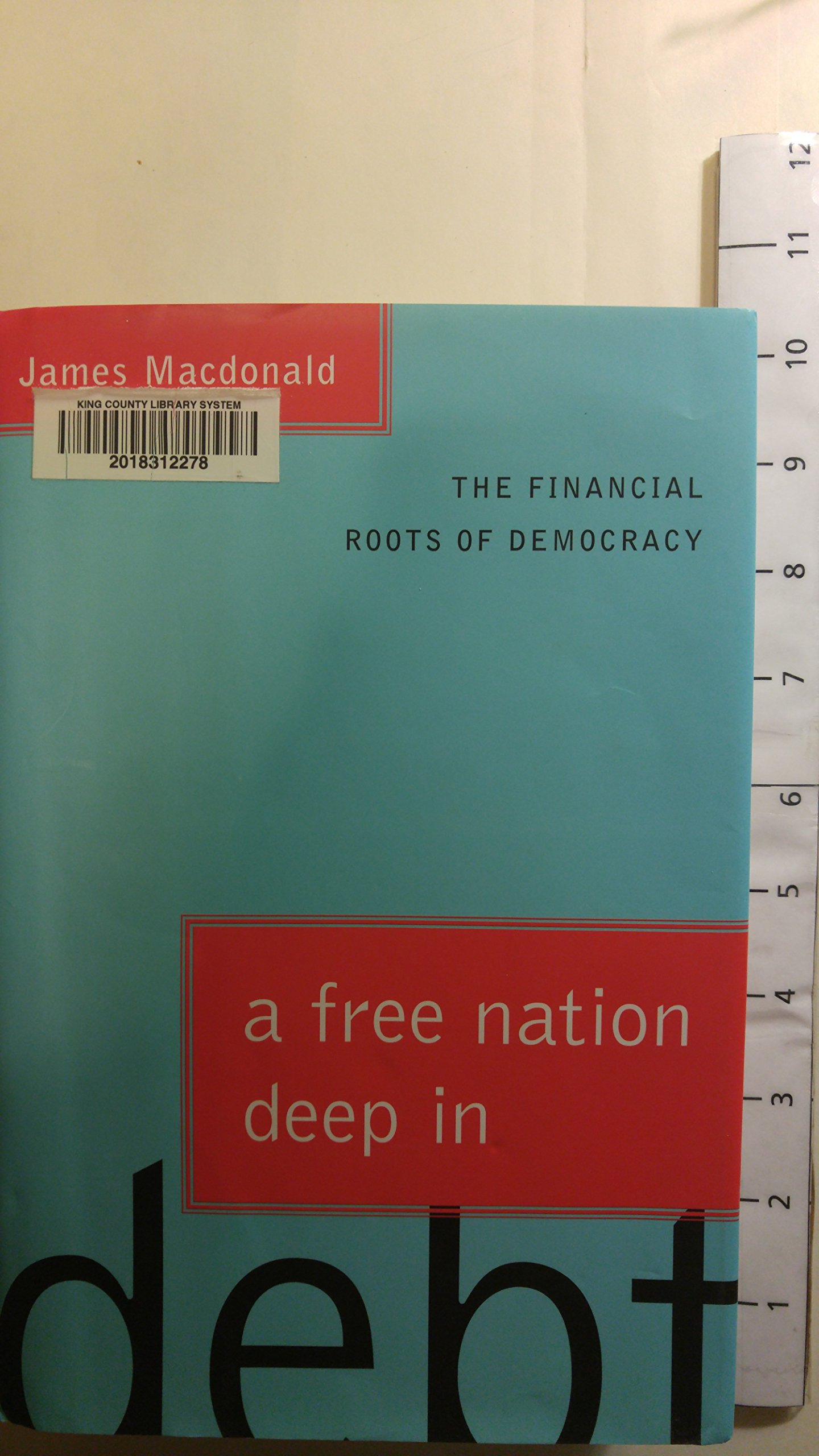



Nowadays, the idea that the way a country borrows its money is connected to what kind of government it has comes as a surprise to most people. But in the eighteenth century it was commonly accepted that public debt and political liberty were intimately related. In A Free Nation Deep in Debt , James Macdonald explores the connection between public debt and democracy in the broadest possible terms. He starts with some fundamental questions: Why do governments borrow? How do we explain the existence of democratic institutions in the ancient world? Why did bond markets come into existence, and why did this occur in Europe and not elsewhere? Macdonald finds the answers to these questions in a sweeping history that begins in biblical times, focuses on the key period of the eighteenth century, and continues down to the present. He ranges the world, from Mesopotamia to China to France to the United States, and finds evidence for the marriage of democracy and public credit from its earliest glimmerings to its swan song in the bond drives of World War II. Today the two are, it seems, divorced--but understanding their hundreds of years of cohabitation is crucial to appreciating the democracy that we now take for granted. MacDonald, a former investment banker, examines the historical linkage between political freedom and public debt, showing why representative governments have been able to borrow more cheaply from citizen lenders than autocratic heads of state who do not consider their citizens to be equals. Beginning at the end of the Bronze Age, this wide-ranging, comprehensive treatise traces the story of public finance and political freedom through the Napoleonic Wars to the twentieth century. We learn that the U.S. role in World War I was funded with public debt and, it is interesting to note, that World War II was the last major engagement in which savings bonds were a vital part of national security and the war effort. The mature bond markets of today have a global reach, and governments no longer depend upon citizen lenders. Even when considering the hard facts of money and credit markets--and their political implications--the author emphasizes the relationship between the state and its people, in this well-considered work. Mary Whaley Copyright © American Library Association. All rights reserved "Chief Justice John Marshall observed that the power to tax involves the power to destroy. James Macdonald argues that the power to borrow is the key to democracy. This startling and original book traces the evolution of public debt from the Bronze Age to our own and in clear, lucid prose shows that successful state finances have been both a cause and an effect of the emergence of democratic forms. This is a truly unusual work written by somebody who combines financial expertise and historical imagination." --Jonathan Steinberg, University of Pennsylvania "Macdonald's wide-ranging exploration of representative political institutions and the ability of states to borrow, survive, and prosper is history at its best. Political liberty, sound public financial policies, and well-functioning securities markets nurture one another, but across human history all three have been hardly gained, easily lost, and therefore rare. It is a deep insight, one that all who cherish freedom should understand and heed." --Richard Sylla, Henry Kaufman Professor of the History of Financial Institutions and Markets, Stern School of Business, New York University "A profound and original work of historical scholarship . . . Macdonald has something exciting to teach." --Niall Ferguson, author of The Cash Nexus James Macdonald was for many years an investment banker. This is his first book. He lives in Oxford, England.