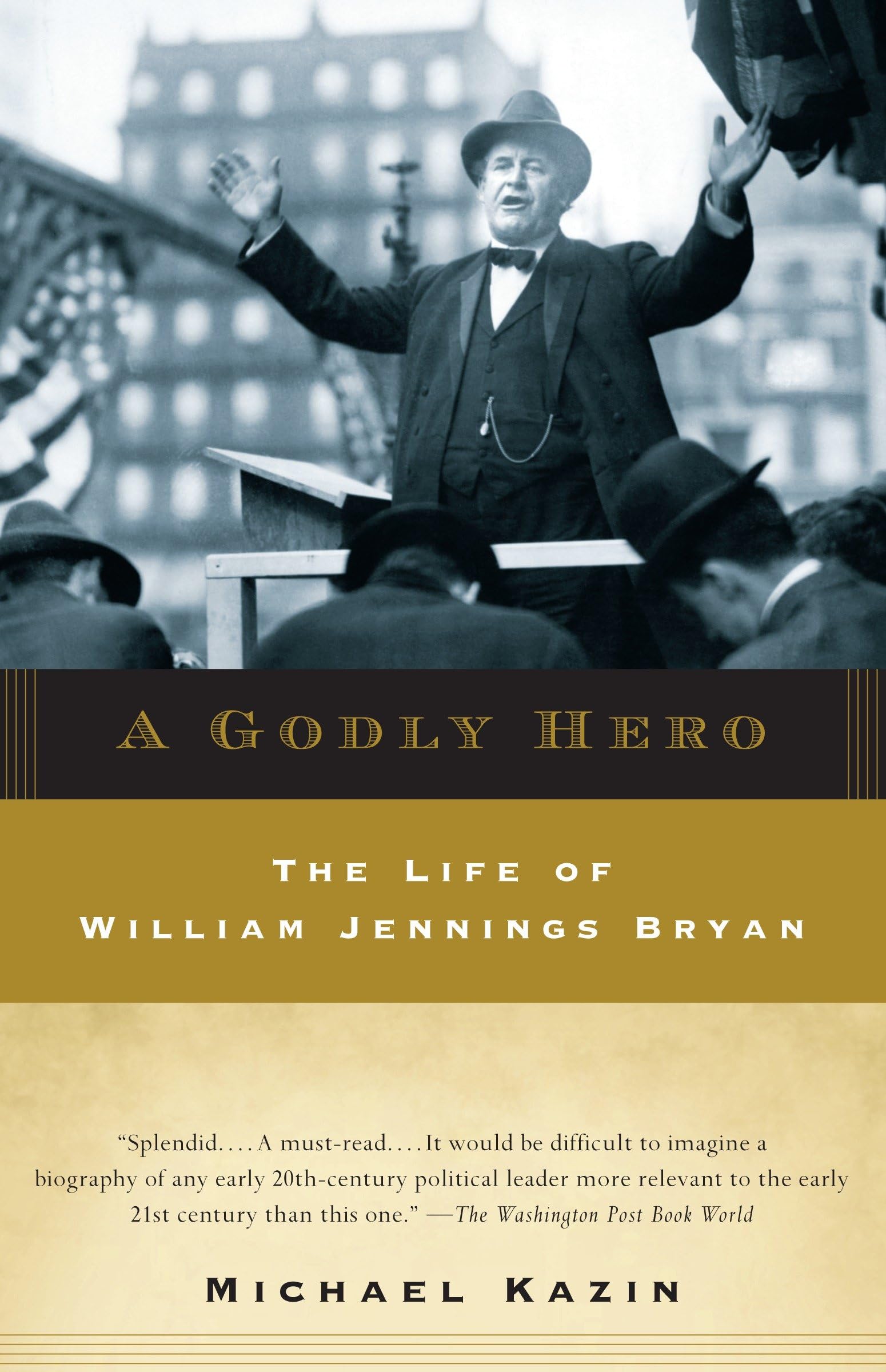



ONE OF THE BEST BOOKS OF THE YEAR: THE WASHINGTON POST, CHICAGO TRIBUNE, LOS ANGELES TIMES, ST. LOUIS POST-DISPATCH. Politician, evangelist, and reformer William Jennings Bryan was the most popular public speaker of his time. In this acclaimed biography—the first major reconsideration of Bryan’s life in forty years–award-winning historian Michael Kazin illuminates his astonishing career and the richly diverse and volatile landscape of religion and politics in which he rose to fame. Kazin vividly re-creates Bryan’s tremendous appeal, showing how he won a passionate following among both rural and urban Americans, who saw in him not only the practical vision of a reform politician but also the righteousness of a pastor. Bryan did more than anyone to transform the Democratic Party from a bulwark of laissez-faire to the citadel of liberalism we identify with Franklin D. Roosevelt. In 1896, 1900, and 1908, Bryan was nominated for president, and though he fell short each time, his legacy–a subject of great debate after his death–remains monumental. This nuanced and brilliantly crafted portrait restores Bryan to an esteemed place in American history. “A powerful, timely re-evaluation.” — The New Yorker “Splendid. . . . A must-read. . . . It would be difficult to imagine a biography of any early 20th-century political leader more relevant to the early 21st century than this one.” — The Washington Post Book World “A superb biography and a challenging reconsideration of Bryan’s place in U.S. political history.” — Los Angeles Times Book Review “Instructive, illuminating–engagingly written. . . . Bryan emerges from Kazin's new biography as the founding father of the modern Democratic Party and maybe even of modern American politics.” — The Boston Globe MICHAEL KAZIN is professor of history at Georgetown University. The author of three previous books about American history-- America Divided , The Populist Persuasion , and Barons of Labor -he is a frequent contributor to The New York Times , The Washington Post , The Nation , and The American Prospect and the recipient of fellowships from the Guggenheim Foundation, the National Endowment for the Humanities, the Woodrow Wilson Center, and the Fulbright Scholar Program. He lives in Chevy Chase, Maryland. Education of a Hero, 1860–1890 He borrows from the philosopher his principles, from the poet his language, from the warrior his courage, and mingling with these his own enthusiasms, leads his hearers according to his will. —William Jennings Bryan on oratory, 1877 Salem may never be more than a pleasant stop along the interstate highway that slices through the verdant prairie of south-central Illinois. Stretched out beyond the sign listing a population of eight thousand is the usual array of chain hotels and restaurants, gaudy gas stations and car washes, and tiny convenience stores. An imposing new Caterpillar rental and repair place suggests that the local economy is thriving, while twenty-six local churches compete to fill a set of loftier needs. Yet one can stroll down the main street of Salem in the middle of a weekday in summer without encountering more than a handful of residents. The nearest movie theater is down in Centralia, sixteen miles away. A different fate seemed possible in the 1850s, when Silas Bryan moved to town. The Ohio and Mississippi Railroad had just run tracks down Main Street, which made it possible to reach St. Louis in only ninety minutes—the same time it takes to drive the distance today. A Methodist women’s college with two faculty members had recently opened its doors, and freshly built churches dotted the dirt streets of the newly incorporated town, the seat of Marion County. A few miles outside town, there lay ample deposits of bituminous coal, and three flour mills were unable to keep up with the demand of a growing population. “Salem is rapidly improving,” boasted the local weekly in 1854, “and its elements of wealth and prosperity are now being rapidly developed.” Soon it would be “a commanding point . . . where industry, sobriety, and honesty will surely thrive; where good health may be found, where long life may be enjoyed and where all the concomitants of competence and oppulence [sic] are inevitable.” Silas Bryan’s own ambitions dovetailed with those of his town. He was born in 1822, the eighth child of a farm family from Point Pleasant, a village that then lay inside Virginia’s western border with Ohio. At the age of eighteen, he left a crowded log cabin to move westward in search of an education and, perhaps, a fortune. Harvesting crops and chopping wood, he slowly amassed enough credits to graduate, at the age of twenty-seven, from McKendree College, a Baptist institution in southern Illinois. He then followed a career path common to educated men in rural America during the middle of the nineteenth century: a few years of teaching school followed by reading law books and passing a bar