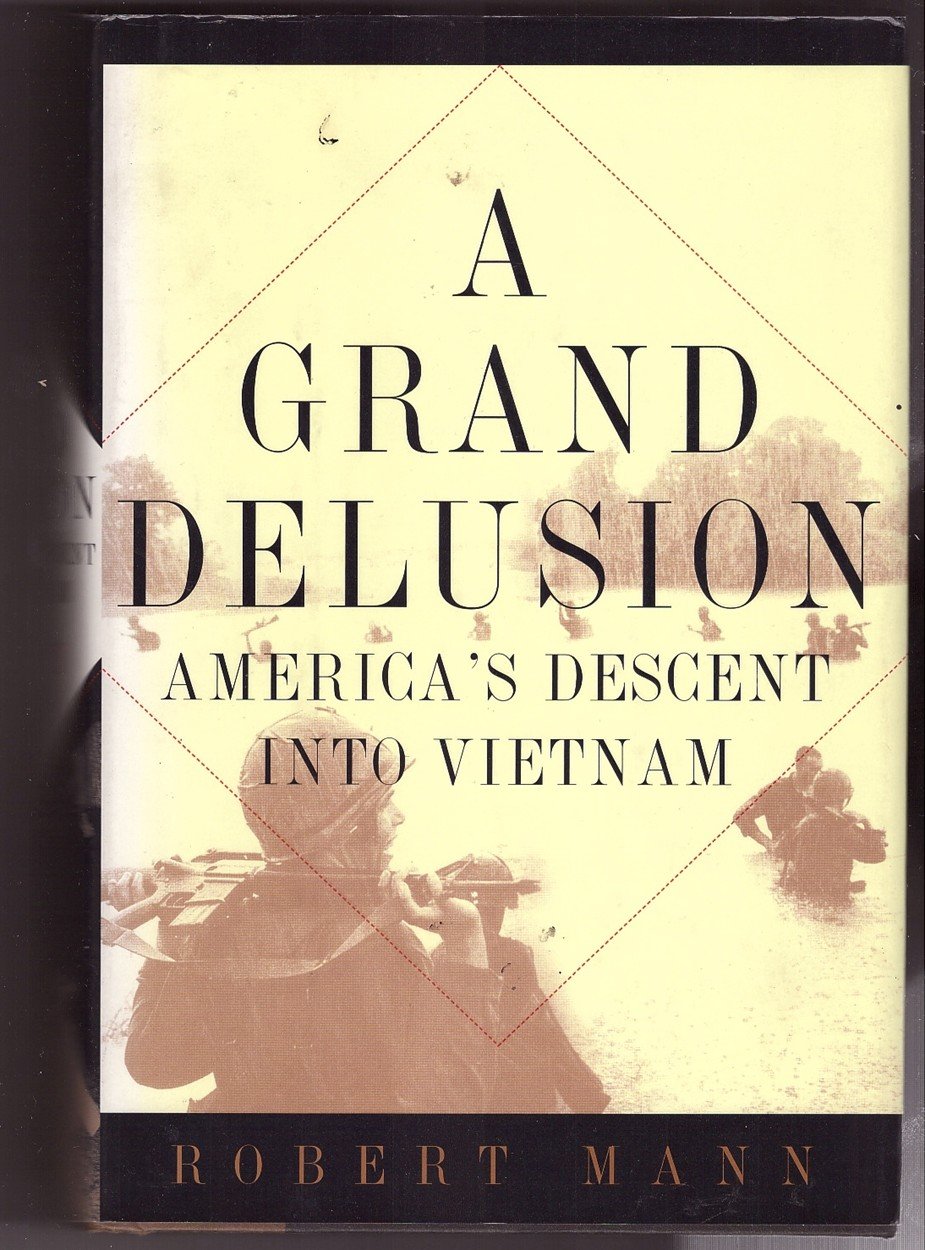



A Grand Delusion is the first comprehensive single-volume American political history of the Vietnam War. Spanning the years 1945 to 1975, it is the definitive story of the well-meaning but often misguided American political leaders whose unquestioning adherence to Cold War dogma led the nation into its tragic misadventure in Vietnam. At the center of this narrative are seven such men-Dwight Eisenhower, John F. Kennedy, Lyndon Johnson, Richard Nixon, J. William Fulbright, Mike Mansfield, and George McGovern. During their careers, each occupied center-stage in the nation's debate over Vietnam policy.Mann focuses in particular on the role played by leading members of Congress, including senators' Mansfield and Kennedy's shaping of American policy toward Vietnam in the 1950s; Congress's acquiescence in the 1950s to the Eisenhower administration's support of the American-backed Diem government; and the blank check that Congress gave to Lyndon Johnson with the 1964 Gulf of Tonkin resolution.Mann considers as well the evolution of opposition to the war, including pivotal hearings conducted by the Senate Foreign Relations Committee from 1966 to 1968; the small band of war opponents led by senators Fulbright, McGovern, and Wayne Morse; Mansfield's quiet-but-persistent lobbying campaign to dissuade his friend Lyndon Johnson from escalating the war in 1965; the bitter political feud that erupted between Fulbright and Johnson-erstwhile friends-over the war; McGovern and Hatfield's determined effort to force Richard Nixon to withdraw American forces from Vietnam; and Congress's assertion of its Constitutional role in war making in the early 1970s, culminating in the passage of the War Powers resolution in 1973.In addition to being a piercing analysis of the political currents that resulted in and eventually ended the war, A Grand Delusion is an epic tragedy filled with fascinating characters and a keen reflection on the antagonisms and beliefs that divided the nation during those tumultuous years. Political biographer Robert Mann minces no words when he characterizes America's "ill-advised military foray into Vietnam" as a sequence of delusions. America's citizens and lower-echelon political leadership, he writes, were deluded about the nature of the communist threat to Southeast Asia, which was less an expression of some grand design on the part of Moscow and Beijing than one of nationalist resistance to colonialism. Several presidents were deluded about the effects of their policies in Vietnam and the prospects for military success. Lyndon Johnson and Richard Nixon deluded voters into believing that peace was close at hand, while the death toll mounted under their management of the war. Vietnam, Mann suggests, was never vital to U.S. national security, as five presidents once insisted. Political from the outset, the war resisted the military solution those leaders promised. And it nearly resulted in a civil war at home, which, Mann writes, yielded a pervasive distrust of the government at all levels of society. "The Vietnam War," he concludes, "should be remembered as the kind of tragedy that can result when presidents--captivated by their grand delusions--enforce their foreign and military policies without the informed support of Congress and the American people." Mann's book, a useful adjunct to such standard texts as Stanley Karnow's Vietnam: A History and A.J. Langguth's recent Our Vietnam , joins the history of the war in Vietnam to the conduct of the cold war at large. Controversial and provocative, it promises to find many readers. --Gregory McNamee Recent volumes suggest that America's lengthy involvement in the Vietnam War was the necessary cathartic event that allowed the Cold War to be abandoned at last. While not elucidating that thesis, this book reinforces it with its involved rendition of the collision of personalities throughout the White House, Congress, and elsewhere during that era. Mann's history concentrates on seven American leaders in the halls of power rather than on the battlefield, a subject that has been thoroughly covered elsewhere. A former press secretary to two U.S. senators, Mann has the perspective of a generation not closely associated with the events, so his approach can be analytical, lacking the emotional component that has kept us from examining our actions dispassionately in the first place. At times, his excellent description of the war's political evolution reads like an unlikely novel. Here is Mike Mansfield, senator and Asian political expert, whose eventual opposition to the war was discounted because at first he was a proponent of military intervention, and Lyndon Johnson, whose forceful personality kept him from listening to the very people whom he first believed when they eventually grew disenchanted with his policies. This is a gripping tale, well told and voluminously documented, with the 1960s and 1970s as a volatile background. A good complement to A.J. Langgut