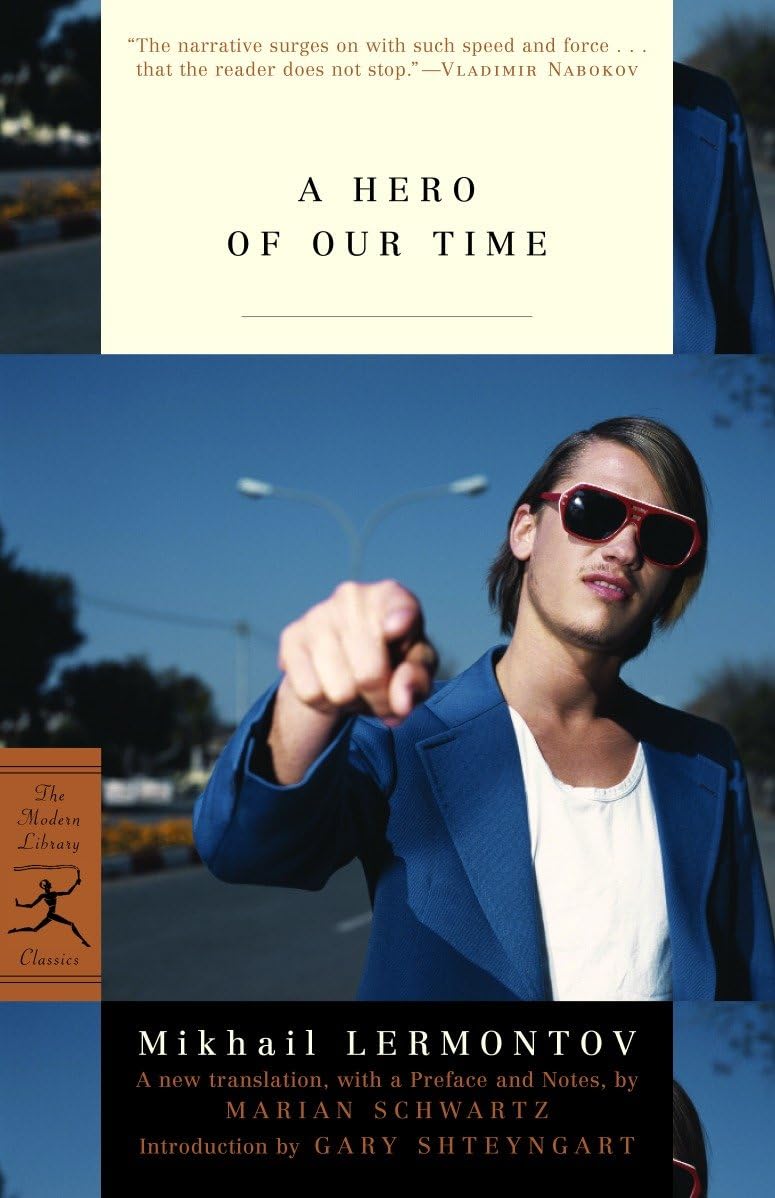



In its adventurous happenings–its abductions, duels, and sexual intrigues– A Hero of Our Time looks backward to the tales of Sir Walter Scott and Lord Byron, so beloved by Russian society in the 1820s and ’30s. In the character of its protagonist, Pechorin–the archetypal Russian antihero–Lermontov’s novel looks forward to the subsequent glories of a Russian literature that it helped, in great measure, to make possible. "It's high time an up-to-date and idiomatic version of A Hero of Our Time was made available to American readers. Marion Schwartz's translation of Lermontov's classic adventure novel captures all the suppleness and wit of Lermontov's prose, the fine texture of his descriptions and the galloping rhythm of his narrative passages. This is a fine addition to the Modern Library." -- Michael Scammell “Military life in the Caucasus, bandits, duels, romance--at the hands of a passionate adventurer with "a restless imagination, an insatiable heart. That is Pechorin, and also Lermontov. If you have a personal all-time bestseller list, make room for A Hero of our Time . “-- Alan Furst "In Russia Mikhail Lermontov is considered one of the greatest writers of the nineteenth century. Marian Schwarz's compelling translation shows us why." -- Peter Constantine Introduction by Timothy Binyon Translated by Vladimir and Dmitri Nabokov From the Hardcover edition. Introduction by Timothy Binyon Translated by Vladimir and Dmitri Nabokov "From the Hardcover edition. MIKHAIL LERMONTOV was born in Moscow in 1814. Influential as a poet, novelist, and visual artist, Lermontov died in 1941 at the age of 26. VLADIMIR NABOKOV was born in St. Petersburg, Russia, in 1899. After studying French and Russian literature at Trinity College, Cambridge, he launched his literary career in Berlin and Paris. In 1940 he moved to the United States, here he achieved renown as a novelist, poet, critic, and translator. Lolita, arguably his most famous novel, was first published, by the Olympia Press, Paris, on September 15, 1955, and became a controversial success. Nabokov died in Montreux Switzerland in 1977. I BELA I was traveling post from Tiflis. My cart's entire load consisted of one small valise, which was half filled with travel notes about Georgia. Of these, the greater part, fortunately for you, have been lost, and the valise containing my remaining possessions, fortunately for me, is intact. The sun was already beginning to drop behind the snowy ridge when I rode into the Koyshaur Valley. The driver, an Ossetian, drove the horses tirelessly in order to make it up Koyshaur Mountain by nightfall, singing songs at the top of his voice. A glorious spot, this valley! On every side of the mountain are impregnable reddish cliffs hung with green ivy and crowned with clusters of plane trees, yellow precipices scoured by running water, and there, high up, a golden fringe of snows, while below, the Aragva, having embraced another nameless stream gushing noisily from a black, mist-filled gorge, has stretched out like a silver thread and shimmers like a snake with scales. When we reached the foot of Koyshaur, we stopped at an inn. Here, crowded noisily around, were a score of Georgians and mountaineers; close by, a caravan of camels had halted for the night. I was obliged to hire oxen to drag my cart up this accursed mountain because it was already autumn and the roads were icy--and this mountain was nearly two versts long. There was nothing to be done for it: I hired six oxen and several Ossetians. One of them hoisted my valise on his shoulders, the others began helping the oxen with their shouts--and nothing more. Behind my cart, a team of four oxen was pulling another with the greatest ease, despite the fact that it was piled high, to the very top. This circumstance amazed me. Walking behind the cart was its owner, who was smoking a small Kabardian pipe set in silver. He was wearing an officer's overcoat without epaulets and a shaggy Circassian hat. He seemed to be about fifty; his swarthy complexion showed that he was long familiar with the Caucasian sun, and his prematurely gray whiskers were not in keeping with his firm step and robust countenance. I walked over to him and bowed in greeting; he returned my bow without speaking and released a huge puff of smoke. "You and I are fellow travelers, it seems." He again bowed, without speaking. "You must be on your way to Stavropol." "Exactly so...with government property." "Tell me, please, why is it that four oxen are pulling your heavy cart easily, while six beasts can scarcely budge my empty one, even with the help of these Ossetians?" He smiled slyly and gave me a significant look. "You doubtless have not been in the Caucasus long." "About a year," I replied. He smiled a second time. "But what is the matter?" "What's the matter! Horrible brutes, these Asiatics! You think they're helping by shouting? The devil only knows what they're shouting! The oxen under