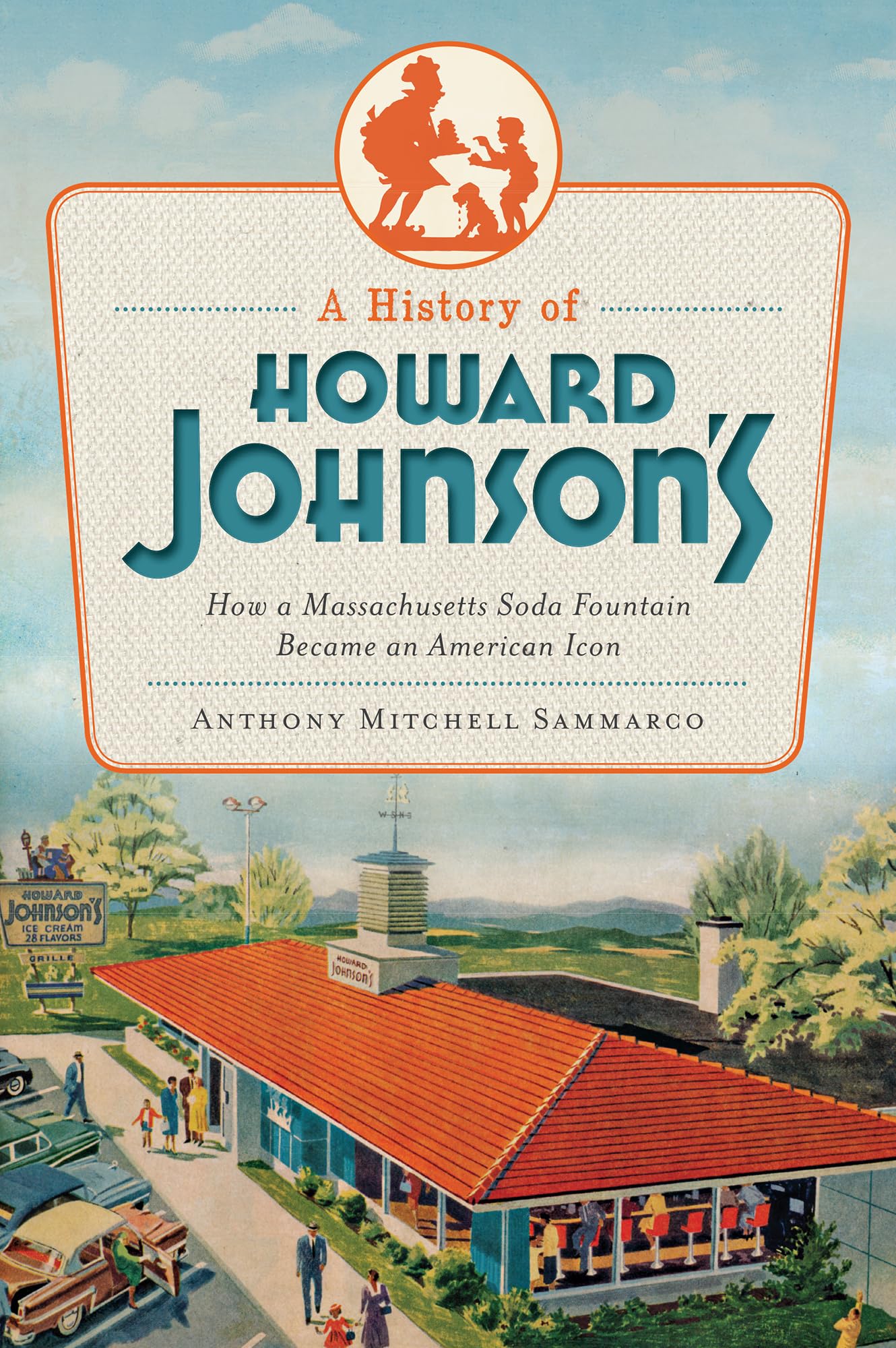
A History of Howard Johnson's: How a Massachusetts Soda Fountain Became an American Icon (American Palate)
$14.71
by Anthony Mitchell Sammarco



Learn more about the "Father of the Franchise Industry" in this illuminating history about the Howard Johnson restaurant franchise and the man behind it all. Howard Johnson created an orange-roofed empire of ice cream stands and restaurants that stretched from Maine to Florida, and all the way to the West Coast. With a reputation for good food at affordable prices, hungry customers would regularly return for more. The attractive white Colonial Revival restaurants, with eye-catching porcelain tile roofs, illuminated cupolas and sea blue shutters, were described in "Reader's Digest" in 1949 as the epitome of "eating places that look like New England town meeting houses dressed up for Sunday." Highlighted in television shows such as Mad Men and films Netflix's 2019 The Irishman , it's obvious that Howard Johnson's occupies an indelible and pleasant place popular culture. Boston historian and author Anthony M. Sammarco recounts how Howard Johnson introduced twenty-eight flavors of ice cream, the "Tendersweet" clam strips, grilled frankforts and a menu of delicious and traditional foods that families eagerly enjoyed when they traveled. Anthony Mitchell Sammarco is a noted historian and author of over sixty books on Boston, its neighborhoods and surrounding cities and towns. He lectures widely on the history and development of his native city. A History of Howard Johnson's How a Massachusetts Soda Fountain Became an American Icon By Anthony Mitchell Sammarco The History Press Copyright © 2013 Anthony Mitchell Sammarco All rights reserved. ISBN: 978-1-60949-428-5 Contents Acknowledgements, Introduction, Chapter 1: The Johnson Family, Chapter 2: Quincy in the Age of Howard Johnson, Chapter 3: Orleans and the Beginnings of the Orange-Roofed Empire, Chapter 4: The Father of the Franchise Industry and the "Tendersweet" Clam, Chapter 5: The New York World's Fair and the "Queen of Rego Park", Chapter 6: From Maine to Florida, Plus a Few Favorite Recipes, Chapter 7: Ephemera, Advertisements and Children's Menus, Chapter 8: Employees and Associates, Chapter 9: Howard Brennan Johnson, the Red Coach Grill and the Ground Round, Chapter 10: The Rise of the Motel and the Johnson Legacy, Bibliography, About the Author, CHAPTER 1 The Johnson Family In the early days, the company was a lovely place to work because it was a small outfit with closeness between the people. Everyone worked together. — Jack Hipson Howard Deering Johnson, the son of John Hayes Johnson and Olive Belle Wright Johnson, was born on February 2, 1897, in Dorchester, Massachusetts. The Johnson family lived at 4 Franklin Street in Port Norfolk, a neighborhood today referred to as Neponset. In 1899, the family moved to Quincy, Massachusetts, and lived at 309 Belmont Street in Wollaston (it has been listed as both 34 and 241 Belmont Street, but the house was renumbered when the street was extended toward Squantum Street). His father, John H. Johnson, was a cigar manufacturer for many years, first doing business under his own name and conducting a retail store at 69 High Street and, later, at 15 Court Square in Boston, in addition to manufacturing cigars. He was referred to as a "shrewd business trader." He later served as the treasurer and general manager of the United Retailers Company, a cigar manufactory on Summer Street in downtown Boston. It was said that the "senior Johnson believed in facing facts squarely with courage and conviction and reared his son ... under rigid disciplinary methods. As a result Mr. Johnson's strong determination and phenomenal memory were products of early training and discipline and were to prove invaluable in the years to come." The Johnson family, like most aspiring middle-class families moving at the turn of the twentieth century to Quincy, set down roots in the community, and they joined the Wollaston Unitarian Church, a shingle-style church designed by noted Dorchester architect Edwin J. Lewis Jr. and built in 1888 at 155 Beale Street in Wollaston. In 1960, the congregation merged with the First Parish Church in Quincy, and the church was sold to St. Catherine's Greek Orthodox Church. John H. Johnson also became a member of the Neighborhood Club, the Granite City Club, the Quincy lodge of Elks and the Community Club in Quincy. Howard Johnson and his sisters attended the Wollaston Grammar School, then a small wood-frame stick-style school that was located on Beale Street between Prospect and Winthrop Avenues, but he left school in the eighth grade to begin working with his father. According to an article in Pageant, "When he was 12 years old he went to work in a Boston drugstore. For $5 a week he washed windows, scrubbed the floor and sold cigars. At 16 he became a salesman for his father, a cigar wholesaler." The grit and determination manifested by the young Howard Johnson toward work was obvious when his father imported a large order of cigars from the American West Indie