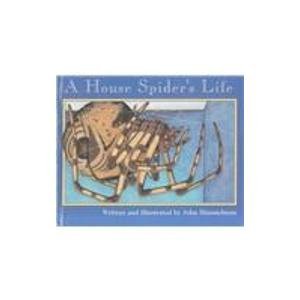



Illustrations and simple text describe the daily activities and life cycle of a house spider K-Gr 2-The small worlds of two common arthropods are revealed in these vividly illustrated picture stories. Most of the realistic color paintings-one per page-are close-ups, providing a bug's-eye view of the subject. One or two simple sentences briefly describe each stage of development from the time the animal hatches until it lays eggs of its own. A bit of drama is introduced when the creatures encounter humankind. In Spider, the protagonist barely escapes being sucked into a vacuum cleaner, and on the last page it is shown dangling on a strand of spider silk over the open mouth of a sleeping child. In Butterfly, a migration flight is interrupted when it is caught and then released by a child with a net. A foreword provides the scientific name of the species and miscellaneous facts about its behavior, life span, etc. Each title has a clearly written and logically organized text, but it is the attractive format and cleverly composed illustrations that young readers will most enjoy. Each painting is framed by a triple border with assorted body parts escaping onto the margins, giving the pictures a three-dimensional effect. Gail Gibbons's Monarch Butterfly (1989) and Spiders (1993, both Holiday) provide more detailed information on anatomy, physical and behavioral characteristics, etc. Faith McNulty's Lady and the Spider (HarperCollins, 1986) has a more engrossing story line. Still, Himmelman's eye-catching paintings will appeal to browsers. -Karey Wehner, San Francisco Public Library Copyright 2000 Cahners Business Information, Inc.