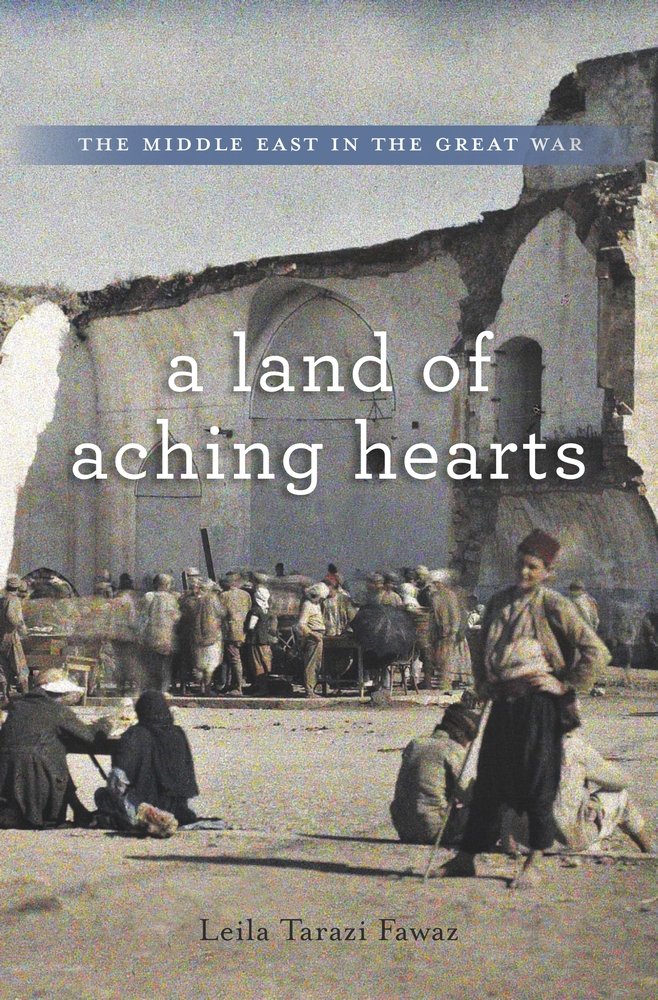



The Great War transformed the Middle East, bringing to an end four hundred years of Ottoman rule in Arab lands while giving rise to the Middle East as we know it today. A century later, the experiences of ordinary men and women during those calamitous years have faded from memory. A Land of Aching Hearts traverses ethnic, class, and national borders to recover the personal stories of the civilians and soldiers who endured this cataclysmic event. Among those who suffered were the people of Greater Syria―comprising modern Syria, Lebanon, Jordan, Israel, and Palestine―as well as the people of Turkey, Iraq, and Egypt. Beyond the shifting fortunes of the battlefield, the region was devastated by a British and French naval blockade made worse by Ottoman war measures. Famine, disease, inflation, and an influx of refugees were everyday realities. But the local populations were not passive victims. Fawaz chronicles the initiative and resilience of civilian émigrés, entrepreneurs, draft-dodgers, soldiers, villagers, and townsmen determined to survive the war as best they could. The right mix of ingenuity and practicality often meant the difference between life and death. The war’s aftermath proved bitter for many survivors. Nationalist aspirations were quashed as Britain and France divided the Middle East along artificial borders that still cause resentment. The misery of the Great War, and a profound sense of huge sacrifices made in vain, would color people’s views of politics and the West for the century to come. “A detailed account of the political and cultural events that occurred in the Middle East just before and during World War I. It concerns the way in which Arabs were caught up in Europe’s first major war of the twentieth century, and how this proved to be a turning point in Middle Eastern history, but one not of the Arab peoples’ own making…What is startling, though, is how so much of what World War I unleashed―struggles over identity, sectarian or otherwise, national border disputes, rights of minorities, the place of women in society―still reverberates to this day… Fawaz explores the war’s effect on the region’s ordinary people: fishermen, villagers, entrepreneurs, émigrés, soldiers and draft dodgers are woven into a rich tapestry. She takes us aboard ships and into train stations, along the lines outside bakeries and into crowded prison camps. These are the vantage points from which Fawaz observes the scope and scale of the war. In minute detail, she recounts the devastation it wrought, including the way common catastrophes of locusts, famine and disease were exacerbated by the exploits of Europeans, such as the prolonged Anglo-French naval blockade. Fawaz is always at pains to present the ingenuities and the tenacity of ordinary Arab people under these pressures… As Fawaz does, [historians] should draw on local sources, languages and experiences to restore the Middle East’s full complexity rather than reinforcing the blinkered, one-sided narrative of butchers and beheaders.” ― Tom Finn , The Nation “Magnificent… [Fawaz] write[s] perceptively and sympathetically about a complex and sophisticated society unfamiliar to most Americans… [She] recounts the effects of the Great War upon a Middle East grown prosperous and relatively free during a period of industrialization and Ottoman political decline.” ― Robin Darling Young , Commonweal “Intensely moving… [Fawaz] does an astounding amount of research into primary sources that haven’t to my knowledge been synthesized before to an extent this masterful. Great figures stride through the history of the Middle East in the years of the First World War and its aftermath… But the main focus of Fawaz’s book is the plight of ordinary people caught up in the often calamitous changes the war swept into the entire remains of the Ottoman Empire… Her book is a first-rate work of historical investigation, but it also functions as a kind of doleful question mark shadowing the present day, which has the dubious advantage of being able to see live video feed of the disruptions and sufferings being inflicted on the descendants of the same ordinary folk Fawaz so skillfully uncovers.” ― Steve Donoghue , Open Letters Monthly “Drawing on poetry, plays, and works of contemporary fiction, Fawaz supplements traditional historical sources the better to capture the experience and popular memory of the Great War. The result is one of the finest social histories of war in the modern Middle East yet published.” ― Eugene Rogan , Middle East Journal “[Fawaz] write[s] as vividly and knowledgeably about political developments as about land tenure. [She] bring[s] ordinary men and women as well as military and political leaders to life…The long devastating war that destroyed this last Muslim Empire also killed off many dreams and plans, and Fawaz pays homage to them by salvaging the stories of ordinary men and women whose lives were cut short or changed forever.” ― Donna Robinso