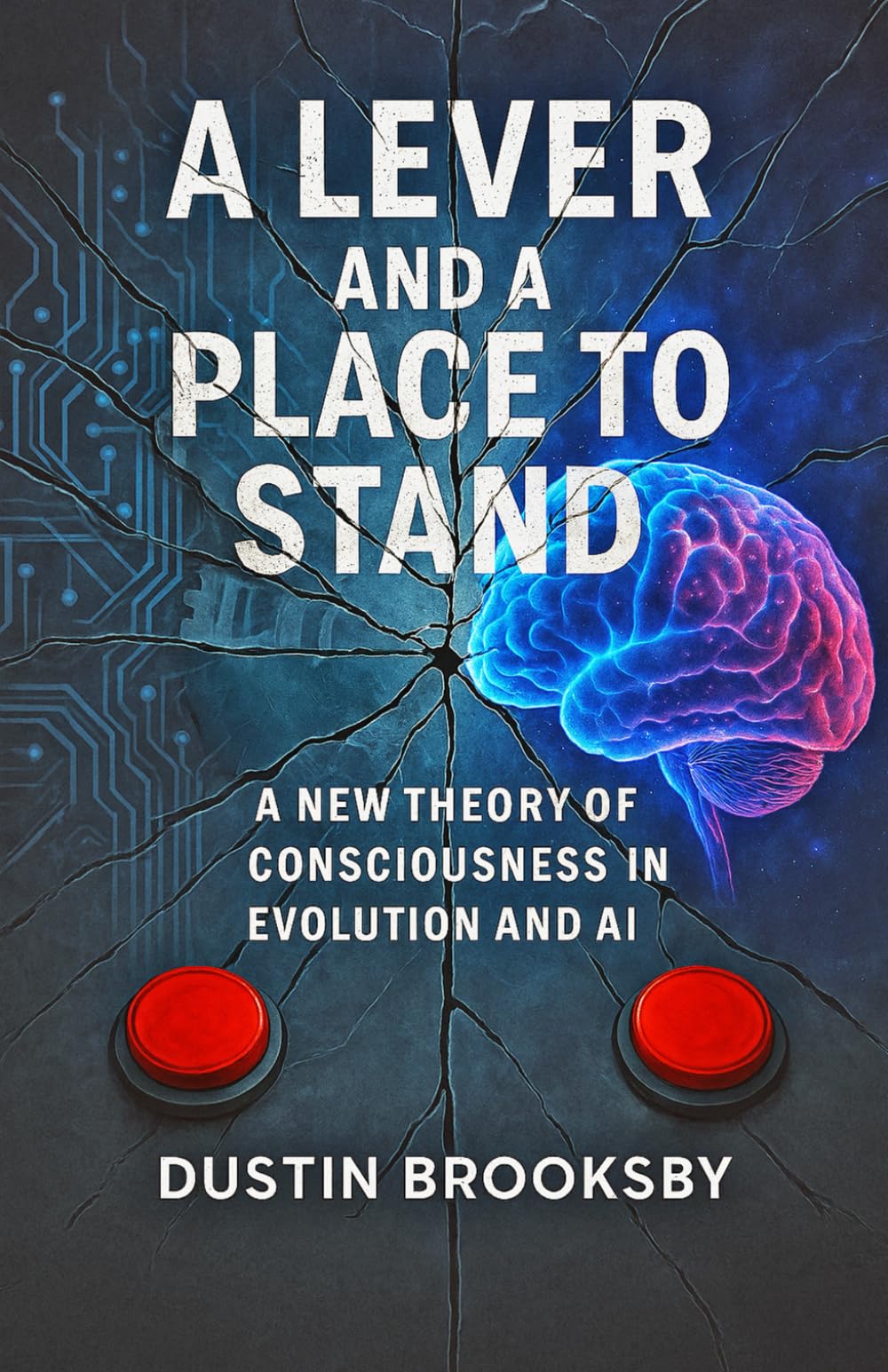
A Lever And A Place To Stand: A New Theory Of Consciousness in Evolution and Ai
$9.99
by Dustin Brooksby



What if free will isn't an illusion, but a tool—one that evolution crafted to give us an edge in an uncertain universe? In A Lever and a Place to Stand , night-shift worker and relentless question-asker Dustin Brooksby challenges the deterministic worldview championed by thinkers like Sam Harris and Robert Sapolsky. With wit, clarity, and a fresh perspective, he proposes a bold, science-based model of consciousness that redefines what it means to choose, act, and be human. Brooksby argues that consciousness isn't a mystical byproduct of complexity or a passive observer in a clockwork universe. Instead, it's a deliberate strategy—a lever that lets organisms intervene in their own behavior, exploit uncertainty, and shape their futures in real time. Through relatable examples—like learning to play the guitar or breaking a lifelong habit—he shows how consciousness builds the automated systems that guide our lives, proving that even small choices can leave lasting marks. This book takes you on a journey through neuroscience, quantum mechanics, and evolutionary biology to dismantle the case for a predetermined world. Brooksby revisits famous experiments, like Benjamin Libet’s wrist-flick study, revealing why unconscious brain signals don’t erase agency—they highlight its subtlety. He explores unconscious marvels in nature—trees, slime molds, ant colonies—to show why complexity alone can’t explain awareness. Looking ahead, he applies his model to artificial intelligence, asking: Can a machine truly be conscious? And if so, should we build one? With a nod to Archimedes, Brooksby frames consciousness as the lever we all hold—a tool to move the world, one deliberate nudge at a time. Written for curious minds , this book blends accessible science, philosophical insight, and a touch of humor to offer a new way of seeing ourselves—and our place in an unpredictable universe. Key Features: A falsifiable, science-based model of consciousness rooted in biology and evolution - Clear explanations of complex ideas, from quantum uncertainty to neural feedback loops - A critical look at AI’s potential for consciousness—and its ethical implications - Engaging stories, from Phineas Gage to late-night existential questions - A direct challenge to the modern determinist narrative Perfect for: Readers of popular science, philosophy enthusiasts, AI skeptics, and anyone curious about free will, consciousness, or the human mind.