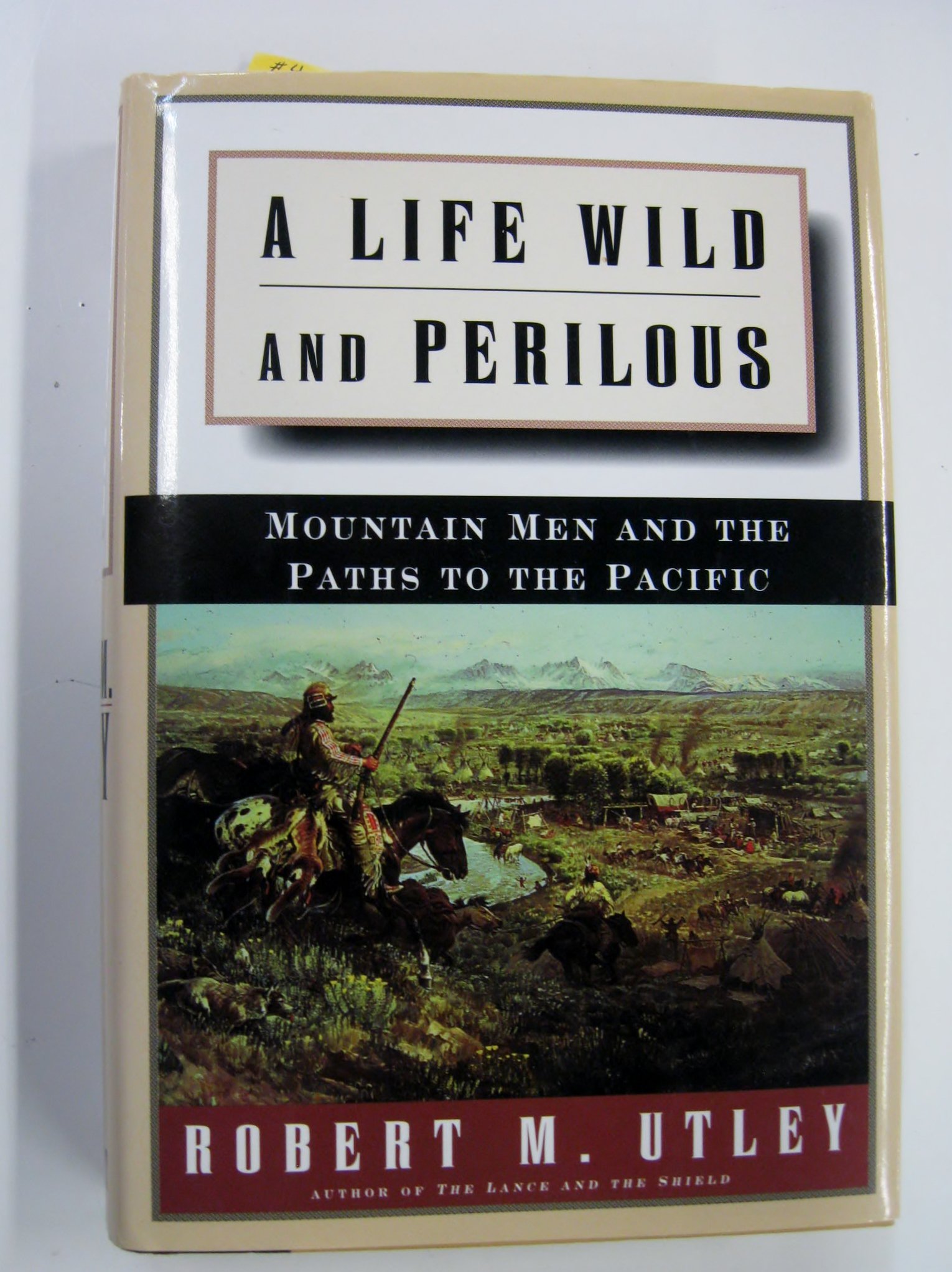
A Life Wild and Perilous: Mountain Men and the Paths to the Pacific
$18.60
by Robert M. Utley



The author of The Lance and the Shield describes how the trails of the West were carved out by a group of hunters and traders, known as mountain men, who came to know the land and, in turn, became valuable guides for the missionaries and the settlers who followed them. 20,000 first printing. It's true, Robert Utley writes, that mountain men such as "Crazy Bill" Williams and Jeremiah "Liver-Eating" Johnson were an unlearned, unwashed, drunk, and violent bunch who tore a bloody swath across the then-unconquered American West from the 1810s to the 1840s. Yet their travels across deserts and plains and over high mountains yielded a huge body of geographical knowledge that would enable American pioneers to cross the Mississippi and traverse the continent in relative security. Utley, a historian with a fluent narrative style, tells the stories of hard-fighting men like Jim Bridger, Benjamin Bonneville, Kit Carson, and Joseph Walker, whose names now figure prominently on maps of the region but are otherwise little remembered. Utley, former chief historian of the National Park Service, knows his terrain firsthand and admirably captures the exciting adventures of the first white men to explore the Rocky Mountain West. While he offers minibiographies of characters such as Jedediah Smith, Kit Carson, and Jim Bridger, he has fashioned a full-blown social history of a movement that still captures the imagination of readers today. Though scholars might criticize the book for being "once over lightly," general readers will appreciate the popular magazine style. Recommended for public and academic libraries.?David S. Azzolina, Univ. of Pennsylvania Libs., Philadelphia Copyright 1997 Reed Business Information, Inc. An interlude between the Lewis and Clark expedition and the Mexican-American War was the heyday of the mountain men, whose story of exploration, peril, and profit gets a clear-eyed, comprehensively researched update from Utley, a prolific western historian and also the author of an outstanding biography of Sitting Bull ( The Lance and the Shield , 1993). His narrative of the trappers is entrancingly delivered: few were literate, but all were talkative, and their geographic and ethnographic knowledge of the Rockies and the Native Americans, transmitted orally and gradually disseminated through the 1840s, blazed the way for the realization of "manifest destiny." Numbering about a thousand at any one time (the first were Lewis and Clark veterans, engaged by a St. Louis fur company), they were mangled by Blackfeet, but soon emissaries of competing firms, employees of beaver tycoon John Jacob Astor among them, were ascending the Missouri, wintering in the Tetons, and surviving an incredible variety of Indian ambushes, bear attacks, and benders at the annual Green River rendezvous--those essentials to the mountain-man romance. But Utley, though an able storyteller, is not seduced by myth. He soberly sets the incidents into the gradual expansion of discovery--15 maps illustrate the process--that the mountain men effected and the American emigrants depended on after the fur empire collapsed. A magnificent read for the many fascinated by the history of the West and the facts behind legendary names such as Jedediah Smith, Jim Bridger, or Kit Carson. Gilbert Taylor From a veteran historian of the West, a fine account of early American explorers, a unique group of men who ``could be led but not commanded.'' The mountain men, Utley (The Lance and the Shield, 1993) writes, were a ``mostly illiterate'' bunch of rough-and-tumble entrepreneurs, given to gaudy dress, drunkenness, and, often, mindless violence. Yet over the first half of the 19th century they collected a vast amount of information on the geography of the West, blazing trails across the high plains, the Rockies, the Great Basin, and the Sierra that would eventually bring Anglo settlers across the Mississippi into newly conquered territories. They went, Utley writes, less from noble motives than ``to make money in a pursuit that promised adventure, excitement, personal freedom.'' Still, some of these mountain men were, in Utley's view, aware of their importance to the historical moment: Working to thwart Spanish, French, British, and Russian designs on the vast region, they foresaw that their explorations would open the West to the claims of manifest destiny. Utley offers excellent descriptions of men like Jim Bridger, John Charles Frmont, Jedediah Smith, Benjamin Bonneville, Joe Meek, Kit Carson, Old Bill Williams, and Joseph Walker, whose names now dot maps of the West. He also writes easily of what might be called mountain-man culture and dispels a few myths along the way, especially the notion of the trapper-explorer as lone wolf: The mountain men traveled in groups of 40 to 60 men, Utley writes. To ``wander in lonely solitude . . . would have been suicidal.'' Despite their caution, many mountain men died violently, killed by Indians or fellow trappers. Some we