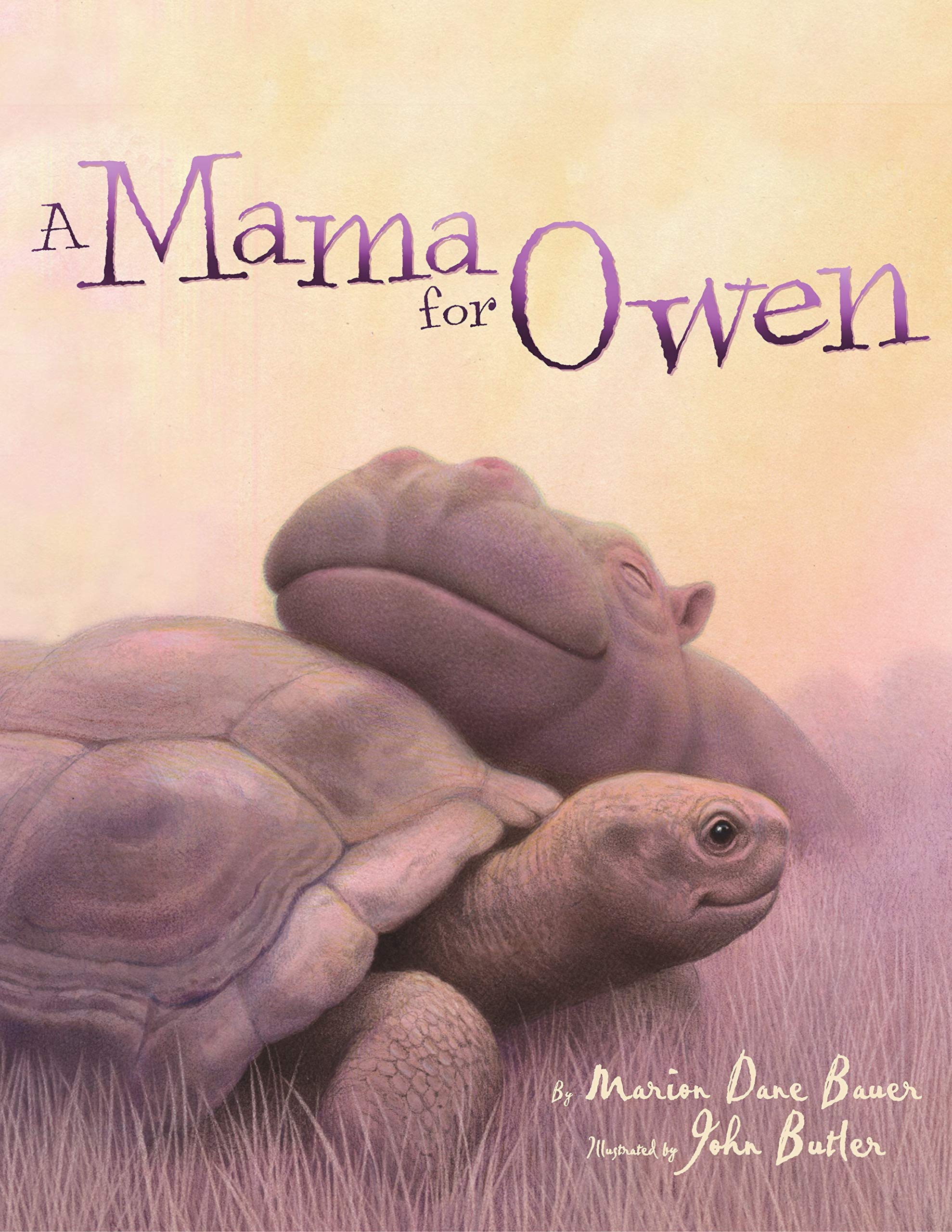



Owen the baby hippo and his mama were best friends. They loved to play hide-and-seek on the banks of the Sabaki River in Africa. That was all before the tsunami came and washed Owen's world away. But after the rain stops, Owen befriends Mzee, a grayish brown tortoise. He plays with him, snuggles with him, and decides he just might turn out to be his best friend and a brand-new mama. Inspired by the tsunami of 2004, acclaimed storyteller Marion Dane Bauer and celebrated illustrator John Butler depict this heartwarming true tale of healing, adoption, and rebirth -- with splendid illustrations and oodles of love. PreSchool-Grade 1—The true story of the African baby hippo that was separated from his mother during the Indian Ocean Tsunami of 2004 and then bonded with a giant tortoise is one that has endeared itself to many. This version is a bit too endearing. Bauer's symmetrical text gives the basic facts, compressing details in order to draw clear parallels between the hippo's activities with his mother and then with the tortoise. The author uses repetitive phrasing to convey the severity of the situation: "The rain fell and it fell and it fell. The Sabaki River rose and it rose and it rose." While this is a time-honored narrative device, when combined with Butler's soft-focus, anthropomorphic artwork, the effect is cloying and monotonous. The scenes, rendered in acrylic paint and colored pencils in a gray/brown/pale-lavender palette, feature animals that smile continuously, even during the storm. For strong visuals and a conceptually satisfying account, stick with the striking photographs and sensitive narrative provided in Isabella Hatkoff, Craig Hatkoff, and Paula Kahumbu's Owen & Mzee: The True Story of a Remarkable Friendship (2006) and its sequel, Owen & Mzee: The Language of Friendship (2007, both Scholastic), reviewed in this issue.— Wendy Lukehart, Washington DC Public Library Copyright © Reed Business Information, a division of Reed Elsevier Inc. All rights reserved. *Starred Review* Worlds away from Jeanette Winter's retelling, Mama (2006), in which the nearly wordless text and stark design offered youngsters little buffer against Owen's terrifying separation from his mother, Bauer's picture-book version closely matches its narrative and visual tones to its target audience. A rhythmic, lulling narrative smooths the barbed edges of the disaster ("The rain fell and it fell and it fell. The Sabaki River rose and it rose and it rose"), and Butler's feathery illustrations, featuring smiling, doe-eyed animals rendered in soft tones of butter, rose, and lavender, hint at the sunny outcome even during the story's troubling opening scenes. Composition choices, too, spin the trauma appropriately for the very young; for instance, even as Bauer acknowledges, post-tsunami, that Owen's mother was "lost" and Owen himself was "alone in the sea," Butler's close-up picture avoids the overwhelming, long-distance perspective of a tiny figure dwarfed by the vast ocean. Apart from a font cluttered with ornamentation, the book's large format and attractive presentation invites sharing--even with sensitive young listeners. Jennifer Mattson Copyright © American Library Association. All rights reserved Marion Dane Bauer is the author of many books for young readers, including the Newbery Honor book On My Honor and the Coretta Scott King Book Illustrator Award winner The Stuff of Stars . She lives in St. Paul, Minnesota, and can be reached at MarionDaneBauer.com. John Butler has illustrated more than forty books for children, including Little Chick , Little Bunny , A Mama for Owen , and While You Were Sleeping . He has worked for Sesame Street and Time magazine and resides in the United Kingdom.