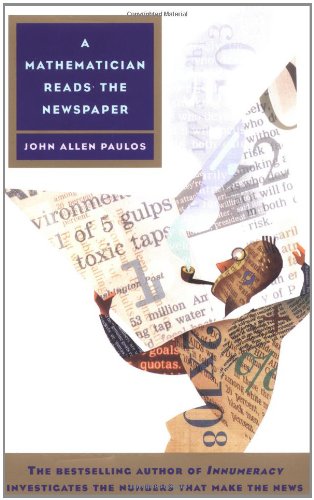



With the same user-friendly, quirky, and perceptive approach that made Innumeracy a bestseller, John Allen Paulos travels though the pages of the daily newspaper showing how math and numbers are a key element in many of the articles we read every day. From the Senate, SATs, and sex, to crime, celebrities, and cults, he takes stories that may not seem to involve mathematics at all and demonstrates how a lack of mathematical knowledge can hinder our understanding of them. ... this book should be mandatory reading for every journalist - as well as the readers, viewers and former tutors they supposedly serve. -- Robert Matthews, New Scientist, 1995 A Mathematician Reads the Newspaper is irresistible. -- Rudy Rucker, Scientific American, 1995 Although the combination of math and newspapers sounds uniquely unappetizing, John Allen Paulos creates a truly thought- provoking book from that mixture. -- USA Today, Best Bet, 1995 But the dirty secret about the media's contribution to American "Innumeracy," first examined in a delightful book by that title by John Allen Paulos, is about to be revealed in his sequel, "A Mathematician Reads the Newspaper. -- Max Frankel, New York Times, 1995 Even better, Paulos' wit and humor - admirably displayed in Innumeracy - are in top form. His irreverent and pointed comments entertain as well as educate. Though Paulos writes about a bewildering number of topics, he has something fresh and interesting to say about each. -- Charles Seife, Philadelphia Inquirer, 1995 In his new book, the mathematician John Allen Paulos continues his witty crusade against mathematical illiteracy ...... Mr. Paulos's little essay explaining the Banzhaf power index and how it relates to Lani Guinier's ideas about empowering minorities is itself worth the price of the book. -- Richard Bernstein, New York Times, 1995 It would be great to have John Allen Paulos living next door. Every morning when you read the paper and came across some story that didn't seem quite right - that had the faint odor of illogic hovering about it - you could just lean out the window and shout, "Jack! Get the hell over here!"..... Paulos, who wrote the bestseller Innumeracy (the mathematical equivalent of illiteracy), has now written a fun, spunky, wise little book that would be helpful to both the consumers of the news and its purveyors. -- Joel Achenbach, Washington Post, 1995 Paulos uses his considerable talents and a breezy style to discuss many ways to apply simple, or at least simply explained, mathematics and logic to analyze the contents of the newspaper. ... the book is a compendium of unusually sound advice, which, if widely read and understood, could improve a lot more for us than the way we read the newspaper. -- Journal of the American Medical Association, 1995 This is press criticism, but not of the usual kind .... This is press criticism of the sort that George Orwell had in mind when he observed that what's important isn't news, and what's news isn't important. ..... This is a subversive book. Paulos argues that the world is so complex that it cannot be accurately described, much less manipulated. ...... a wise and thoughtful book, which skewers much of what everyone knows to be true. -- Lee Dembart, Los Angeles Times, 1995 "After reading A Mathematician Reads the Newspaper, it will be impossible to look at the newspaper in the same way."-- Philadelphia Inquirer "It would be great to have John Allen Paulos living next door. Every morning when you read the paper and come across some story that didn't seem quite right--that had the faint odor of illogic hovering about it-- you could just lean out the window and shout, 'John! Get the hell over here!'. A fun, spunky, wise little book that would be helpful to both the consumers of the news and its purveyors." -- Washington Post Book World e user-friendly, quirky, and perceptive approach that made Innumeracy a bestseller, John Allen Paulos travels though the pages of the daily newspaper showing how math and numbers are a key element in many of the articles we read every day. From the Senate, SATs, and sex, to crime, celebrities, and cults, he takes stories that may not seem to involve mathematics at all and demonstrates how a lack of mathematical knowledge can hinder our understanding of them. The Top 10 list has become a staple of newspapers, television, and magazines for a variety of reasons, the top ten being: 1. Ten is a common and familiar number, the base of our number system. Numbers are rounded to 10 or to multiples of ten or tenths. The resulting distortion, of course, need not have much to do with reality. We're told, for example, that we use 10 percent of our brain power, that 10 percent of us consume 90 percent of the world's resources, and that decades define us. (Is there anything more vapid than explanation by decade? In the free love, antiwar sixties, hippies felt so and so; the greed of the eighties led yuppies to do