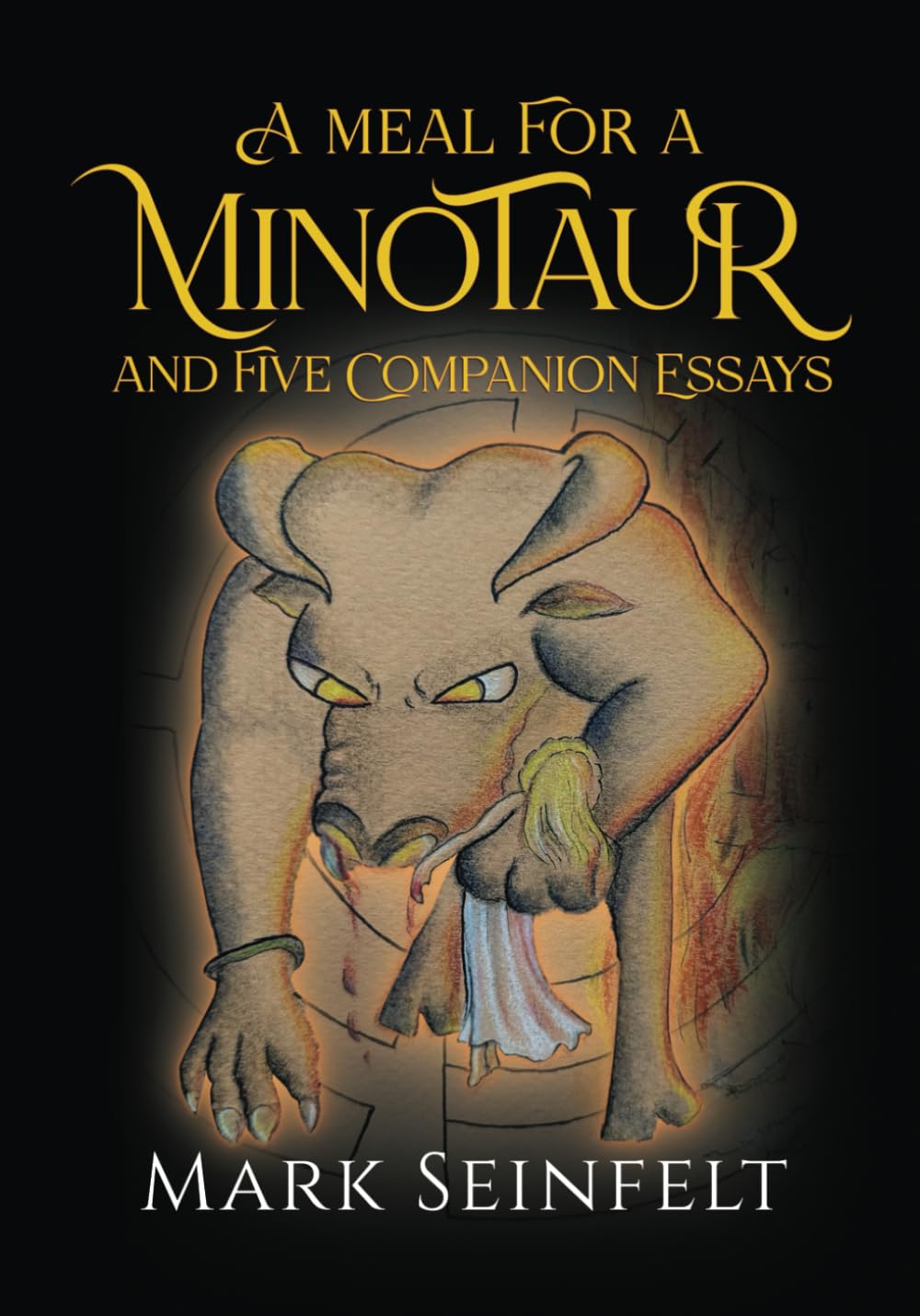



Mark Seinfelt's "A Meal for a Minotaur" is a Bildungsroman dealing with the spiritual education of its protagonist Theseus at the hands of his one-time victim Helen of Troy, whom, or so the story goes (Theseus himself can’t remember), Theseus kidnapped and raped as a small girl. The grown, goddess-like Helen—who reverts from time to time into a not-so-very-innocent child—becomes a second Ariadne for the now aged hero. Every bit as much a victim as her predecessor, the Cretan princess, she nonetheless points and directs her erstwhile corruptor’s way through a stupendous new labyrinth, far more twisted and complex than the dreaded maze of Minos which Theseus threaded as a boy with Ariadne’s assistance. As "A Meal for a Minotaur" commences, the setting of the novel is initially hazy and unclear, but soon the reader comes to understand that the novel unfolds and takes place in the mystical and numinous space of maternal origins, a locality or “egg” which exists outside of linear time and which is identified with both Plato's pleroma and Goethe’s subterranean “realm of the Mothers” in "Faust, Part Two"—a womb of possibility and pure consciousness where opposites meet, where knowledge and memory are enhanced and constricted at the same time, where simultaneously all things pass without precise boundaries into one another, and in which all being originates, a sphere the soul returns to again and again between incarnations and where ultimate explanation seems tantalizingly just out of reach. Theseus’ attitudes and ways of thinking develop and mature, as moving through the pleroma in quest of redemption, he witnesses how a slew of authors down the course of the centuries rework and retell his and Helen’s stories as he strives to avert the terrible fate awaiting the Spartan queen—whom he now considers more a daughter than a future bride—outside of the egg, a destructive destiny that she seems doomed to repeat over and over again for all eternity and for which Theseus seems in part responsible. Ironically, the great but grievously flawed hero grows more compassionate and more humane as he learns that the inhuman adversary he seeks, a new and more fearsome second Minotaur, is in fact a part of himself, an integral aspect of his own identity, and how we humans all must confront, fight, and conquer the monster within before we can escape hell and gain heaven. In addition to the novel proper, the volume also includes five companion essays on literature, myth, music and morality which provide further insight into the preceding fiction (together serving as a clew to the labyrinth, as it were) including "Empedocles' Final Draft" in which the author returns to the subject of suicides of world-famous authors, the topic of his first published work "Final Drafts" in 1999, "The Birth and Investiture of Skanda," a modern retelling of the demanding and onerous if also rib-tickling conception of the Hindu God of War, the son of the deities Siva and Parvati, and "Operation Crossbroch," an account of the escape of novelist Hermann Broch from post-Anschluss Austria, whose freedom was not won by commandos brandishing machine pistols but by authors (including Thomas Mann and James Joyce) wielding the lancets of their art. Seinfelt portrays Broch as a sort of modern-day Theseus trapped in Nazi hell and the authors who came to his rescue as a collective Herakles Mark Seinfelt's A MEAL FOR A MINOTAUR AND FIVE COMPANION ESSAYS combines a novel (a Bildungsroman concerning the spiritual and psychological re-education of Theseus) with five essays, collectively exploring themes of memory, guilt, and redemption through the lens of classical mythology. The novel, designated "Labyrinth," begins with an aged Theseus trapped within the labyrinthine Omnipleroma: a mystical, atemporal "egg" or realm of origins. Alongside him is Helen of Troy, whom he may have kidnapped and violated as a child—an event he cannot clearly recall. Helen, who shifts between an adult, goddess-like form and that of a child, serves as his guide through a maze "far more twisted and complex than the dreaded maze of Minos which Theseus threaded as a boy." Theseus, burdened with guilt, pieces together his fragmented memories, such as the slaying of the first Minotaur, his problematic relationships with women, and the tragic death of his son Hippolytus. His journey becomes an internal struggle when Theseus learns that the monstrous "new Minotaur" he must confront "is in fact a part of himself, an integral aspect of his own identity." Complementing this narrative are five "Clew" essays, which delve into related territories—from authorial suicide ("At the Lip of the Volcano...") to mythic parallels ("The Birth and Investiture of Skanda") and literary theory ("The Leitmotiv's Literary Origins")—offering further insight into the novel's themes. These diverse pieces, presented as potential keys or parallel explorations, serve to deepen the complex landscape introduced in the main narrat