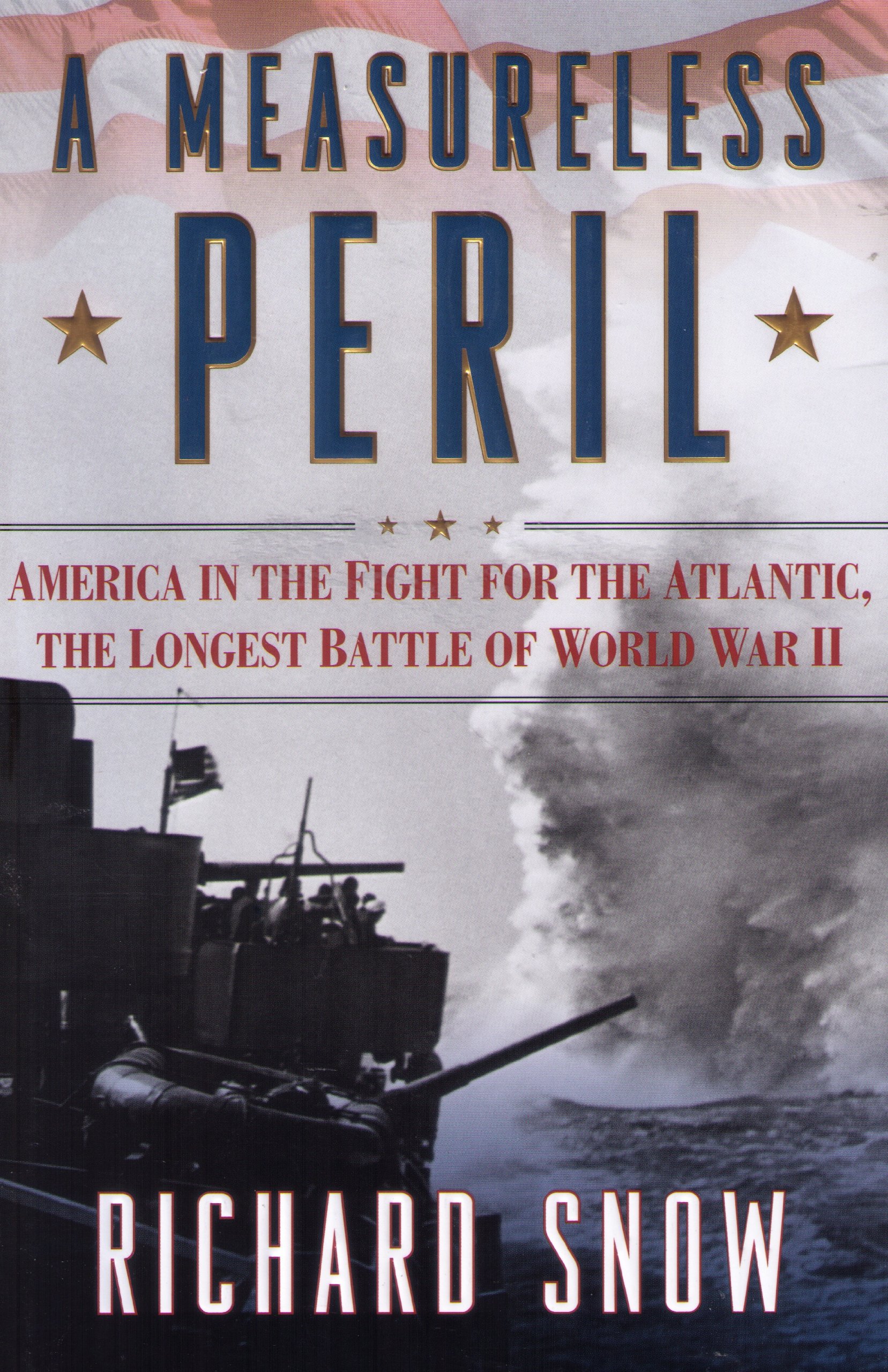
A Measureless Peril: America in the Fight for the Atlantic, the Longest Battle of World War II
$14.97
by Richard Snow



Of all the threats that faced his country in World War II, Winston Churchill said, just one really scared himwhat he called the "measureless peril" of the German U-boat campaign. In that global conflagration, only one battlethe struggle for the Atlanticlasted from the very first hours of the conflict to its final day. Hitler knew that victory depended on controlling the sea-lanes where American food and fuel and weapons flowed to the Allies. At the start, U-boats patrolled a few miles off the eastern seaboard, savagely attacking scores of defenseless passenger ships and merchant vessels while hastily converted American cabin cruisers and fishing boats vainly tried to stop them. Before long, though, the United States was ramping up what would be the greatest production of naval vessels the world had ever known. Then the battle became a thrilling cat-and-mouse game between the quickly built U.S. warships and the ever-more cunning and lethal U-boats. The historian Richard Snow captures all the drama of the merciless contest at every level, from the doomed sailors on an American freighter defying a German cruiser, to the amazing Allied attempts to break the German naval codes, to Winston Churchill pressing Franklin Roosevelt to join the war months before Pearl Harbor (and FDRs shrewd attempts to fight the battle alongside Britain while still appearing to keep out of it). Inspired by the collection of letters that his father sent his mother from the destroyer escort he served aboard, Snow brings to life the longest continuous battle in modern times. With its vibrant prose and fast-paced action, A Measureless Peril is an immensely satisfying account that belongs on the small shelf of the finest histories ever written about World War II. From an experienced journalist and editor comes a chatty but absorbing history of the American role in the Battle of the Atlantic, undoubtedly the longest and most crucial campaign of WWII. The book isn’t for beginners because, made up of short essays rather than as a continuous narrative, it leaps around from the upper echelons (e.g., the formative years of Karl Doenitz’s notions about U-boat warfare tactics and Admiral King’s nearly disastrous refusal to begin coastal convoys in 1942) to the low ones (e.g., the many and varied ordeals of the survivors of the liner Athenia, first casualty of the U-boat war). Interspersed among the essays is the WWII career of Snow’s father, who began the war helping build destroyer escorts and ended it serving aboard one. For all its patchiness, the book is historically balanced and eminently readable, deserving a place in at least larger WWII naval collections. --Roland Green “What’s the Matter with the Davis ?” Looking back on the Atlantic struggle One hot, windy September afternoon in the early 1970s my mother and father came home to Bronxville from a two-week vacation in Maine. Bronxville is a town in Westchester County, half an hour north of Manhattan on what was then the Penn Central railroad. Like countless thousands of other couples, my mother, Emma, and my father, Richard, had quit the city in the hopeful months after World War II ended to raise their infant child in a house surrounded by suburban greenery and well-nourished public schools. The beneficiary of this relocation came down to help them unload their luggage, and I was soon joined by Mr. Curcio, the superintendent of the apartment building in the village my parents had moved into after I’d gotten out of college. Superintendent Curcio was a chatty, affable, powerfully built man (he once paused halfway up a flight of stairs to speculate with me at some length about the Mets’ chances, all the time holding two air conditioners, one under each arm). He scooped a half dozen suitcases out of the Chrysler, and as we headed toward the apartment, something—the weather, perhaps—reminded him of having taken part in the landings on Sicily in July 1943, and he began to talk about it. “Look, I’m a wop,” he said cheerfully about his Italian heritage, “but let me tell you, once those wops on the beach were shooting at me, I was one hundred percent American. Guys begin dropping around me, and I start firing while I’m still in the water.” The story continued until the suitcases were in front of the door. We all said thanks, and then my mother put a protective hand on my father’s forearm. “I’m so glad,” she told Mr. Curcio, “that Dick was never in action.” AT A LITTLE AFTER eight thirty on the morning of April 24, 1945, a sailor said to my father, “What’s the matter with the Davis ?” He meant the Frederick C. Davis , destroyer escort 136, and she looked funny, canted forward and apparently stopped in the water. My father was watching her from the deck of another destroyer escort, the USS Neunzer , DE-150. The Davis lay a few hundred yards away, but not for long. “Jesus Christ!” said someone. “She took a fish.” And sure enough, although nobody aboard the Neunzer had heard