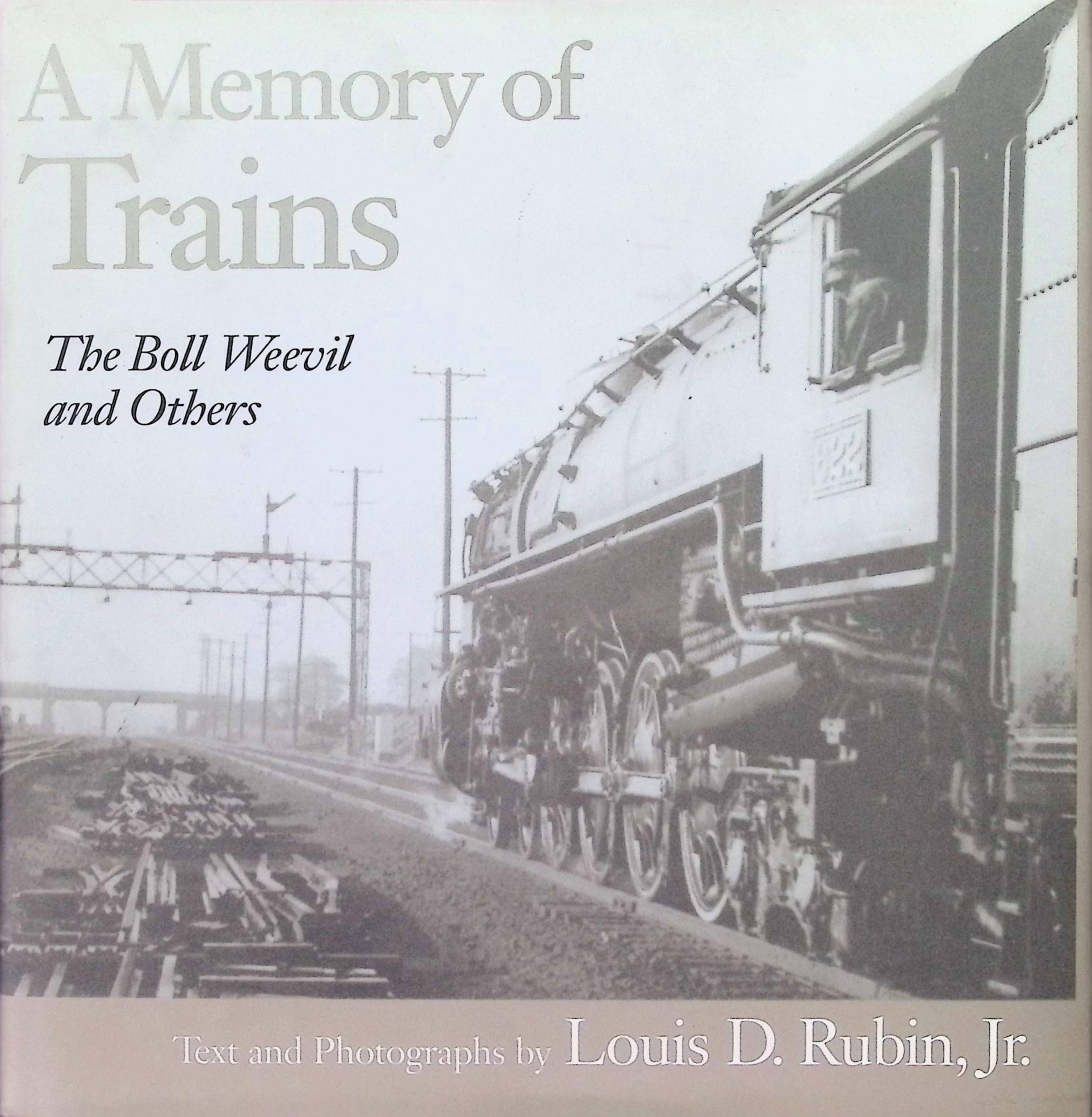



"A Memory of Trains is a book about trains like Mark Twain's Life on the Mississippi is a book about steamboatswhich is to say, it is about trains, but it is about so much more. It is social history, memoir, andas the author says at one pointa journey toward a vocation," writes Fred Hobson in the introduction. As the son of a railroad conductor and product of a railroad town (Hamlet, N.C.) Im a passionate railway buff. But in this wonderful reminiscence of old trains great and small, North and South, freight and passenger, smoke and whistle, illustrated by his own photographs, Louis Rubin shows himself King of the Buffs and Master of the Tracks. You can almost hear someone shouting "all aboard!" says Tom Wicker. "Railfans will find all the material they crave about the webs of passenger and freight routes that once plied those parts of the nation ... Rubin's work is also a literary elegy of trains and the culture they bore ... a handsome volume ... Trainspotters everywhere will love it," says Publishers Weekly. "It is his beautifully written narrative, humble and elegant, that makes the book such a gem," wrote Preservation magazine. And the photographs "convey the power, grace, movement, and beauty of the speeding train." "The author's photos accompany the well-written chapters, leave readers saddened by all that was lost when railroads lost their grandeur, but they will appreciate the memories this autobiography stirs," says Roger Carp in Trains magazine. "His photographs, 122 in number, are pure nostalgia; freight trains, passenger trains, trains rolling across trestles and heading into small-town stations, cabooses, water towers, and a carnival train with gaudily painted flatcars ... For readers old enough to remember the book is a joy; for readers too young to remember, here is a chance to share the joy," says George Cohen in Booklist magazine Rubin, a retired university English professor and founder of Algonquin Books, chronicles his fascination with steam locomotives that he rode and photographed in the days before diesel-powered trains. He focuses on the southeastern and Middle Atlantic states, where he lived and worked. Rubin reminisces not only about the trains but also recalls the Pullman porters and redcaps, conductors, brakemen, engineers, and travelers meeting families and friends. His photographs, 122 in number, are pure nostalgia: freight trains, passenger trains, trains rolling^B across trestles and heading into small-town stations, cabooses, water towers, and a carnival train with gaudily painted flatcars. Most of the engines are spewing plumes of bituminous coal smoke. For readers old enough to remember, the book is a joy; for readers too young to remember, here is a chance to share the joy. George Cohen Copyright © American Library Association. All rights reserved "All the machinery was on the outside, and when they came pounding along the rails, drive wheels turning, drive rods stroking, pistons exploding with sound and fury and sending a swirling cloud of bituminous coal smoke overhead, the earth shook." This is the way that Louis D. Rubin, Jr., remembers steam railroading during the days when trains were still the dominant mode of American intercity travel. In the years after the Second World War, as a young newspaperman he spent much of his time riding and photographing trains. Now, in a memoir featuring more than one hundred of his photographs, he tells of the role that railroading played in his life as a child and youth and as an adult in search of a vocation. It was a time when the coal-powered Iron Horse, which had settled and peopled a continent, was giving way to the diesel-electric locomotive. By the mid-1950s, when Rubin settled into what would prove to be a distinguished teaching career, the steam locomotives were gone from the American scene. A cub reporter who would later become a Southern literary critic and historian, Rubin began his lifelong engagement with trains in the Carolinas and Virginia, then journeyed westward to the Appalachians, northward to Maryland, New Jersey, and the Northeast, and then into the Deep South, the Midwest, and the Far West. The text and photographs of A Memory of Trains recount that journey. There was one train that Rubin had yet to travel aboard or photograph. Known as the Boll Weevil, it ran on a branch of the Seaboard Air Line Railrway between Hamlet, North Carolina, and Savannah, Georgia, via his hometown of Charleston. His account of the day he finally arrived at the station in Hamlet to ride the Boll Weevil down to Charleston and his exploration of what the little train meant for him contitute a poignant episode in this memoir of railroads and railroading. Railrans and general readers alike will enjoy this account and photographs of a time when, in the author's words, "trains were everywhere to heard, going places." At 76, Louis D. Rubin, Jr., is hardly retired. A Memory of Trains is his 50th book, a memoir told throu