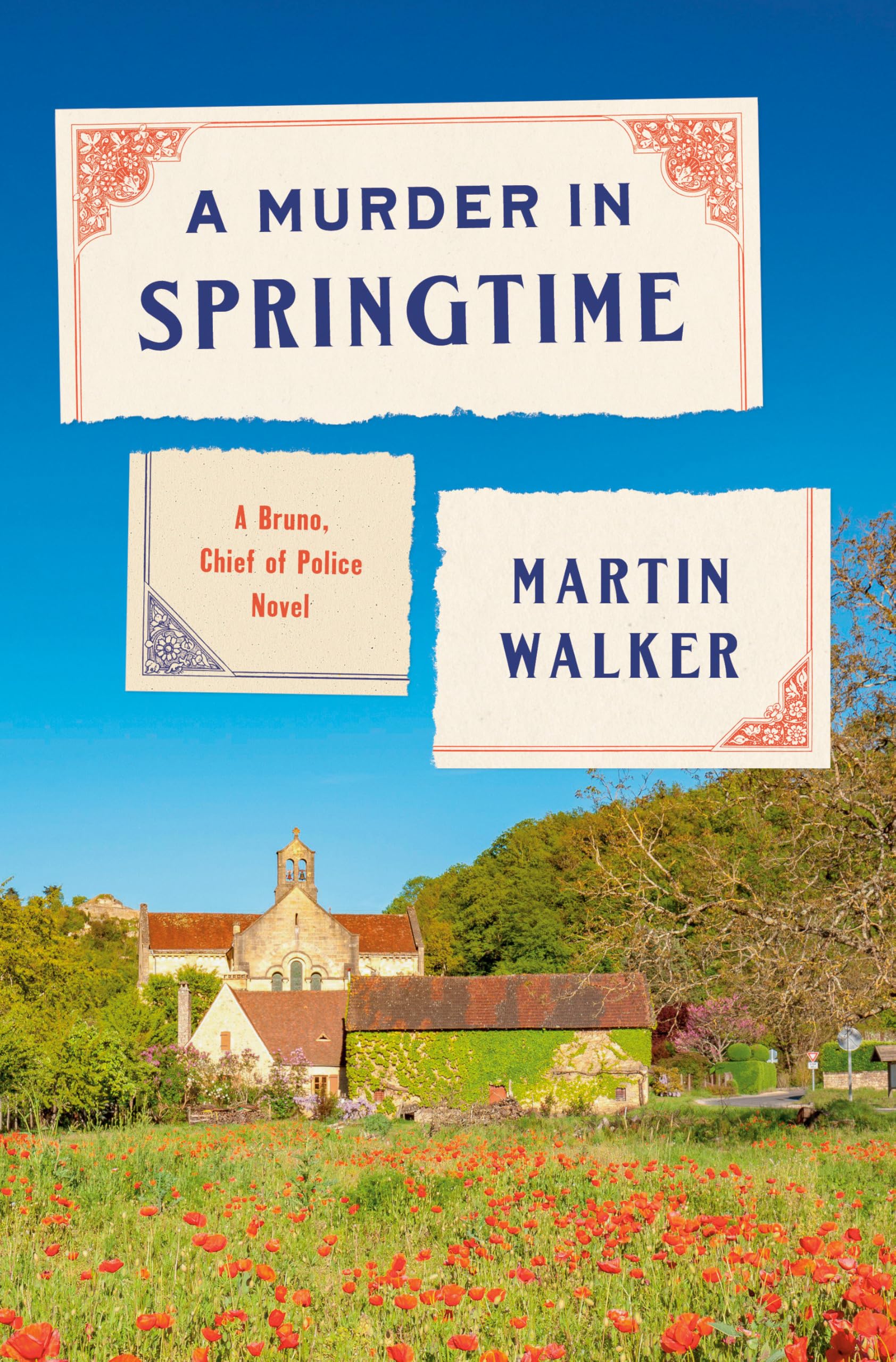
A Murder in Springtime: A Bruno, Chief of Police Novel (Bruno, Chief of Police Series)
$30.00
by Martin Walker



In the next installment of the Bruno, Chief of Police series, a newcomer to St. Denis is found dead at the home of one of Bruno’s best friends—and for once, Bruno feels as though he is too close to the case to investigate, until it becomes clear that he’s the only person who can solve the crime. After Bruno sees he’s missed several phone calls from his longtime neighbor Pamela, he has no idea what to expect. He’s shocked to hear that she’s found her new lodger on her back patio, brutally murdered. Bruno knows that Pamela isn’t capable of killing anyone, but then who’s the culprit? And what’s the motive? The victim had only just moved to town to take a job at the local nursing home. She had no enemies in the village—but no friends, either. Bruno decides that he can’t be impartial where Pamela is involved, so the force assigns the case instead to their rising star rookie, Fabien. Bruno is happy for Fabien to take the lead. Lately, Bruno’s been distracted: by his faltering relationship, by a meddlesome film crew that’s descended on the Dordogne, by a group of opinionated small business owners Bruno wants to help to organize a logistically complicated night market. He can’t seem to catch a break. But when Fabien realizes that the victim is connected to his own past, Bruno steps back in to help. The village has never felt more crowded, and the clock is ticking: Will Bruno and Fabien be able to catch a killer? After a long career working in international journalism and for think tanks, MARTIN WALKER now gardens, cooks, explores vineyards, writes, travels, and has never been busier. He divides his time between Washington D.C. and the Dordogne. Chapter 1 Bruno Courrèges, chief of police of the Vézère Valley in the département of France officially named the Dordogne but which the locals stubbornly continue to call the Périgord, was engaged in one of his favorite pursuits. He was in the kitchen of his house on a Saturday evening in winter, cooking, with a glass of wine at his elbow. This was not unusual, since he loved to feast with his friends, but on this particular evening he was cooking for two, which was less common. And he was doing so with a touch of romance in his heart, and a sense of occasion that had ensured that the carpets had been vacuumed, the sheets and towels changed and the windows scrubbed until they sparkled. His wine had been freshly poured from a bottle chilling on the steps outside the kitchen door, a locally grown Chardonnay from Château les Brandeaux. A bottle of Château Mondazur from the Pécharmant had been opened and awaited decanting. He had cooked a new batch of his own dog biscuits, not just for his basset hound, Balzac, but to be shared with an elegant young female of the same species who was also expected for dinner. She was named after the defiantly liberated novelist George Sand, who had shocked nineteenth-century France by wearing trousers and smoking in public while conducting flamboyant affairs with Chopin, de Musset and Prosper Merimée, among others. It had been Bruno’s recognition of the dog’s name, and his appreciation of her looks, style and pedigree, that had alerted him to the special attractions of George Sand’s owner, Laura Segret, who was to be his guest that evening. They had met in unhappy circumstances, connected by the suicide of Laura’s friend and business partner Monique Duhamel. Bruno had found the body, in her own car, parked near a spot of Monique’s happy childhood memories, and had brought to Laura a farewell letter addressed to her from her friend. The legal complications surrounding Monique’s death had brought Bruno and Laura repeatedly together, and mutual admiration for each other’s dogs soon turned into mutual attraction between their owners. Cooking for a lover was special, Bruno thought, an act of love in itself. There was the planning of the setting; should lovers sit face-to-face? But the magic of touch would be much easier if one sat at the head of the table and the other alongside. It would also facilitate one of the special pleasures of lovers dining together, to offer choice forkfuls to the beloved. And then there was the choosing of the menu—nothing too heavy—and then of the wines, to be enjoyed in moderation. Bruno had decided to present as a first course a little smoked salmon. It was to be accompanied by two thin slices of toasted whole wheat bread, generously smeared with avocado and a touch of black pepper. He had already prepared the dessert, a light syllabub of lemon juice, double cream and two wineglasses of Rosette, the sweet but light white wine that was unique to the Bergerac. Bruno had experimented with the dessert wine of the region, Monbazillac, but found it tended to dominate. These two dishes had been already prepared and were cooling in the fridge. For the main course, he had decided on duck legs, picked up the previous day from his friends at the Lac Noir farm, which sold so many breasts to restaurants for mag