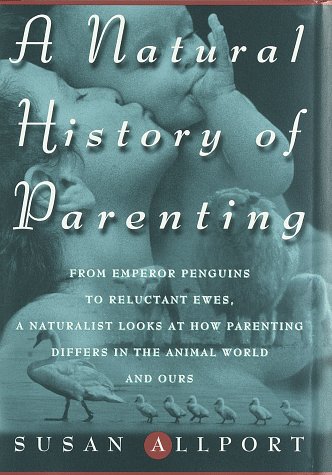
A Natural History of Parenting: From Emperor Penguins to Reluctant Ewes, a Naturalist Looks at Parenting in the Animal World and Ours
$3.99
by Susan Allport



"We humans parent our young longer than any other animal on earth. For us, parenting is such an essential part of reproduction that we tend to think of parenting as an essential part of all reproduction. . . . Most creatures living on the earth today do not bother with such things at all. Beyond producing good-sized eggs and finding, perhaps, a suitable spot to lay them, most animal parents never give their young any kind of care. They never even see their young. And were they to see them, they would be much more inclined to eat them than to offer them food, protection, or guidance." In A Natural History of Parenting,Susan Allport, a naturalist and science writer, explores the exciting and often startling dynamics of maternal and paternal behavior among the species. When one of the ewes Allport was raising refused to mother her new lamb, she was forced to reconsider many of her preconceptions about the world of parenting. She began to explore the roots of parental instincts across the broad spectrum of the animal kingdoms. In A Natural History of Parenting, she examines the awesome diversity of nature to reveal what we share with insects, birds, and other animals, and, just as important, how we differ from them. Allport's study takes the reader from caves in Texas filled with twenty million bats to huge tanks of beluga whales at the New York Aquarium, from the icy reaches of East Greenland where Arctic wolves raise their young to ant nests where huge labor pools have led to primitive infant care. Along the way, she gathers research on myriad creatures--beavers and wasps, birds and elephants, frogs and humans--to show us a magnificent variety of parental behavior among species, from a male emperor penguin forgoing nourishment to spend weeks protecting an egg balanced on the top of his feet to the manifestations of the human female's "nesting instinct. Susan Allport is the best kind of science writer--knowledgeable, inquisitive, and entertaining. This invaluable book will ensure that you never again think in the same way of how and why we nurture our young. "Susan Allport tackles a complex subject head on with penetrating analysis. Her acute observations, introspection, and logical conclusions capture the essence of the whole spectrum of understanding parenting, and make major contributions to the delicate art of rearing children. Allport has given parenting a fresh and exciting direction. The next century will need just such courageous and responsive attention to the underpinnings of the human society. " --Kenneth A. Chambers, zoologist at the American Museum of Natural History and author of A Country Lover's Guide to Wildlife One of the important points in Susan Allport's A Natural History of Parenting is made in the subtitle: ... A Naturalist Looks at How Parenting differs [emphasis added] in the Animal World and Ours . Everyone admits that not all adult humans are alike, and anyone with more than one child knows that not all babies are alike. Allport recognizes that not all sheep or puffins are alike, either. Her survey of the variability and stresses of parenting across the animal kingdom proves that seeing biological factors in human behavior doesn't mean seeing only one correct and natural way to raise children. YA?Within the natural world, survival is the primary objective. This fascinating book looks at the reproduction and parenting patterns of a variety of birds, fish, and mammals and examines the ways in which these animals adapt to maximize their odds of reproducing successfully, even if that means abandoning offspring. In a clear and lively manner, Allport explores such topics as how and where various animals build nests, why most primates give birth at night, and the specific composition of various mammal's milk. YAs will learn about biology, sociology, anthropology, and family organization, and how humans compare with other species in the basic areas of reproduction, parenting, and nurturing.?Judy Sokoll, formerly at Fairfax County Public Library, VA Copyright 1998 Reed Business Information, Inc. Allport's extremely readable book on a complex subject answers the question of why there are so many ways of raising offspring in the animal kingdom. The author's interest in this subject was sparked when an ewe she owned showed no interest in her first lamb, but the book covers more than just the mammals. By interweaving descriptions of unusual reproductive behavior in insects, fish, amphibians, reptiles, birds, and mammals with theories explaining the evolutionary advantages of those behaviors, Allport shows how well popular writing can explain science. Although she mentions the names of a number of researchers in the field, citations for all her interesting observations would have been helpful--the reader is left to glean from the bibliography. Allport explains complicated theories very clearly and often relates the discussion to the patterns found in human societies. In sp