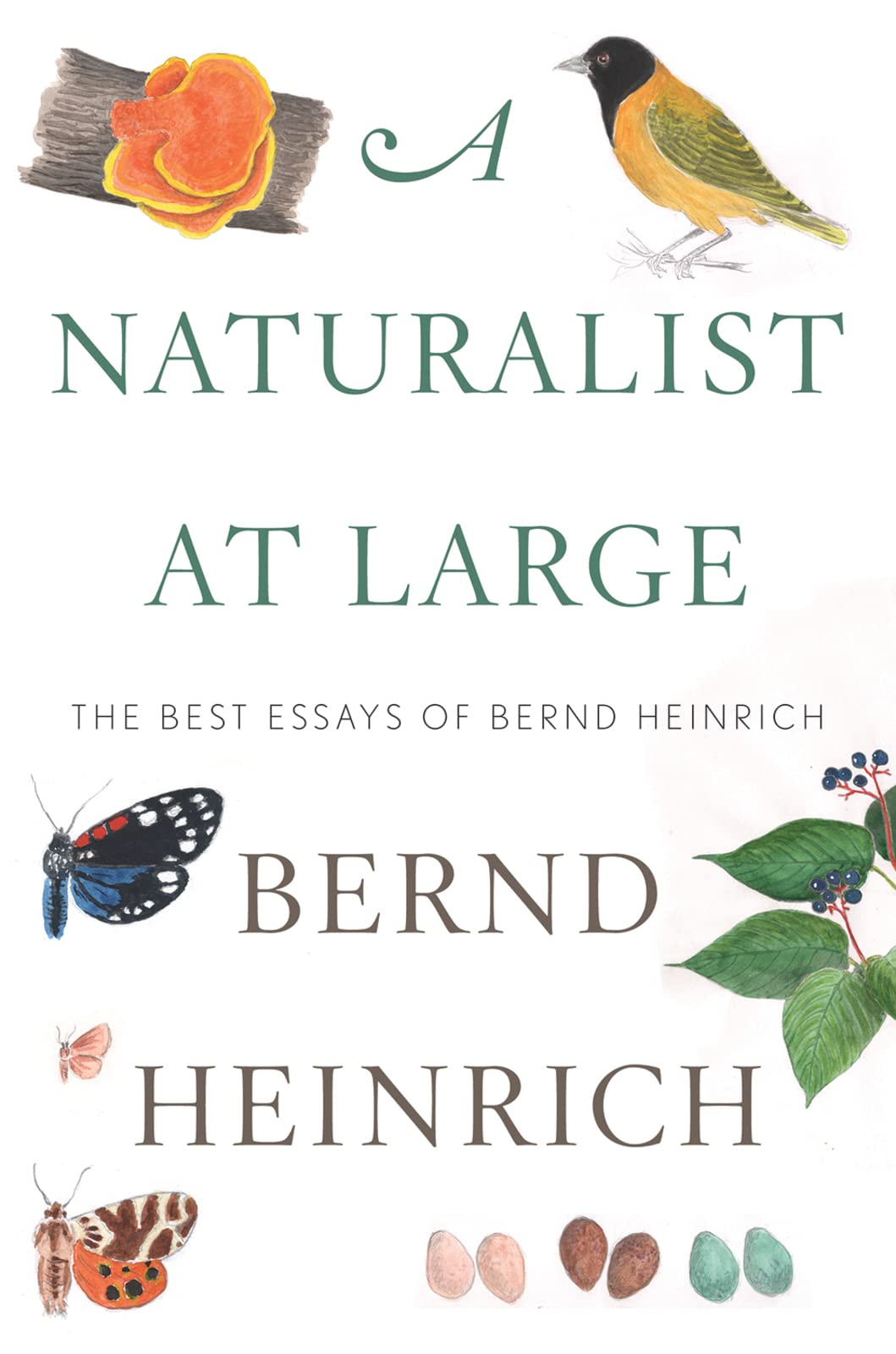
A Naturalist At Large: The Best Essays of Bernd Heinrich – Acclaimed Natural History and Memoir from Decades of Discovery
$18.94
by Bernd Heinrich



Some of the world’s greatest writings on ravens and other birds, insects, trees, elephants, and more, collected for the first time in book form showing why Bernd Heinrich is so beloved for his “passionate observations [that] superbly mix memoir and science” ( New York Times ) From one of the finest scientist/writers of our time comes an engaging record of a life spent in close observation of the natural world, one that has yielded “marvelous, mind-altering” (Los Angeles Times) insight and discoveries. In essays that span several decades, Heinrich finds himself at home in Maine, where he plays host to visitors from Europe (the cluster flies) and more welcome guests from Asia (ladybugs); and as far away as Botswana, where he unravels the far-reaching ecological consequences of elephants’ bruising treatment of mopane trees. The many fascinating discoveries in Naturalist at Large include the maple sap harvesting habits of red squirrels, and the “instant” flower-opening in the yellow iris as a way of ensuring potent pollination. Heinrich turns to his great love, the ravens, some of them close companions for years, as he designs a unique experiment to tease out the fascinating parameters of raven intelligence. Finally, he asks “Where does a biologist find hope?” while delivering an answer that informs and inspires. Praise for One Wild Bird at a Time "[Bernd Heinrich is] a dedicated watcher happy to knock down the fourth wall of zoology." —Wall Street Journal Praise for The Homing Instinct “Deep and insightful writing.” — David Gessner, Washington Post Praise for Life Everlasting "Despite focusing on death and decay, Life Everlasting is far from morbid; instead, it is life-affirming . . . convincing the reader that physical demise is not an end to life, but an opportunity for renewal."— Nature Praise for Bernd Heinrich “He richly deserves the comparison to Thoreau.”— Washington Post Book World “Passionate observations [that] superbly mix memoir and science.”— New York Times Book Review BERND HEINRICH is an acclaimed scientist and the author of numerous books, including the best-selling Winter World, Mind of the Raven, Why We Run, The Homing Instinct, and One Wild Bird at a Time. Among Heinrich's many honors is the 2013 PEN New England Award in nonfiction for Life Everlasting. He resides in Maine. Life in the Soil (Adapted from 'Life in the Soil," Natural History Magazine (NHM) , November 2014, pp. 13'15) Papa, Mamusha, and my sisters Ulla and Marianne, and I (the latter two of us age five and almost eleven) were quartered in a one-room hut in a dark forest in northern Germany right after World War II. Towering pines, spruce, and beech shaded the ground except for a small sloping patch in front of the cabin. Light snow had recently covered the ground, and now, after a warm spring rain, it had become black, and that made me notice something marvelous by our doorstep. From one day to the next, I saw a small patch of the dirt turning a luminous green. Perhaps the next day or so after that, the patch of dirt had expanded over the black ground: I was mesmerized by this verdant, magically spreading circle of grass blades. This was, as far as I can remember, my earliest moment of wonder. Had grass been underfoot before, I would have hardly noticed it, from seeing it all the time. But watching that single patch expand from one day to the next was a moment of magic and mystery, maybe even of ecstasy, forever stamped into my memory. Even so, for a long time the dirt the grass had spawned from remained for me merely something crumbly under the soles of my feet and between my toes. It was the sand on a mile or so of the wooded road between our hut and the village school. Shiny green beetles flashed in front of me on my walks, and after a brief zigzagging flight, where they glinted like jewels in the sun, they landed a few yards ahead. We called them 'sand beetles," and later I knew them as tiger beetles. Although I couldn't fly, I could run, and it felt good to be on par with such gorgeous company. Tiger beetles (of the family Cicindelidae) are related to carabids, which are commonly called ground beetles, or Laufkäfer. ' Ground beetles do not fly, but they all run (which is reflected in their German name, derived from laufen, 'to run'). These earthbound beetles soon became my passion, to have and to hold. It came through the influence of my father, a biologist. In order to get some cash he was now digging tree stumps out of the ground that had been left by the occupying British soldiers who had harvested the trees. He earned a few pfennigs selling the wood. But he decided the pits he was digging might be adapted to serve as traps to catch mice and shrews. It was exciting for me to accompany him, ever more so because ground beetles fell into the pits too, and he showed me how to preserve and thus to collect them like some other kids then collected stamps. He gave me a