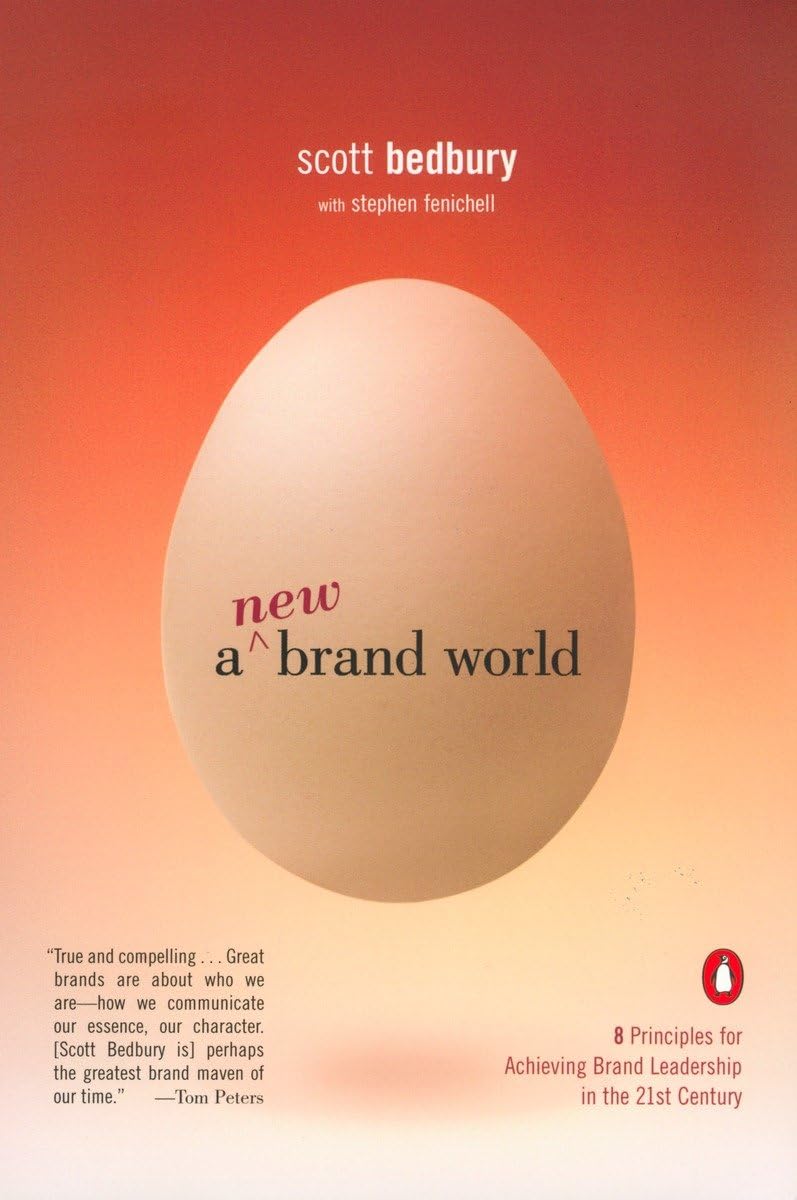
A New Brand World: Eight Principles for Achieving Brand Leadership in the Twenty-First Century
$16.00
by Scott Bedbury



What does it really take to succeed in business today? In A New Brand World , Scott Bedbury, who helped make Nike and Starbucks two of the most successful brands of recent years, explains this often mysterious process by setting out the principles that helped these companies become leaders in their respective industries. With illuminating anecdotes from his own in-the-trenches experiences and dozens of case studies of other winning—and failed—branding efforts (including Harley-Davidson, Guinness, The Gap, and Disney), Bedbury offers practical, battle-tested advice for keeping any business at the top of its game. "I don't think there is anyone in the world who knows more about brands than Scott Bedbury — there is certainly no one who can tell his story and make his points with such insight and wit. A New Brand World gives you the inside story of Nike, Starbucks and other top brands with sharp commentary and analysis. This is a highly entertaining read, but one with many valuable lessons about how to build and manage strong brands. Inspiring and informative, it will make you a better marketer. It got the left side of my brain buzzing, the left side humming, and my brand mojo working! —Kevin Lane Miller , E.B. Osborn Professor of Marketing, Amos Tuck School of Business "This is an 'anthology' of great branding stories that is as entertaining as it is informative." — Business Book Review "[Bedbury is] perhaps the greatest brand maven of our time." — Tom Peters Scott Bedbury was Senior Vice President of Marketing at Starbucks from 1995 to 1998. Prior to that he spent seven years as head of advertising for Nike, where he launched the "Bo Knows" and "Just Do It" campaigns. He is currently an independent brand consultant and a speaker for the Leigh Bureau. Stephen Fenichell is the author of Plastic: The Making of A Synthetic Century and Other People's Money . His articles have appeared in New York , Men's Journal , GQ , Lear's , Spy , Connoisseur , Condé-Nast Traveler , and Wired . 1: all aboard the brandwagon Principle #1 Relying on brand awareness has become marketing fool's gold. You've probably noticed in the past couple of years that once-arcane phrases like "brand dilution," "brand synergy," "brand equity," and "brand recognition" have begun tripping lightly off just about every tongue in the business punditocracy. Such glib terms and phrases are typically uttered not only with a straight face but also with a solemn pursing of the lips and no detectable trace of irony. "In the landmark 1967 film The Graduate," the New York Times business reporter Joel Sharkey recently wrote, "there is the famous scene at the cocktail party where a helpful older man whispers this single word of business advice into the ear of a callow, befuddled young Dustin Hoffman: 'Plastics.' Remake the movie today, and you'd have to change the line to 'branding.'" These days, the term "branding" is being uttered in the same pious, reverential tones formerly reserved for buzz words like "synergy," "leverage," and "strategic planning." The brand idea is no longer confined just to packaged consumer products. Today the word "brand" has become part of the vernacular within every department of any progressive company. It is on everyone's radar screen, though not everyone really knows what it means. Personally, and speaking as something of a brand fool, all this loose talk makes me nervous. For it was only a few years ago that everyone had given brands up for dead. Brand Awareness Versus Brand Strength Step back to the spring of 1993, when Marlboro, one of the world's most recognizable brands (if not the most recognizable) stunned the marketing world when it announced that it would have to aggressively cut its cigarette prices to stay competitive. The move was prompted by an onslaught of lower-cost, less-known competitors. Some of these were essentially generic, without any real brand sensibilities or public recognition in the market, other than that they were cheap. Others were barely brands in their own right. Wall Street analysts hammered Marlboro's parent company Philip Morris's stock, and several business magazines heralded the death of branding the very next week. According to them, it was price, not brand image, that would matter in the future. Building a strong brand was a concept that had run its course. My friend Watts Wacker, a professional futurist, had it right when he stated at an Association of National Advertisers conference that year, "I believe the nineties officially began with Marlboro's inability to sustain its price. When the number one brand realized that its value proposition (what the brand was really 'worth' in the minds of the customer) was out of sync, that underlines the difference between a pig and a hog." Asked by one conference participant to define that difference, Wacker gamely replied, "You feed a pig, but you slaughter a hog. Brands can be piggy, but they can't be hogs." To me, the Marl