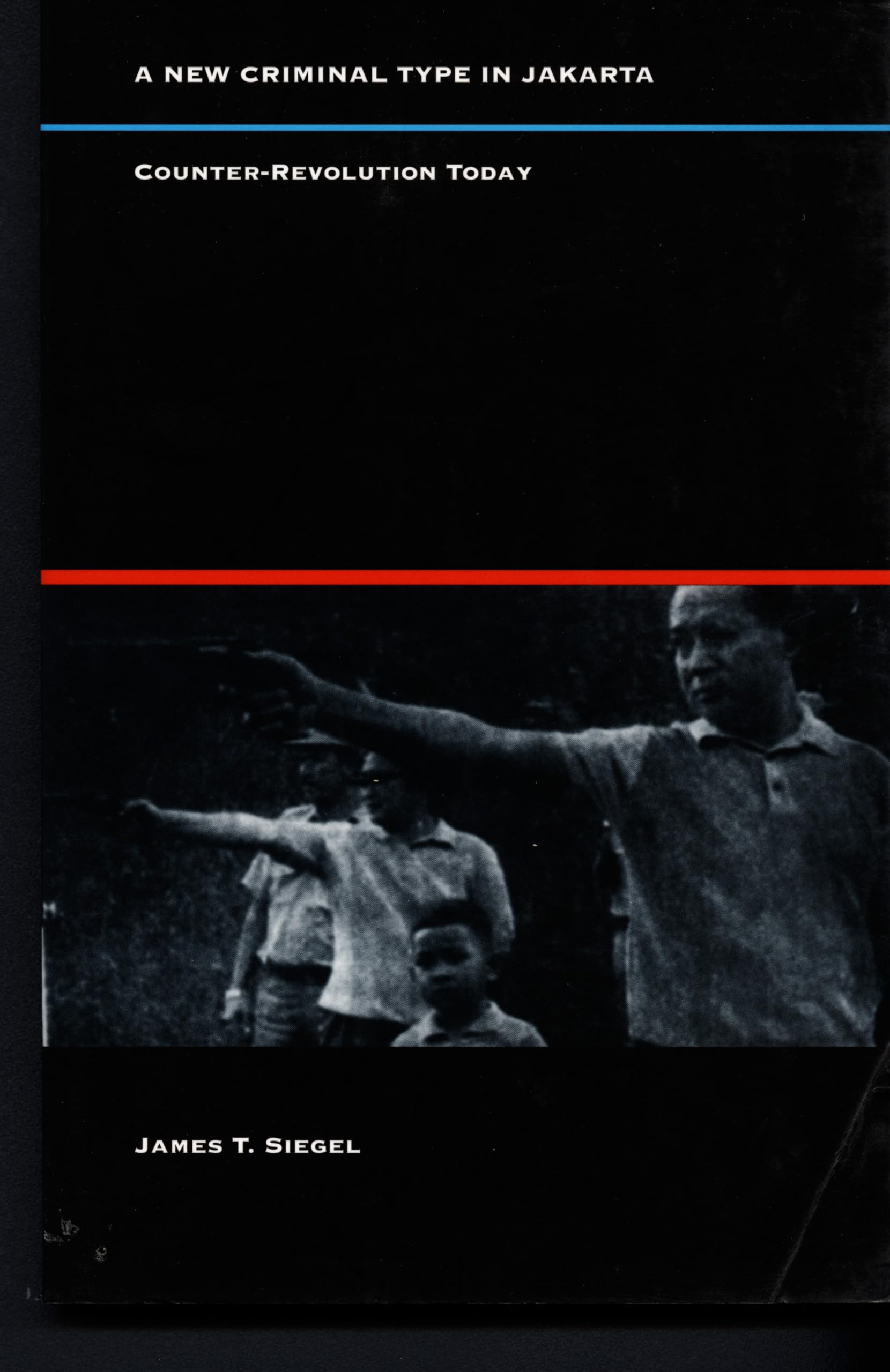



In A New Criminal Type in Jakarta , James T. Siegel studies the dependence of Indonesia’s post-1965 government on the ubiquitous presence of what he calls criminality, an ensemble of imagined forces within its society that is poised to tear it apart. Siegel, a foremost authority on Indonesia, interprets Suharto’s New Order—in powerful contrast to Sukarno’s Old Order—and shows a cultural and political life in Jakarta controlled by a repressive regime that has created new ideas among its population about crime, ghosts, fear, and national identity. Examining the links between the concept of criminality and scandal, rumor, fear, and the state, Siegel analyzes daily life in Jakarta through the seemingly disparate but strongly connected elements of family life, gossip, and sensationalist journalism. He offers close analysis of the preoccupation with crime in Pos Kota (a newspaper directed toward the lower classes) and the middle-class magazine Tempo . Because criminal activity has been a sensationalized preoccupation in Jakarta’s news venues and among its people, criminality, according to Siegel, has pervaded the identities of its ordinary citizens. Siegel examines how and why the government, fearing revolution and in an attempt to assert power, has made criminality itself a disturbing rationalization for the spectacular massacre of the people it calls criminals—many of whom were never accused of particular crimes. A New Criminal Type in Jakarta reveals that Indonesians—once united by Sukarno’s revolutionary proclamations in the name of “the people”—are now, lacking any other unifying element, united through their identification with the criminal and through a “nationalization of death” that has emerged with Suharto’s strong counter-revolutionary measures. A provocative introduction to contemporary Indonesia, this book will engage those interested in Southeast Asian studies, anthropology, history, political science, postcolonial studies, public culture, and cultural studies generally. “James T. Siegel tells the story of a nation not able to contain its revolution and makes us feel the pathos of its aftermath. This special book challenges any market-optimistic approach to the understanding of Indonesia and non-Western societies in general.”—Rudolf Mrázek, University of Michigan “The mastermind Suharto conducts his murderous regime of nepotism with cunning and with a profound understanding of Indonesian history, its racial myths and violent obsessions. James Siegel’s amazing book thankfully appears when we need most of all to understand the mind of a dictator, the ruin he has brought upon his country’s democracy, and the further horrors of which he is capable, which may consume us all.”—Rickard Klein, Cornell University "James T. Siegel tells the story of a nation not able to contain its revolution and makes us feel the pathos of its aftermath. This special book challenges any market-optimistic approach to the understanding of Indonesia and non-Western societies in general."--Rudolf Mrazek, University of Michigan James T. Siegel is Professor of Anthropology and Asian Studies at Cornell University and author of numerous books, including Solo in the New Order: Language and Hierarchy in an Indonesian City and Fetish, Recognition, Revolution . A New Criminal Type in Jakarta Counter-Revolution Today By James T. Siegel Duke University Press Copyright © 1998 Duke University Press All rights reserved. ISBN: 978-0-8223-2241-2 Contents Acknowledgments, A New Criminal Type in Jakarta, Introduction: Killing Those in One's Own Image, 1 Illegitimacy and "the People", 2 Bastards, Revolution, and Kriminalitas, 3 In Lieu of "the People": The Replacement of Ghosts, 4 A New Criminal Type in Jakarta: The Nationalization of Death, 5 Counter-Revolution Today: Neither the Story nor Stories—Words and Photographs, Notes, CHAPTER 1 Illegitimacy and "The People" In the Adat [customary] law even an illegitimate child can become an heir. —Kijaji R. H. Moh. Adnan In his Autobiography: As Told to Cindy Adams (Jakarta: Gunung Agung, 1965) President Sukarno speaks of his youth; he tells how poor his family was. His father could not afford a midwife. Then he leaps forward in time to speak of the rumor about his birth that circulated after he became prominent and that one could still hear in 1965. He says they say: "He is the illegitimate son of a Dutch planter who made love with a native peasant in the field, then farmed the baby out for adoption." Unfortunately the only witness to swear to my real father and to testify that I did, indeed, come from my true mother, not some coffee worker in the field, had long since passed away. (18–19) It is a question of his parentage and, therefore, of his legitimacy. The story was told by the Dutch in order to claim him for themselves and thus, no doubt, to show that an opponent who could defeat them must be one of them, not a mere "native." For the D