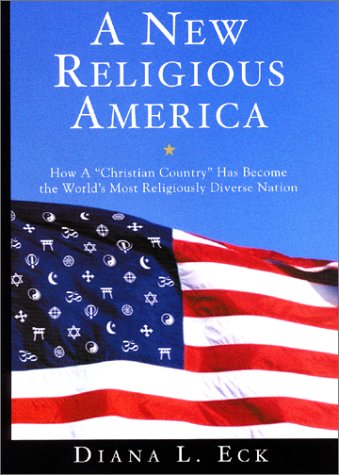
A New Religious America: How a "Christian Country" Has Become the World's Most Religiously Diverse Nation
$12.95
by Diana L Eck



"The United States is the most religiously diverse nation in the world," leading religious scholar Diana Eck writes in this eye-opening guide to the religious realities of America today. The Immigration Act of 1965 eliminated the quotas linking immigration to national origins. Since then, Muslims, Buddhists, Hindus, Sikhs, Jams, Zoroastrians, and new varieties of Jews and Catholics have arrived from every part of the globe, radically altering the religious landscape of the United States. Members of the world's religions live not just on the other side of the world but in our neighborhoods; Hindu children go to school with Jewish children; Muslims, Buddhists, and Sikhs work side-by-side with Protestants and Catholics. This new religious diversity is now a Main Street phenomenon, yet many Americans remain unaware of the profound change taking place at every level of our society, from local school boards to Congress, and in small-town Nebraska as well as New York City. Islamic centers and mosques, Hindu and Buddhist temples, and meditation centers can be found in virtually every major American metropolitan area. There are Muslims, Hindus, and Buddhists in Salt Lake City, Utah; Toledo, Ohio; and Jackson, Mississippi. Buddhism has become an American religion, as communities widely separated in Asia are now neighbors in Los Angeles, Seattle, and Chicago. Eck discovers Muslims worshiping in a U-Haul dealership in Pawtucket, Rhode Island; a gymnasium in Oklahoma City; and a former mattress showroom in Northridge, California. Hindu temples are housed in a warehouse in Queens, a former YMCA in New Jersey, and a former Methodist church in Minneapolis. How Americans of all faiths and beliefs can engage with one another to shape a positive pluralism is one of the essential questions -- perhaps the most important facing American society. While race has been the dominant American social issue in the past century, religious diversity in our civil and neighborly lives is emerging, mostly unseen, as the great challenge of the twenty-first century. Diana Eck brilliantly analyzes these developments in the richest and most readable investigation of American society since Robert Bellah's classic, The Habits of the Heart. What Eck gives us in A New Religious America is a portrait of the diversity of religion in modern America, complete with engaging characters, fascinating stories, the tragedy of misunderstanding and hatred, and the hope of new friendships, offering a road map to guide us all in the richly diverse America of the twenty-first century. An eye-opening Account of the changing Landscape of America The 1990s saw the U.S. Navy commission its first Muslim chaplain and open its first mosque. - There are presently more than three hundred temples in Los Angeles, home to the greatest variety of Buddhists in the world. - There are more American Muslims than there are American Episcopalians, Jews, or Presbyterians. America has always been a fundamentally Christian or "Judaeo-Christian" country with a few atheists and agnostics included. We're a secular, pluralist polity within that framework or so the received opinion goes. But in this wide-ranging book, Eck (religious studies, Harvard) shows us that this received opinion is erroneous. The framework is now, and in fact has always been, much broader. Eck discusses the history in America of three religious traditions with large numbers of adherents: Islam, Buddhism, and Hinduism. Islam, she shows, arrived with African slaves. Buddhism and Hinduism came early as well, with the first Asian immigrants to the West Coast. These faiths are growing rapidly because of recent changes in our immigration laws and political turmoil in much of Asia, and thus our sense of religious pluralism needs to broaden. Well written and thorough, this volume will appeal especially to scholars, but casual readers will find much to enlighten them. Warmly recommended for both academic and public libraries. James F. DeRoche, Alexandria, VA Copyright 2001 Reed Business Information, Inc. This excellent overview of America's exploding religious diversity doubles as an impassioned call to action. In a sweeping introduction, Eck shows that since the changes in immigration laws in the 1960s, the nation's religious constituency has been altered forever. There are now as many Muslims living in the U.S. as there are Jews or Episcopalians. From Toledo, Ohio, to Eck's hometown, Cambridge, Massachusetts, the religious landscape has changed but so subtly that it has largely gone unnoticed. Soon, Eck argues, we will have to face up to the radical changes wrought by this newly grown religious diversity. After chapters focused on U.S. Hindus, Buddhists, and Muslims, Eck opens a larger discussion of the meaning of religious diversity and freedom in America. She starts with the motto on U.S. currency, e pluribus unum , and examines, in her final chapter, the models Americans can use to still become one from many. Immen