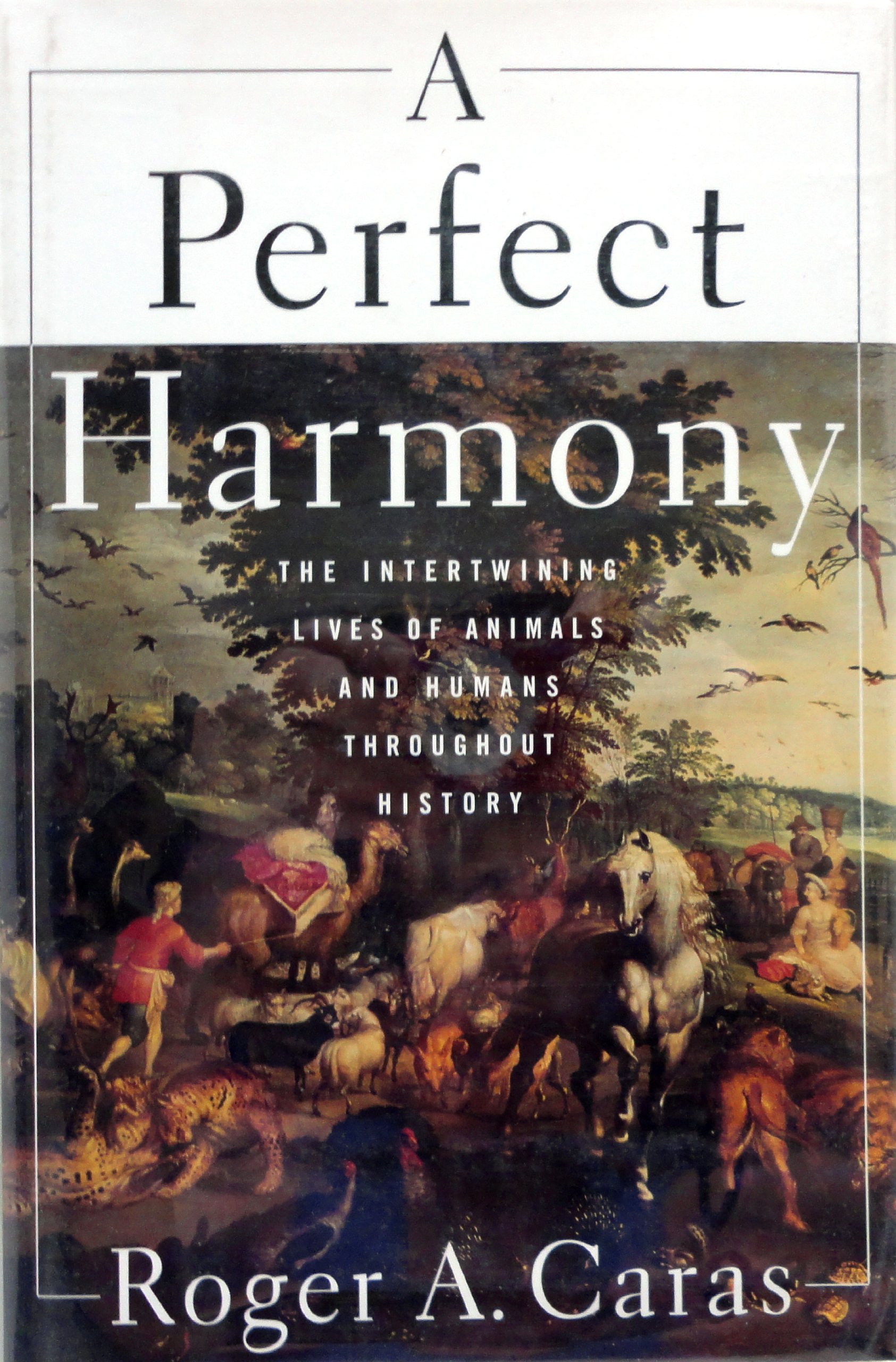
A PERFECT HARMONY: The Intertwining Lives of Animals and Humans Throughout History
$18.95
by Roger A. Caras



What would today's world be like if man had not domesticated animals? This is the question that celebrated animal expert Roger Caras explores in A Perfect Harmony. A fascinating and colorful combination of history, anthropology, and personal experience, the book examines animal species both familiar and exotic in order to illustrate their monumental impact on the development of civilization. Accessible, absorbing, and wonderfully appealing, A Perfect Harmony illuminates a vital but virtually ignored aspect of human history: the partnership between man and domestic animals through the ages. At the dawn of civilization, Caras asserts, man alone was unable to take the giant steps necessary to achieve our current levels of technology and sophistication. But at each stage in our cultural evolution, he writes, domesticated animals enabled us to move on to the next level. The extent of our dependence upon these animals - which have provided us with food, clothes, shelter, and means of transport - is beyond calculation. By turns wicked and wry, passionate and poignant, Caras illustrates how every domesticated animal from the reindeer to the silkworm has provided some valuable service to its human masters and has, in many cases, altered the course of history. Humanity's relationship with animals both domestic and wild is a topic not often discussed as a part of history. It is a vital aspect of human history, however, as the domestication of animals had a monumental impact on human affairs, making much of human progress possible-exploration, travel, agriculture, and the birth of industry. Caras is the current president of the ASPCA as well as a prolific author of articles and books on pets and wildlife. Here he offers a unique, and sometimes surprising, discussion of our continuing life with animals. Devoting each chapter to a particular species-goats, sheep, dogs, cattle, elephants, etc.-he introduces the reader to the unique characteristics of each species and gives a brief history of its development. The book is well written and researched and is logically organized. As there is little literature on this topic, A Perfect Harmony will be of interest both to curious lay readers and scholars in the field. Deborah Emerson, Monroe Community Coll., Rochester, N.Y. Copyright 1996 Reed Business Information, Inc. An informative, insightful, though also rather dry history of animal domestication through the ages, by ASPCA president Caras, author of numerous fine works on pets and wildlife (The Cats of Thistle Hill, 1994, etc.). As Caras defines it, domestication is ``the shaping of a species by man, using selective breeding to replace natural selection.'' In studiously reviewing the origins and probable methods of domestication, as well as the ancestry of all manner of animals, from goats and horses in the Stone Age to camels and elephants around 4000 b.c., to ferrets and cats in more recent years, Caras explains how ``animals have played a vital role in man's evolutionary course.'' For example, having a ready supply of goats at hand allowed humans to travel in desert and mountain areas for the first time, and also enabled the once-nomadic human race ``to feed ever-growing concentrations of people, allowing towns and later cities to grow.'' And the Industrial Revolution was spawned at least in part, says Caras, by the huge flocks of sheep that grazed in Europe at the beginning of the 18th century, providing both wealth and wool to fuel the change. Along the way, though, there have been numerous downsides to domestication. The very goat that ``led man out of the darkness of the cave . . . has today, by the billions, stripped the vegetation off the land and changed the face of continents.'' And feral animals--domesticated species that have wound up back in the wild--have wreaked havoc on wildlife in many areas of the world. Throughout, Caras is steadfast in repeating a specific moral message: that domesticated animals are generally treated cruelly though they give us much, and that we need to be more caring and compassionate toward them. A conglomeration of fact, lore, and speculation, of primary interest to the natural history buff rather than the usual Caras followers. -- Copyright ©1996, Kirkus Associates, LP. All rights reserved.