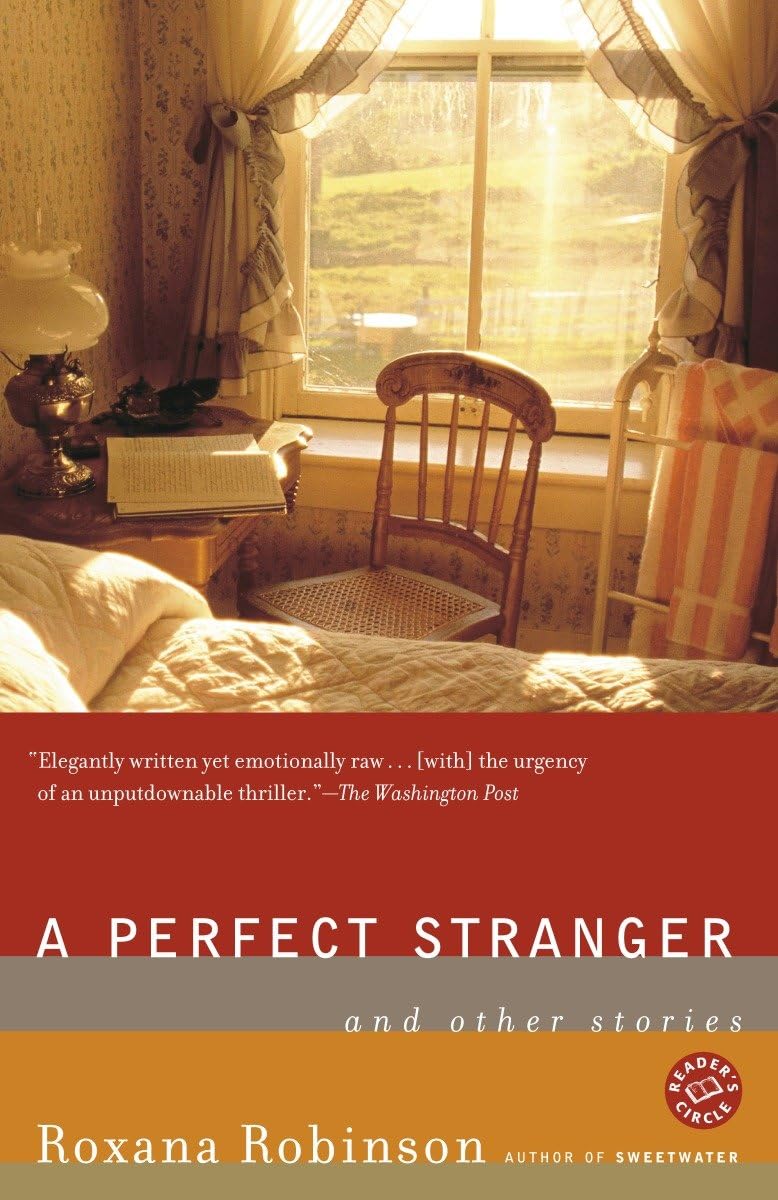



In Roxana Robinson’s lucid and elegant prose, her characters’ inner worlds open up to us, revealing private emotional cores that are familiar in their needs, their secrets, and their longings. These people tell us the truth–not only about themselves, their relationships, and their lives, but about ourselves as well. A Perfect Stranger powerfully and affectingly examines the complex, intricate network of experiences that binds us to one another. These stories are tender, raw, lovely, fine–and they reaffirm Roxana Robinson’s place at the forefront of modern literature. “Elegantly written yet emotionally raw . . . [with] the urgency of an unputdownable thriller.” –The Washington Post “**** . . . Robinson fills her pages with detailed, sensuous writing that strikes a deep emotional chord. . . . [A] splendid collection.” –People “[Robinson’s stories chart] the ebb and flow of affection and fury within relationships [and] carry us across the spectrum of human experience.” –The New York Times Book Review “If stories were paintings, Roxana Robinson’s short works in A Perfect Stranger . . . could be seen for what they really are: little marvels of light and shadow.” –O: The Oprah Magazine “Brilliant . . . vivid stories . . . a mesmerizing writer.” –The Seattle Times “Start in on any sentence and I’m absolutely sure you’ll read to the end of the story, and of the book, and you’ll come out of it feeling grateful, deeply stirred, seriously happy.” –Alice Munro In Roxana Robinson's lucid and elegant prose, her characters' inner worlds open up to us, revealing private emotional cores that are familiar in their needs, their secrets, and their longings. These people tell us the truth-not only about themselves, their relationships, and their lives, but about ourselves as well. In "Family Christmas," a young girl takes a holiday trip to her grandparents', where the formal atmosphere is shattered by a mysterious and chaotic event that she knows she's too young to understand but struggles to comprehend. In "Blind Man," a college professor copes with the onslaught of grief after his daughter's death. In "The Face Lift," two college friends renew their bond across a great cultural divide. The sad and hilarious "Assistance" flawlessly details the tragicomic aspects of ageing-seen through the eyes of a daughter-turned-caretaker. The terrors of illness are explored in "The Treatment," and in "Assez," a trip to Provence reveals the true volatility of love-and reminds us that we often don't realize that what we have is enough until it's gone. "A Perfect Stranger powerfully and affectingly examines the complex, intricate network of experiences that binds us to one another. These stories are tender, raw, lovely, and fine-and they reaffirm Roxana Robinson's place at the forefront of modern literature. ROXANA ROBINSON is the author of two novels, Sweetwater and This Is My Daughter; a biography of Georgia O’Keeffe; and two previous short-story collections, A Glimpse of Scarlet and Asking for Love . Four of her works have been named Notable Books of the Year by The New York Times . She has received fellowships from the Guggenheim Foundation, the National Endowment for the Arts, and the MacDowell Colony. Robinson’s fiction has appeared in Best American Short Stories , The Atlantic , The New Yorker , Harper’s, Daedalus, and Vogu e. She lives in New York City and Westchester County, New York. Family Christmas At Christmas, we went to my grandparents’. My grandparents lived outside New York in a private park, a strange nineteenth-century hybrid between a club and a housing development. The Park was enclosed by a thick stone wall, and at the entrance was a pair of stone gateposts, and a gatehouse. As we approached the gate, a man appeared in the doorway of the gatehouse, sternly watching our car. Our father, who knew the gatekeeper, would roll down his window and say hello, or sometimes he would just smile and wave, cocking his hand casually backward and forward. The gatekeeper would recognize my father then and nod, dropping his chin slowly, deeply, in confirmation of an unspoken agreement, and we would drive through the gates into the Park. One year there was a gatekeeper who did not know my father. The new man stepped out of the gatehouse as we approached and waved heavily at the ground, motioning for us to stop. He was frowning in an official way. “He’s new,” said my father, slowing down. “Never seen him before.” My mother laughed. “He probably won’t let us in,” she said. My father pulled up to the gatehouse and rolled down his window. “We’re here to see my family, the Weldons,” he said politely. “I’m Robert Weldon.” My father looked like his father: he had the same blue eyes, the long straight nose, and the high domed forehead. The gatekeeper glanced noncommittally at the car, and then he nodded. He was still frowning, but now in a private, interior way that no longer seemed to have anything to do with us. He gav