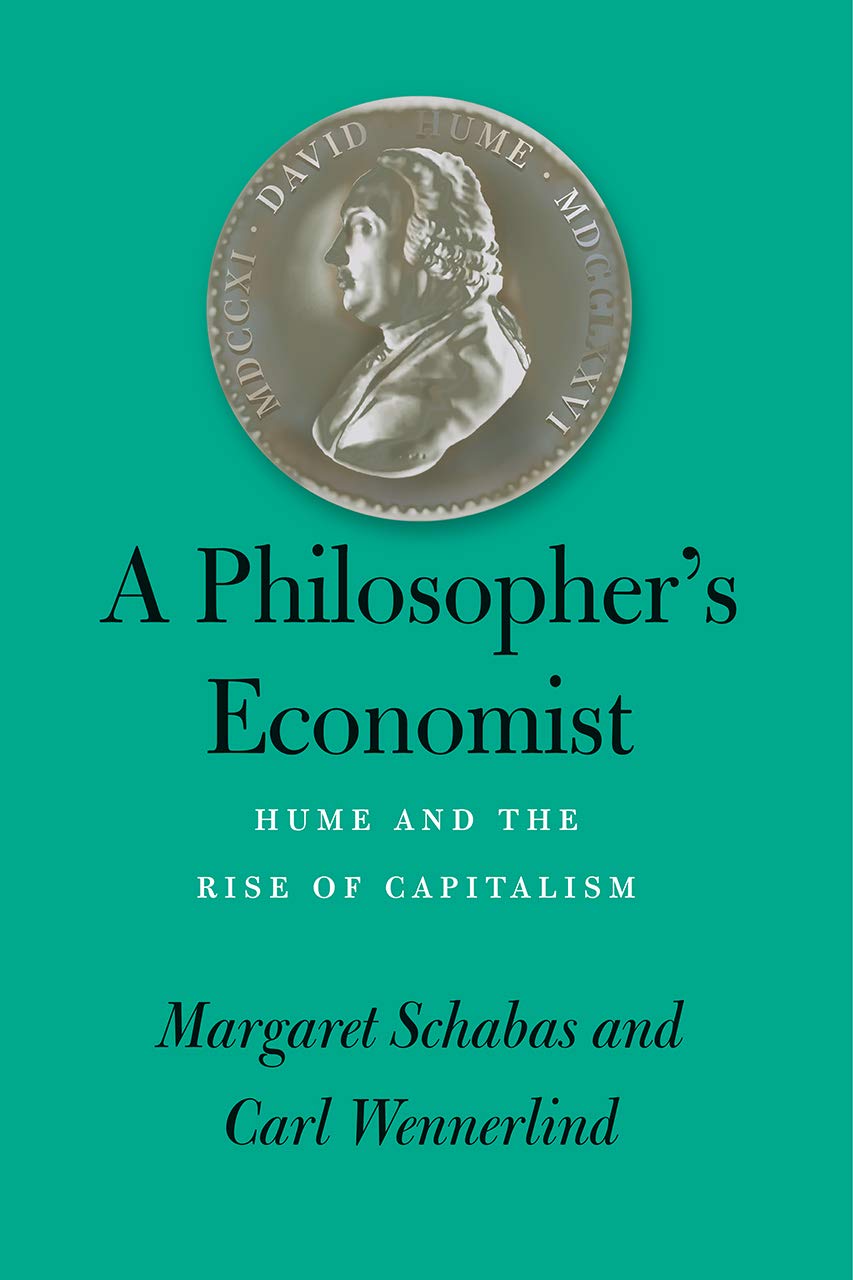



Reconsiders the centrality and legacy of Hume’s economic thought and serves as an important springboard for reflections on the philosophical underpinnings of economics. Although David Hume’s contributions to philosophy are firmly established, his economics has been largely overlooked. A Philosopher’s Economist offers the definitive account of Hume’s “worldly philosophy” and argues that economics was a central preoccupation of his life and work. Margaret Schabas and Carl Wennerlind show that Hume made important contributions to the science of economics, notably on money, trade, and public finance. Hume’s astute understanding of human behavior provided an important foundation for his economics and proved essential to his analysis of the ethical and political dimensions of capitalism. Hume also linked his economic theory with policy recommendations and sought to influence people in power. While in favor of the modern commercial world, believing that it had and would continue to raise standards of living, promote peaceful relations, and foster moral refinement, Hume was not an unqualified enthusiast. He recognized many of the underlying injustices of capitalism, its tendencies to promote avarice and inequality, as well as its potential for political instability and absolutism. Hume’s imprint on modern economics is profound and far-reaching, whether through his close friend Adam Smith or later admirers such as John Maynard Keynes and Friedrich Hayek. Schabas and Wennerlind’s book compels us to reconsider the centrality and legacy of Hume’s economic thought—for both his time and ours—and thus serves as an important springboard for reflections on the philosophical underpinnings of economics. "Margaret Schabas and Carl Wennerlind’s A Philosopher’s Economist is the first book-length study in English exclusively devoted to Hume’s economic thought. . . . this book, suitably co-written by a philosopher and a historian, is a landmark achievement. It offers a wide-ranging survey of Hume’s political economy and views on commercial and financial matters in the Political Discourses , other essays, and his philosophical and historical writings, as well as his private correspondence. Hume’s writings and observations are contextualized with an eye to both intellectual and economic history. In a word, A Philosopher’s Economist is essential reading for Hume scholars and historians of economic thought alike." ― Journal of the History of Economic Thought "[Schabas and Wennerlind's] exceptional study is a welcomed contribution. . . . A Philosopher’s Economist is a serious piece of scholarship that is well-researched and artfully written." ― LSE Review of Books “Justice cannot be done to this authoritative and nuanced book in a short review. It balances deep contextualisation with insightful retrospective appraisal.” ― Journal for Eighteenth-Century Studies "While Hume is not entirely ignored by scholars of economics, his economic ideas have not had the impact of his philosophical endeavors. Margaret Schabas and Carl Wennerlind, two researchers with important interventions in contemporary Hume scholarship, disagree with this trend in their new and provocative book, A Philosopher’s Economist: Hume and the Rise of Capitalism . The two authors attempt to prove that economics was the center of Hume’s intellectual preoccupations and that Hume’s role in the history of economics should be reconsidered – on the one hand he should be seen as a key figure both in the early epistemology of economics and in the development of the actual theories and tools of this academic field; on the other hand, Hume is also presented as an ardent defender of capitalism as a means to improve human happiness and achieve political stability. . ." ― The Journal of Philosophical Economics: Reflections on Economic and Social Issues “There is at last a comprehensive study of David Hume’s economic writings and his economic life and times. A Philosopher’s Economist is illuminating, surprising, and a pleasure to read.” ― Emma Rothschild, Harvard University “In this engaging and thought-provoking book, Schabas and Wennerlind demonstrate both that David Hume was one of the most important early theorists of capitalism and that economics ‘serves as a unifying thread’ in the philosopher’s life work. This book is essential reading for those interested in the history of capitalism, the Enlightenment, and the age of revolutions. It is also vital to understanding the underpinnings of modern economic debates.” ― Steven Pincus, University of Chicago “Fascinating and illuminating. Schabas and Wennerlind trace the principles of economics as a unifying thread for all of Hume’s work. The result is an overdue and highly invigorating work that promises to remain relevant for a long time.” ― Don Garrett, New York University "...this is an excellent book and a major contribution to the literature on a topic that was in need of attention. It is one