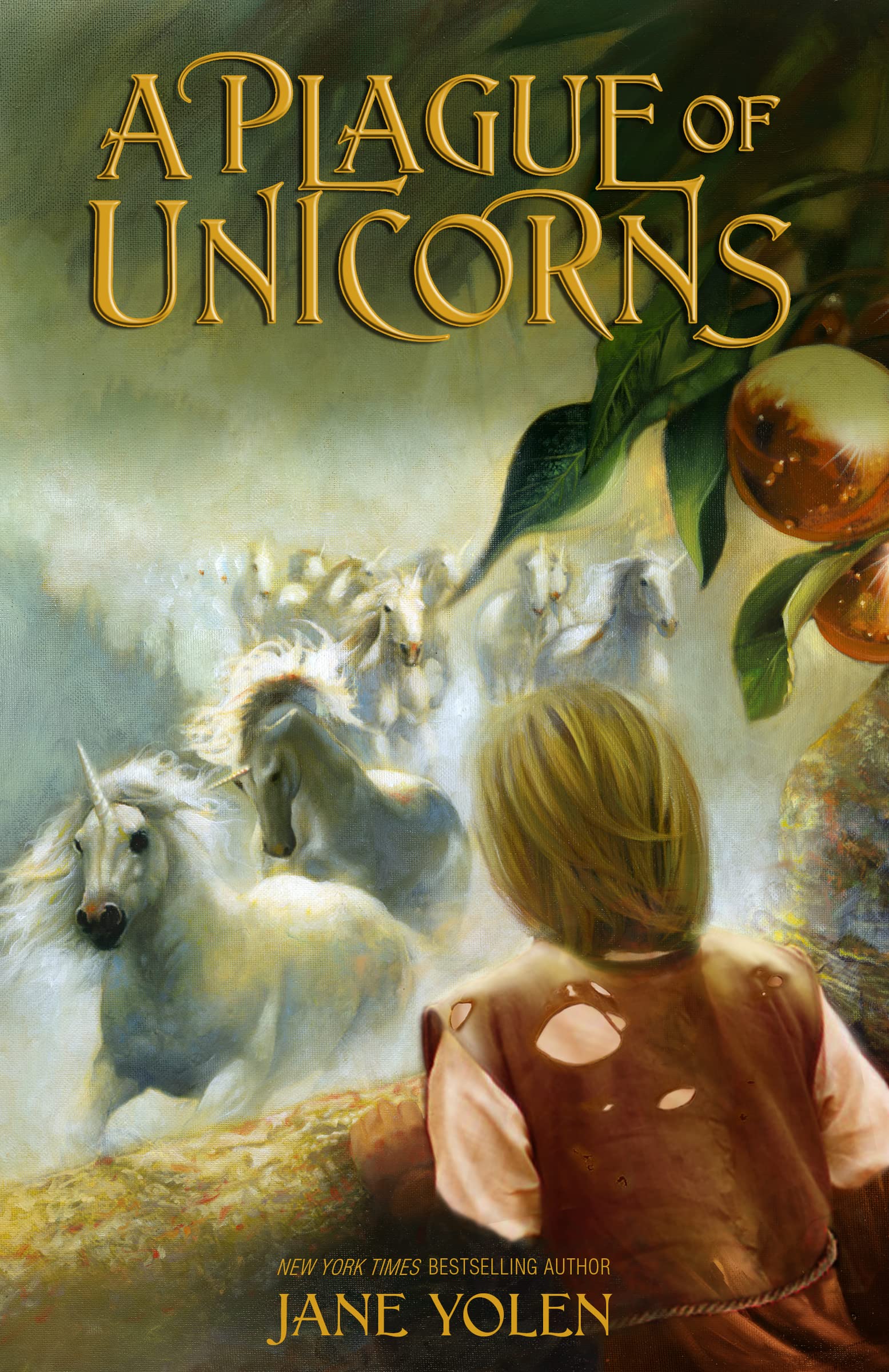



Young James, an earl’s son, is a bit bothersome and always asking the oddest questions. In despair—the last of James’ tutors having quit—his mother sends him off to be educated at Cranford Abbey. She feels the strict regimen will do him a world of good. But Cranford Abbey has its own problems. It has been falling into disrepair. The newly appointed Abbot Aelian takes it upon himself to save the abbey with the use of his secret weapon: a recipe for golden apple cider passed down in his family for many generations. He believes that by making and selling the cider, the monks will raise necessary funds to restore the abbey to its former glory. Abbot Aelian has everything he needs—almost. One obstacle stands in his way, unicorns that happen to feast specifically on the golden apples. Abbot Aelian and his men must fight off the unicorns to make the cider. He and the monks try to form a battalion to fight off the beasts; next they import heroes to fight for them. But the heroes run off, monks are injured, and a herd of ravenous unicorns continue munching. After no success, the abbot finally calls upon the most unlikely of heroes, one suggested by no other than young James. That hero is small and unprepossessing but possesses the skill to tame the beasts. Though wildly skeptical, Abbot Aelian must risk everything and believe in this recommended stranger or risk the fall of Cranford Abbey. Jane has been called the Hans Christian Andersen of America and the Aesop of the twentieth century. She sets the highest standard for the industry, not only in the meaningful body of work she has created, but also in her support of fellow authors and artists. Her books range from the bestselling How Do Dinosaurs series to the Caldecott winning Owl Moon to popular novels such as The Devil’s Arithmetic, Snow in Summer, and The Young Merlin Trilogy, to award-winning books of poetry such as Grumbles from the Forest, and A Mirror to Nature. In all, she has written over 335 books (she’s lost count), won numerous awards (one even set her good coat on fire), and has been given six honorary doctorates in literature. For more information, please visit www.janeyolen.com . A Plague of Unicorns By Jane Yolen ZONDERKIDZ Copyright © 2014 Jane Yolen All rights reserved. ISBN: 978-0-310-74648-5 CHAPTER 1 In which we are introduced to a short history of the unicorn plague * * * In one of the orchards behind the high stone walls of Cranford Abbey grew five different varieties of apple trees. Three varieties bore ordinary green and red apples, which the monks had named Plainsong, Nones, and Prime. One variety of tree bore apples the deep purple of port wine. The priests called them Sanctus. And one group of trees bore apples that were a startling gold, a color that would put mustard to shame and make wheat weep, if such were possible. The first abbot of the abbey had cried "Hosannah!" That's a shout of praise, from the Latin, which is a language abbots, monks, and priests know well. His shout was heard by all the monks laboring in the orchard, and the name stuck. The unicorns dined only on the golden Hosannah apples when they came through Cranford on their fall migration. They left the other apples quite alone. No one remembered when they'd first come through the abbey grounds. There were only two mentions of them in the abbey records. One had been an offhand reference to "the white beast, the glory of God" in one of the long-misplaced hymn books. The other reference was a picture, rather smudged, of a unicorn eating an apple in the middle of the garden of Eden, in an illuminated manuscript about the wild beasts of Britannia. For years no one had disturbed the unicorns at their feast. A lone unicorn may be a magnificent animal, full of rare enchantment and beauty. However, in a herd they can prove exceedingly cranky and exceptionally dangerous if disturbed, especially if they are disturbed while eating golden apples. Now the first abbot, and the second, and the third—all fine and holy men—were long gone to their heavenly reward at the time of this story. They had each suffered the unicorns to share the golden apples, with only a few apples left at the end of the autumn at the topmost of each tree. For as the first abbot wrote in the Abbot's Journal, "There are but few golden apple trees in the orchard, and those trees are far from the others." And the second abbot added that, "The golden apples are not particularly plump nor pleasing to the tongue." And the third had said, definitively, "Not worth the battle." But then the fourth abbot was appointed. Abbot Aelian was a tall, greying man with a face that seemed to be considering everything —monks, tapestries, suppers, silver—and always finding them wanting. He had served as abbot of a smaller abbey in France, and spoke many languages, including owl—or so the French monks believed, for he could whistle and call down owls on Christmas Eve. Abbot Aelian walked the halls