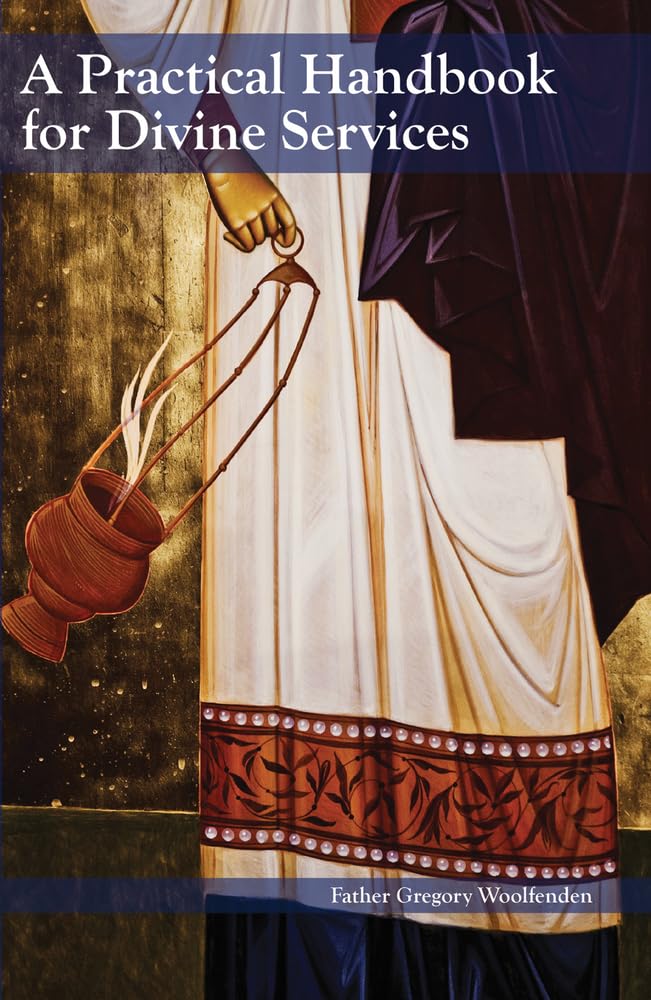



The services and prayer texts of the Orthodox Church are ancient and inspirational, and this invaluable reference guides priests, deacons, servers, readers, and singers in the customs and practices of the church. Including serving the altar and offering worship services, the handbook explains to all laity who desire a further understanding of the church’s Typicon—the rule that governs how divine worship is offered—touching upon a variety of topics, including the Hours, Vespers, Vigil, Divine Liturgy of St. John Chrysostom, and the Presanctified Liturgy. Drawn from Russian resources, this guide also explores the differences found in Greek usage. Gregory W. Woolfenden was a noted liturgical scholar who taught at Ripon College, Oxford, and at the Yale Theological Seminary in New Haven, Connecticut. Originally a priest of the Roman Catholic Church, he left that Church to join the Orthodox Church, where he served as a priest, first in the Russian Orthodox Diocese of Sourozh in the U.K. and later in the Ukranian Orthodox Church in the USA. At the time of his death in 2008, he was the parish priest of the Nativity of the Mother of God, Ukranian Orthodox Church in New Britain, Connecticut. He is the author of several books, including Daily Liturgical Prayer: Origins and Theology and Joyful Light . A Practical Handbook for Divine Services By Gregory Woolfenden Holy Trinity Publications Copyright © 2011 Holy Trinity Monastery All rights reserved. ISBN: 978-0-88465-191-8 Contents Introduction, 1. Little Vespers and the All-Night Vigil, 2. The Third and Sixth Hours, 3. The Divine Liturgy According to the Order of St John Chrysostom, 4. The Liturgy of the Presanctified Gifts, Appendix 1 Vestment Colors, Appendix 2 A Complete Collection of Canon Responses, Appendix 3 Notes for Concelebration by Priests in the Absence of a Bishop, Notes, Index, CHAPTER 1 Little Vespers and the All-Night Vigil 1. Tolling the Bell Toward sunset, the server comes to the Rector for the signal that it is the time to ring the bell for divine service. Having received a blessing, he goes and carries out the duty of tolling the bell as laid down in the order of the Church Typikon. The toll for Little Vespers is rung on the small bell and lasts as long as is takes the ringer to read Psalm 50 or the Creed three times; then, after a short pause, he rings a little chime with the small bell and the chiming bells. 2. The Ninth Hour When it is time for the reading of the Ninth Hour, the priest serving comes to church and vests in a stole. Having vested, the priest stands in the narthex (if the Ninth Hour is being read there), or on the ambo before the holy doors (if the Ninth Hour is served in the church) and pronounces the initial exclamation: Blessed is our God, always now and ever, and to the ages of ages. 3. The Normal Beginning The reader begins the order for the reading of the Ninth Hour by answering Amen. He then says the prayers of the Normal Beginning: Glory to Thee, O Lord ..., O heavenly King ..., Holy God ..., Glory ..., Both now ..., All-holy Trinity ..., Lord have mercy (three times), Glory ..., Both now ..., Our Father . ... The priest pronounces the usual exclamation: For Thine is the kingdom . ... The reader answers: Amen. He continues to read the Ninth Hour with Lord have mercy (twelve times), Glory, now and ever. O come let us worship ..., and Psalms 83, 84, and 85. Glory ..., now and ever. Alleluia (three times). Lord have mercy (three times). Glory . ... The troparion appointed for the day (or of the feast or saint). Both now ..., the Theotokion of the hour: Thou Who for our sake ..., the verse of the hour: Forsake us not utterly ..., and the Trisagion Prayers. 4. The priest pronounces the usual exclamation: For Thine is the kingdom . ... The reader: Amen and the kontakion appointed for the day. Lord have mercy (forty times). Thou Who at all times. ... Lord have mercy (three times). Glory, Both now and ever. More honorable. ... In the name of the Lord, father, give the blessing. The priest responds: God be merciful to us and bless us . ... The reader says Amen and reads the Prayer of the Ninth Hour: O Sovereign, Lord Jesus Christ our God .... 5. If the service is celebrated in the narthex, then the Lesser Dismissal is now given. The priest: Glory to Thee, O Christ our God and our Hope, glory to Thee. The people (choir): Glory ..., Both now. Lord have mercy (three times). Give the blessing. And the priest says the dismissal: May Christ our true God, through the prayers of His most pure Mother, of our venerable and God-loving fathers and all the saints, have mercy and save us, for He is good and loves mankind. The people answer this by singing Lord have mercy three times, and all (priest, reader, choir, brethren, and laity) leave the narthex and enter the church, where Little Vespers is begun. 6. If the service of the Ninth Hour is held