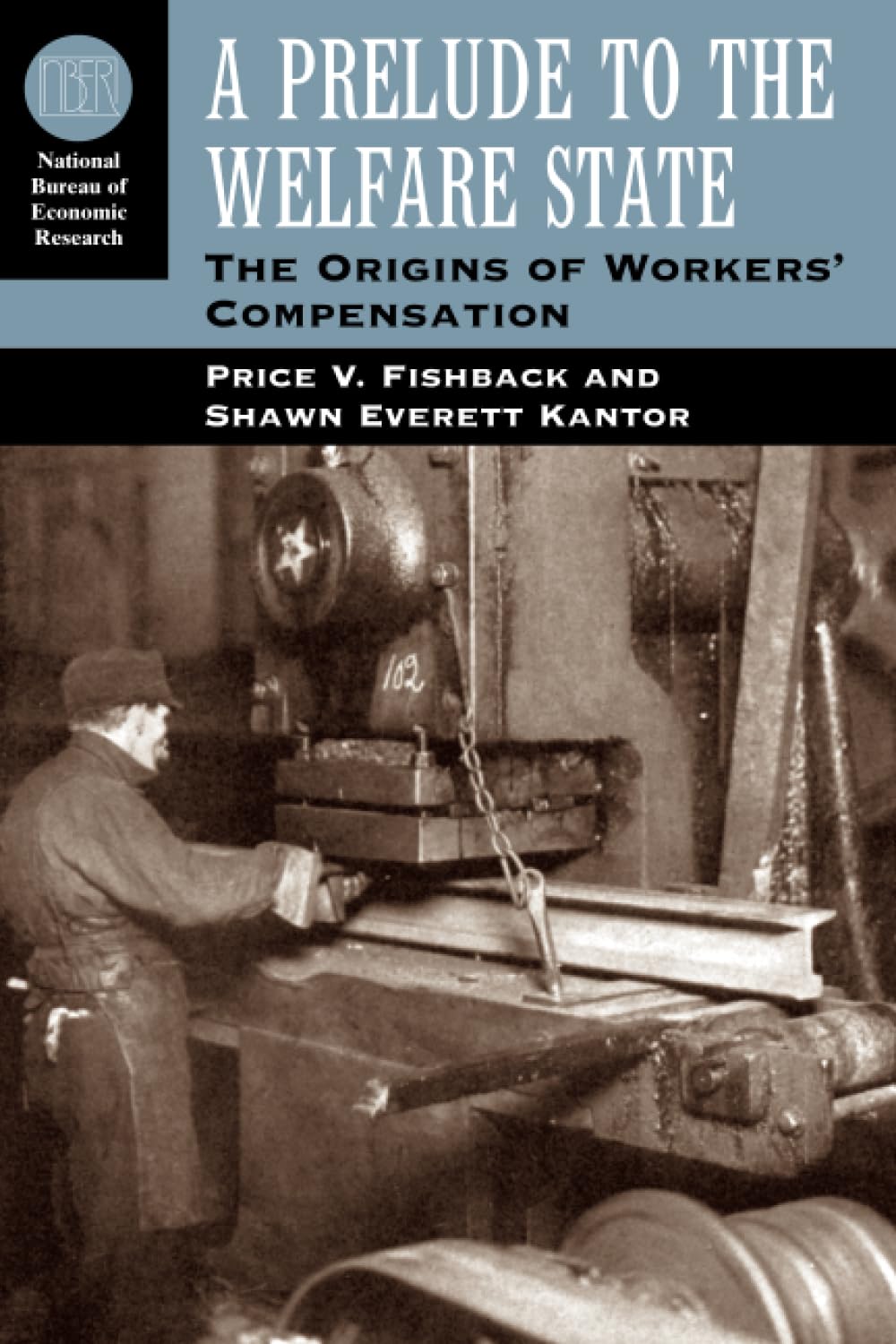
A Prelude to the Welfare State: The Origins of Workers' Compensation (National Bureau of Economic Research Series on Long-Term Factors in Economic
$37.00
by Price V. Fishback



Workers’ compensation was arguably the first widespread social insurance program in the United States—before social security, Medicare, or unemployment insurance—and the most successful form of labor legislation to emerge from the early progressive movement. In A Prelude to the Welfare State , Price V. Fishback and Shawn Everett Kantor challenge widespread historical perceptions by arguing that workers’ compensation, rather than being an early progressive victory, succeeded because all relevant parties—labor and management, insurance companies, lawyers, and legislators—benefited from the ruling. Rigorous and convincing, A Prelude to the Welfare State is a major reappraisal of the causes and consequences of a movement that ultimately transformed the nature of social insurance and the American workplace. “Substantial, well-written, and compelling. . . . The end result is an in-depth analysis of how workers’ compensation was created and initially implemented in the United States at the beginning of the twentieth century”—Christopher R. Larrison, Journal of Sociology and Social Welfare Price V. Fishback is the Frank and Clara Kramer Professor of Economics at the University of Arizona and a research associate of the National Bureau of Economic Research. He is the author of A Prelude to the Welfare State: The Origins of Workers’ Compensation.