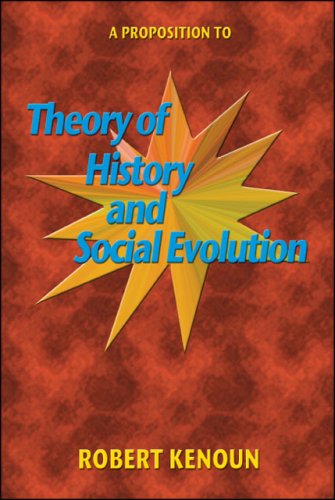



Is society a living organism that seeks deterministic objectives in its evolutionary process? What is the state of finality of this organism when it completes its journey? Is there a theory that explains our historical process to help us understand and predict future historical trends? Do laws of nature, such as laws of physics and thermodynamics, play any role in our social evolution? How does environment set alternative goals for social evolution to pursue? How do human characteristics affect the trends of our historical processes? The goal of the author in this book is to show that society as a living organism, pursues a set of predetermined objectives in its evolutionary process that are set by the laws of nature and the natural environment. In the first chapter, the author discusses the application of laws of nature, laws of evolution pertaining to living systems and other concepts that apply to all systems in general (living or non-living). In chapter 2, he discusses how social organism in its evolutionary process tries to duplicate the structural organization of the human. In chapter 3, he argues that environment sets two deterministic finalities for social evolution through processes that he calls "integration" and "disintegration". Chapter 4 covers an argument, as to how social organism attempts to duplicate human's structural organization in it evolutionary process. In chapter 5 and 6, he explores the integration and disintegration processes of history, and in chapter 7, the author discusses implications of the theories discussed in previous chapters as they apply to our recent history and how historians have misinterpreted historical events of our history. In the same chapter, he discusses the critical issues of our time and how to avoid dangers awaiting humanity. The issues of concern pertain to, socioeconomic equality, prosperity gap among nations, population growth, pollution, global energy policies and globalization. The ideological position of the author in this book is merely scientific and does not belong to any political party. However, he validates these political ideologies against what he believes is a scientific theory for the evolution of social organism in integration process of history. His criticism of current and past policies of U.S and other superpowers is meant, only, to produce better and more sensible policies toward other societies and in general toward humanity. The author believes that by teaching humanity the science behind the social evolution, which points to a deterministic finality that we share together, the process of history can become a less violent and self-regulated process. Robert Kenoun was born in 1950 in Tehran, Iran to an Assyrian family. He attended the engineering school of Tehran University (Daneshkadeh Fanni) and graduated with a B.S. and a M.S. degree in material science and metallurgical engineering. After working for two years in various positions in Iran's nuclear industry, he and his family migrated to the United States at the end of 1978 and resided in Chicago, Illinois. While working for Motorola, he completed his M.S. degree in electrical engineering from Illinois Institute of Technology (IIT). The author has been with Motorola for almost twenty-four years in various technical positions. Currently, he is with Chief Technology Office, developing complex antenna systems for cellular phones. He holds one trade secret, ten issued patents with a few more in the process of being issued.