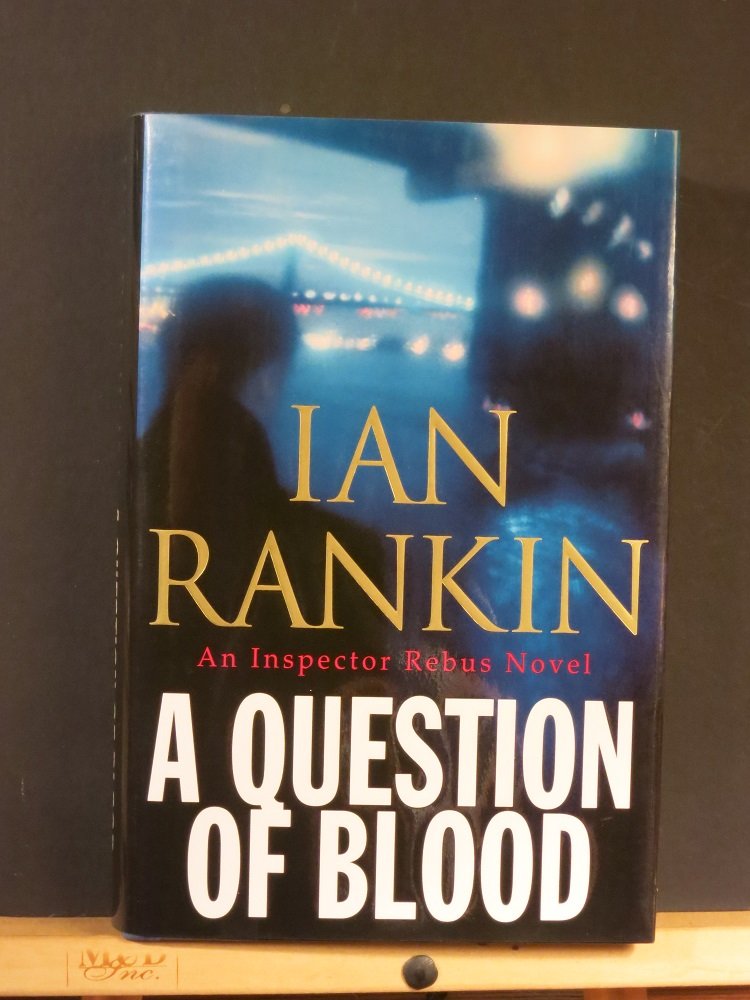



While investigating the murders of two teenagers at a posh Edinburgh boarding school by a reclusive former soldier, killings that may be linked to a local group of Goth teens, Inspector Rebus is faced with possible suspension and painful injuries when the man stalking his partner, Detective Sergeant Siobhan Clarke, dies in a house fire that Rebus is suspected of setting. 50,000 first printing. Given his contempt for authority, his tendency to pursue investigative avenues of his own choosing, and his habitually ornery manner, it's a wonder that John Rebus hasn't been booted unceremoniously from his job as an Edinburgh cop. He certainly tempts that fate again in A Question of Blood , which finds him and his younger partner, Detective Sergeant Siobhan Clarke, trying to close the case of a withdrawn ex-soldier named Lee Herdman, who apparently shot three teenage boys at a Scottish private school, leaving two of them dead, before turning the pistol on himself. "Theres no mystery," Siobhan insists at the start of this 14th Rebus novel (following Resurrection Men ). "Herdman lost his marbles, thats all." However, the hard-drinking, chain-smoking Rebus, who'd once sought entry into the same elite regiment in which Herdman served (but ultimately cracked under psychological interrogation), thinks there's more motive than mania behind this classroom slaughter. Perhaps something to do with the gunman's role in a 1995 mission to salvage a downed military helicopter, or with Teri Cotter, a 15-year-old "Goth" who broadcasts her bedroom life over the Internet, yet keeps private her relationship with the haunted Herdman. Rebus's doubts about the murder-suicide theory are deepened with the appearance of two tight-lipped army investigators, and by the peculiar behavior of James Bell, the boy who was only wounded during Herdman's firing spree and whose politician father hopes to use that tragedy as ammo in the campaign against widespread gun ownership. But the detective inspector's focus on this inquiry is susceptible to diversion, both by an internal police probe into his role in the burning death of a small-time crook who'd been stalking Siobhan, and by the fact that Rebus--who shies away from any family contacts--was related to one of Herdmans victims. Now middle-aged and on the downward slope of his pugnacity (the high point may have come in 1997's Black and Blue ), Rebus has become the engine of his own obsolescence. Overexposure to criminals has left him better at understanding them than his colleagues, and he only worsens his career standing by fighting other people's battles for them, especially Siobhan, who risks learning too many lessons from her mentor. To watch Rebus subvert police conventions and fend of personal demons (that latter struggle mirrored in A Question of Blood by Herdman's own) is worth the admission to this consistently ambitious series. --J. Kingston Pierce Inspector John Rebus is, as always, a complex and genre-defining character. With burned hands and a dependence on malt liquor, his senses here have been dulled. That doesn't stop him from carrying this compelling novel, but not to heights as lofty as Rankin has reached previously. A few critics report that this entry in the series is not completely up to par. Others, however, call A Question of Blood one of the author's most dazzling displays yet. "Rankin does write violent guy-books, of course," attests the Washington Post , "but with such skill that anyone who appreciates good writing should enjoy them." If you haven't read an Inspector Rebus novel yet, here's your chance. Copyright © 2004 Phillips & Nelson Media, Inc. Those "dialogues of the left-unsaid" that have been plaguing Edinburgh copper John Rebus for years (but especially in Dead Souls , 1999) are making themselves heard again, this time in response to an ugly murder with ties to Rebus' own life and family. When a seemingly berserk veteran of the British army's special forces shoots himself after killing two teenage boys and wounding another, Rebus is asked by a colleague to help get inside the shooter's head. (Rebus carries his own scars from the army.) Meanwhile, the rule-breaking inspector is once again the object of an internal investigation, this time to determine if he was involved in the death of a lowlife who was stalking Rebus' partner, Siobhan Clarke. Rebus' demons may not seem quite as compelling a metaphor for the heart of darkness as they once did (Rankin has been mining this theme steadily through 15 books), but the character himself remains among the most fascinating in the genre. Cantankerously anachronistic, the hard-drinking, chain-smoking, unrepentantly individualistic loner absolutely refuses to accommodate himself to a repugnant modern world full of white-wine-drinking, rule-following company men and women. About the only thing left in Rebus' world that he understands is the bad guys, which is why he pursues them so vigorously. Even if his demons ha