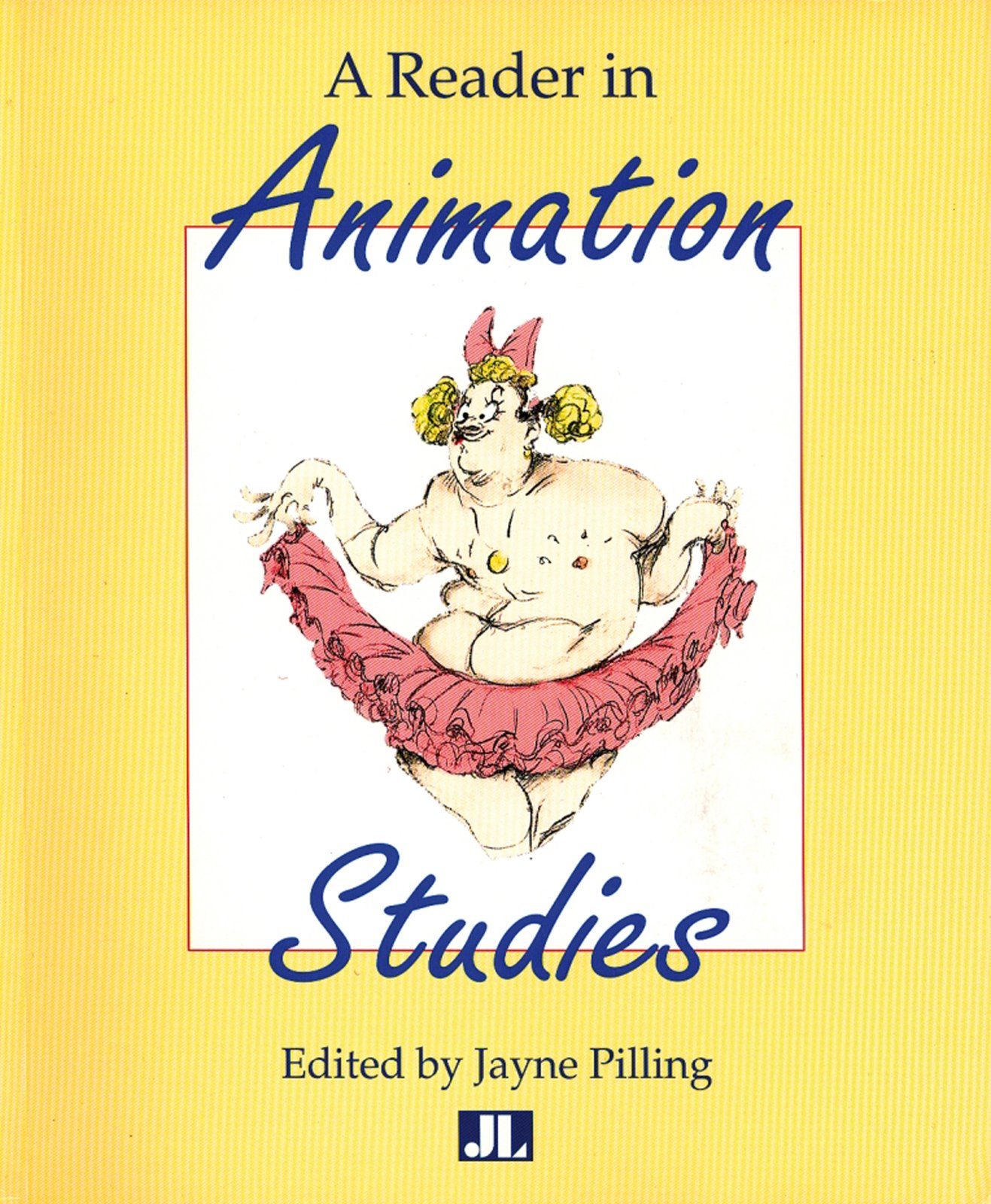



Cartoons―both from the classic Hollywood era and from more contemporary feature films and television series―offer a rich field for detailed investigation and analysis. Contributors draw on theories and methodology from film, television, and media studies, art history and criticism, and feminism and gender studies. Jane Pilling, freelance film programmer, journalist, and translator, also writes and teaches on film and animation, currently at the Royal College of Art in London. She recently made a six-part television series on European animation for UK television. A Reader in Animation Studies By Jayne Pilling John Libbey Publishing Ltd Copyright © 2011 John Libbey Publishing Ltd All rights reserved. ISBN: 978-1-86462-000-9 Contents The Society for Animation Studies: A brief history Harvey Deneroff, vii, Introduction Jayne Pilling, ix, New technologies, 1 What is animation and who needs to know? An essay on definitions Philip Kelly Denslow, 1, 2 'Reality' effects in computer animation Lev Manovich, 5, 3 Second-order realism and post-modern aesthetics in computer animation Andy Darley, 16, Text and context: Analyses of individual films, 4 The Quay brothers' The Epic of Gilgamesh and the 'metaphysics of obscenity' Steve Weiner, 25, 5 Narrative strategies for resistance and protest in Eastern European animation William Moritz, 38, 6 Putting themselves in the pictures: Images of women in the work of Joanna Quinn, Candy Guard and Alison de Vere Sandra Law, 48, 7 An analysis of Susan Pitt's Asparagus and Joanna Priestley's All My Relations Sharon Couzin, 71, 8 Clay animation comes out of the inkwell: The Fleischer brothers and clay animation Michael Frierson, 82, 9 Bartosch's The Idea William Moritz, 93, 10 Norman McLaren and Jules Engel: Post-modernists William Moritz, 104, 11 Disney, Warner Bros. and Japanese animation Luca Raffaelli, 112, Contemporary cartoons and cultural studies, 12 The thief of Buena Vista: Disney's Aladdin and Orientalism Leslie Felperin, 137, 13 Animatophilia, cultural production and corporate interests: The case of Ren & Stimpy Mark Langer, 143, Theoretical approaches, 14 Francis Bacon and Walt Disney revisited Simon Pummell, 163, 15 Body consciousness in the films of Jan Svankmajer Paul Wells, 177, 16 Eisenstein and Stokes on Disney: Film animation and omnipotence Michael O' Pray, 195, 17 Towards a post-modern animated discourse: Bakhtin, intertextuality and the cartoon carnival Terrance R. Lindvall and J. Matthew Melton, 203, (Rewriting) history, 18 Restoring the aesthetics of early abstract films William Moritz, 221, 19 Resistance and subversion in animated films of the Nazi era: The case of Hans Fischerkoesen William Moritz, 228, 20 European influences on early Disney feature films Robin Allan, 241, 21 Norm Ferguson and the Latin American films of Walt Disney F.B. Kaufman, 261, Notes on the contributors, 269, List of SAS Conference papers – 1989 to 1996, 271, CHAPTER 1 What is animation and who needs to know? An essay on definitions Philip Kelly Denslow There are many definitions of animation. The most obvious source of one, the Webster dictionary, says animation is: a: a motion picture made by photographing successive positions of inanimate objects (as puppets or mechanical parts), b: Animated Cartoon, a motion picture made from a series of drawings simulating motion by means of slight progressive changes. This is a fairly common understanding of the term animation, but it reflects a limited exposure to what the artform has to offer. Whether one agrees with it or not, the Webster definition is useful because one can learn something about who is doing the defining. In this case, the folks at G. & C. Merriam should be encouraged to attend an animation festival. In the international animation community, many definitions have become established by various organisations and entities. We scholars, teachers and filmmakers would probably not be able to agree on a precise definition, but we would be able to compile a nice list of them. Definitions of animation vary from one another for many reasons, including historical development, production and marketing requirements, and aesthetic preferences. The reason we are examining this issue is that no matter what definition you chose, it faces challenges from new developments in the technology used to produce and distribute animation. Is virtual reality a form of animation? Does computer-generated lifeform simulation qualify? What about the computerised recording of a mime's movements that are later attached to a character which is rendered a frame at a time? Do digital post-production techniques allowing for undetectable compositing and manipulation of live action scenes reduce the shooting of actors onto film to merely an image acquisition phase of the overall production? Is that production then in reality an animated film? Even a narrow definition of animation that excludes all bu