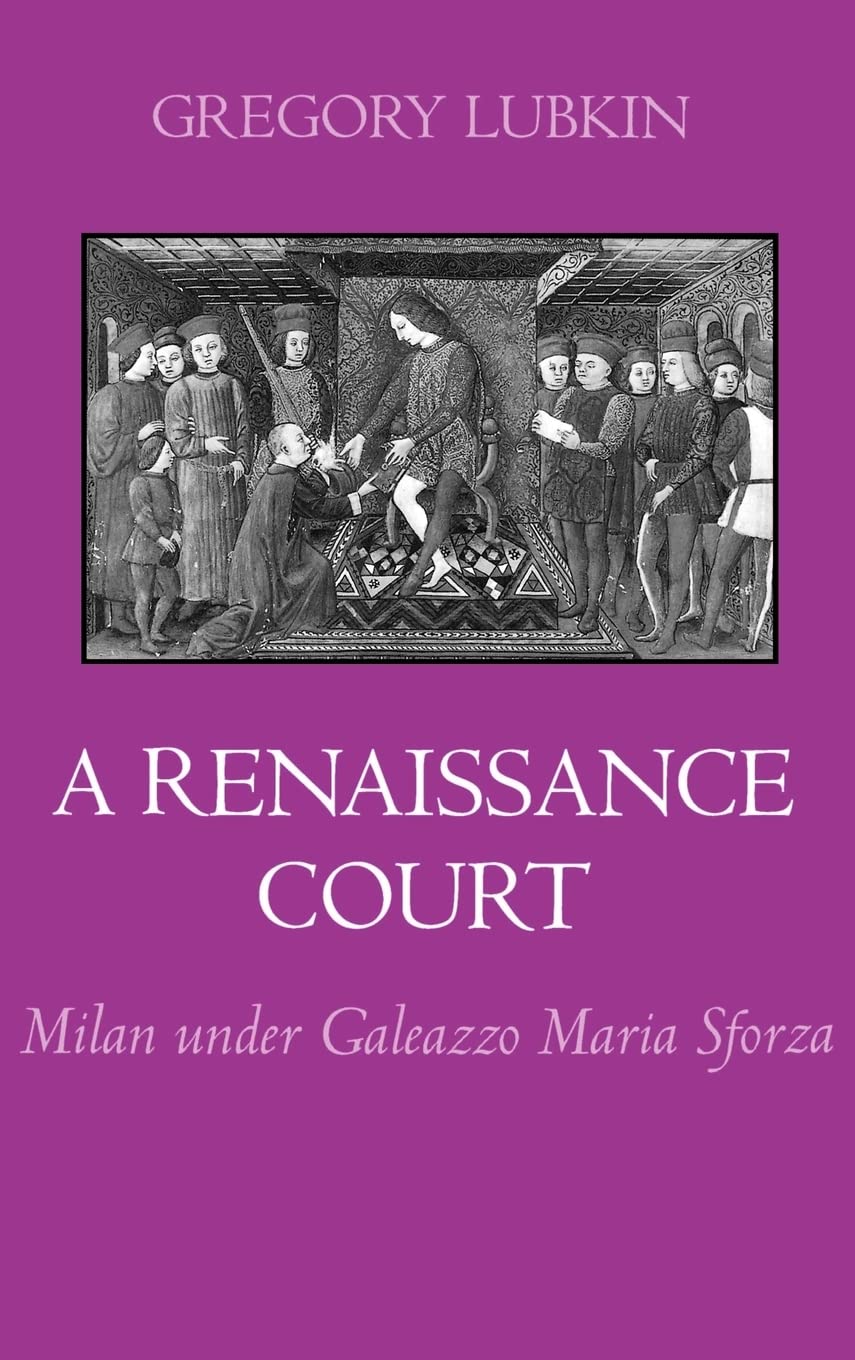



Ambitious, extravagant, progressive, and sexually notorious, Galeazzo Maria Sforza inherited the ducal throne of Milan in 1466, at the age of twenty-two. Although his reign ended tragically only ten years later, the young prince's court was a dynamic community where arts, policy making, and the panoply of state were integrated with the rhythms and preoccupations of daily life. Gregory Lubkin explores this vital but overlooked center of power, allowing the members of the Milanese court to speak for themselves and showing how dramatically Milan and its ruler exemplified the political, cultural, religious, and economic aspirations of Renaissance Italy. "A vivid portrait of the arguably most brilliant court in early Renaissance Europe, which will be used by medieval/Renaissance historians and by musicologists, art historians, and social historians." Vincent Ilardi, University of Massachusetts at Amherst "A vivid portrait of the arguably most brilliant court in early Renaissance Europe, which will be used by medieval/Renaissance historians and by musicologists, art historians, and social historians."―Vincent Ilardi, University of Massachusetts at Amherst Gregory Lubkin has taught at Wellesley College and the University of California, Berkeley, and has authored numerous publications on Renaissance Milan. A Renaissance Court: Milan under Galleazzo Maria Sforza By Gregory P. Lubkin University of California Press Copyright © 1994 Gregory P. Lubkin All right reserved. ISBN: 0520081463 Prologue (March 1466) It is a few days before the Ides of March, in the Year of Our Lord 1466. The winter wind whips through the Gran Croce pass over the Alps. A small band of riders makes its way carefully along the trail, huddling inside their heavy cloaks. One of them feels especially aggrieved by this bitter ride through the mountains. He should be riding in triumph and glory at the head of a great procession, cheered on by admirers and well-wishers. Instead, he travels furtively in a merchant's disguise, with only a few companions. He itches to throw off his drab garments and proclaim himself proudly, but this grim high land is full of bandits and renegades. He fears what will happen if the local people discover that he is Galeazzo Mafia Sforza, new duke of Milan. Twenty-two-year-old Galeazzo was in France with a military expedition when his ducal father Francesco died unexpectedly on March 8. To take his place at the head of the great Sforza dominion, the young heir is hurrying home, without regard for the season, across the Alpine ranges of the duchy of Savoy. Savoy is potentially hostile territory; Galeazzo's mother—Duchess Bianca Maria Visconti—and the Milanese Privy Council have instructed him to take precautions that may safeguard his life and freedom.1 Thus, the proud young duke hides his identity, traveling in clandestine shame with his handful of followers. In the event, these precautions are not only humiliating and demoralizing to Galeazzo; they are also inadequate. As the little band of Milanese descends from the pass, it is sighted by a crowd of the local men, who approach the travelers menacingly. Their lords are no friends to Milan or its duke and have little concern for anyone's safety on these mountain roads. The crowd presses in on the travelers, surrounding them and threatening capture. Galeazzo and his companions see a small church nearby, their only hope for refuge. They find sanctuary within, barricade the doors, and wait to be rescued. For two cold, miserable days, the new ruler of Italy's richest princely state becomes the ignominious prey of a peasant mob. A diplomatic crisis ensues. Count Antonio da Romagnano, a venerable Piedmontese of great learning and considerable influence, intercedes with the ducal government in Turin and the local castellans. Other notables give their support; a Milanese merchant lobbies the Savoyard ducal councillors and lends money to the messengers racing back and forth on this terrible case. Antonio soon secures Galeazzo's release and safe passage, and the duke resumes the road to Milan. On March 20, 1466, the newly freed prince enters his capital city and is formally enthroned. Antonio da Romagnano is quickly rewarded with an appointment to Milan's Privy Council and an honored place at the Sforza court.2 Although he is forty years older than Galeazzo, Antonio will outlive his new master. Charming, ambitious, and intelligent, the young duke has every reason to expect a glorious destiny, but a harsher fate awaits him. Galeazzo Maria Sforza will leave his ducal life ten years later in as violent and shadowy a manner as he begins his reign in March 1466. And yet, during his reign, "this duke Galeazzo held the most beautiful court of any prince in Italy."3 Continues... Excerpted from A Renaissance Court: Milan under Galleazzo Maria Sforza by Gregory P. Lubkin Copyright © 1994 by Gregory P. Lubkin.